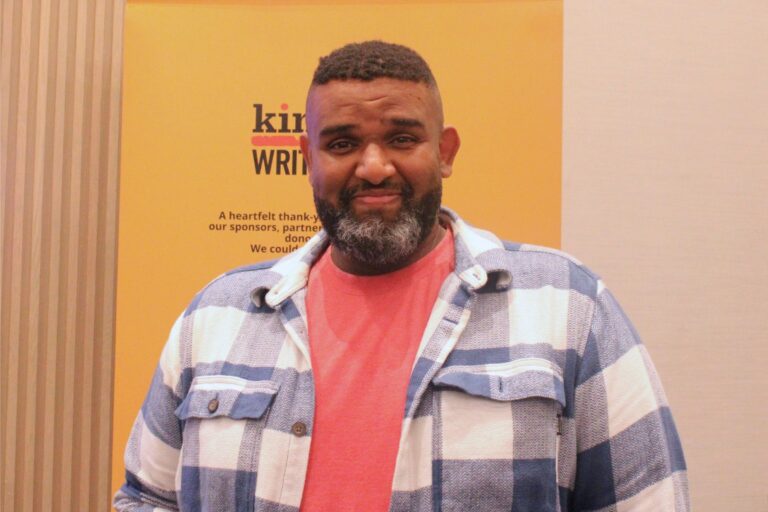
Award-winning writer and CBC Commotion radio host Elamin Abdelmahmoud, ArtSci ’11, uses Paul Simon’s troubled solo music career as a mirror to understand his own writing.
On Oct. 27 at 2:30 p.m. at the University Club, Abdelmahmoud gave the 9th annual Page Lecture, “The Best of Our Possible Lives,” on the calling to write and the act of writing as a prayer. The lecture lasted around an hour and drew a crowd of roughly sixty faculty members and students.
Hosted in honour of poet and painter Joanne Page with support from her family, the Department of English Language and Creative Writing invites one Canadian writer each year to reflect on the “page.”
From contributing to The Queen’s Journal, BuzzFeed News, and to the New York Times, Abdelmahmoud is no stranger to writing. But when he stepped beyond journalism to write his national bestselling memoir Son of Elsewhere, he said his writing career became “genuinely surprising and extraordinary.”
As the crowd listened intently to the beginning of his lecture, Abdelmahmoud broke the room’s silence with a joke.
“I am 18 months late on my second book,” he admitted.
An amusing lecturer with a presence that reflects his CBC daily radio program, his energy invited the crowd to actively engage with his lecture, laughing and clapping along.
For Abdelmahmoud, writing is an invitation because “our best selves emerge on the page.” That brought him to singer-songwriter, Paul Simon. At first, his analogy seemed like an absurd connection, but slowly, Simon came to shape the lecture. Simon’s songwriting was a way to explain Abdelmahmoud’s perception on the calling to write.
He argued Simon’s album Hearts and Bones, a commercial failure, succeeded in capturing what happens when artists “need to be feeling but can’t stop thinking.” He reflected on how music critic Robert Christgau described the album as “a finely wrought dead end.”
Hearts and Bones should have been Simon’s dead end, but then he came out with Graceland, an acclaimed album that’s considered his best work, outside of Simon & Garfunkel.
Abdelmahmoud uses these albums as an analogy to describe his own writing’s fork in the road.
When he receives a calling to write, what he intends to put on the page almost always shifts as his “intuition” stirs him in a different direction. He describes his intuition as a “constellation of feelings” that lets the higher self onto the page.
He quoted a line from Simon’s “Think Too Much (A).” A song that arose out of his stream-of-consciousness, Simon wrote, “Have you ever experienced a period of grace? / Where your brain just takes a seat behind your face.” Abdelmahmoud said that “period of grace” is your mind taking a backseat to let your heart drive the creative process.
But our best selves showing up on the page does not mean they show up in the world. Rather, this higher self can be messy, flawed, and vulnerable.
“The best writing lets you see yourself as neither savior nor damned, but rather something more tender. You summon a flawed being who’s in the throes of wrestling with haggard beauty,” he explained.
Abdelmahmoud said he sees the page as a place to create a sturdier version of himself.
He admitted it is cliché for a millennial, a generation that loves memoirs, to see writing as “a vessel for self-actualization,” but when writing is seen as a prayer, it resembles a ritual that invites that better self to materialize.
The lecture’s extensive question-and-answer period revisited his main topics.
Abdelmahmoud was asked to elaborate on the page’s prayer. He explained that prayer means “closing your eyes and imagining a better version of you.” Then, writing becomes a way to summon that version.
Tags
All final editorial decisions are made by the Editor(s) in Chief and/or the Managing Editor. Authors should not be contacted, targeted, or harassed under any circumstances. If you have any grievances with this article, please direct your comments to eic@queensjournal.ca.