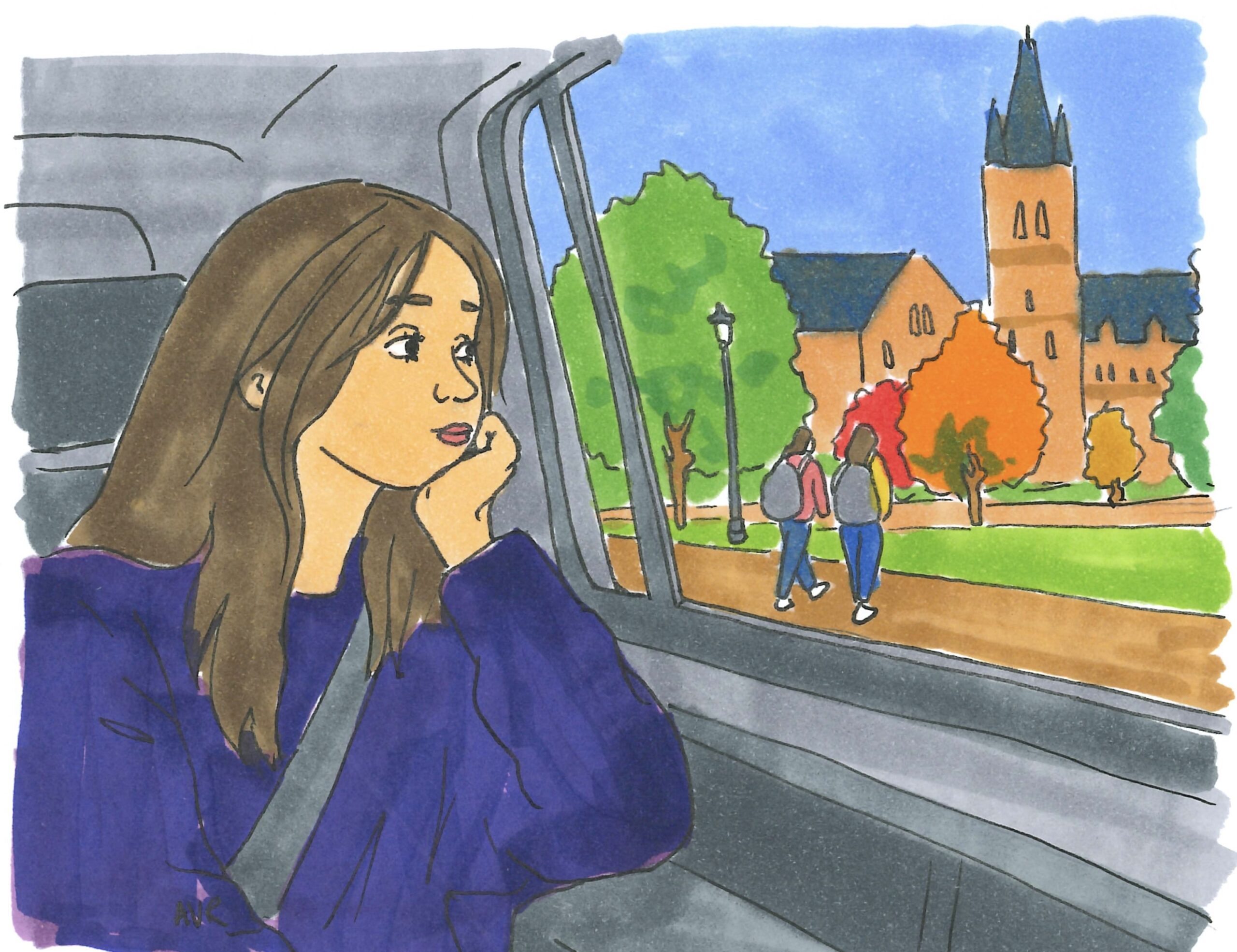
With September rolling around again, Kingston is coming alive; a city and experience I’m just outside of.
Houses fill with students, campus becomes crowded, and the familiar excitement of a fresh new school year settles over the city. Orientation, football games, house parties, new roommates, new friendships — the kind of atmosphere that makes you feel like you’re finally, truly a part
of something.
For me, however, September brings a different feeling. An overwhelming, gut-wrenching feeling of dread.
I live 126 km outside of Kingston in a small town called Colborne.
Journeying downtown is a drive of over an hour each way. A commute I’ve endured more times than I can count, through the demanding conditions of winter storms and construction zones. From five in the morning to after eleven at night.
Living in Kingston for my undergraduate degree was never really a question my family and I got the privilege to have. It was a matter of what we could afford, and the answer was always, “Not now, Eva.”
So, every single day, my university experience has started and ended in a car, on a highway, watching the sun come up over an empty road instead of a
dorm window.
Before starting my first year at Queens, I came to accept I wouldn’t get the opportunity to live in residence. I told myself reason after reason as to why living at home was actually a bonus. More privacy, home-cooked meals, and no drama
with roommates.
However, all I truly did was guilt-trip myself into believing I was okay with it, even grateful for it. The truth was harder to face, as I knew even then that I was saying goodbye to an experience before I’d even get the chance to have it.
I can still remember commuting to campus during O-week of my first-year, not knowing what to expect when arriving on campus for the very first time. I sat in my car with my heart pounding, watching as everyone already had their own “groups.” I’d see clusters of students walking together to events, laughing about something that happened the night before in their new dorms, already building the kind of connection that naturally arises from living down the hall
from someone.
I had never felt so out of place.
And the worst part? This feeling of disconnect remained, and worse, deepened throughout my first and following year at Queen’s.
I’d meet people in my classes, people who I genuinely liked and wanted to get to know better, but every friendship seemed to be paired with a fine print: if it fits around my commute.
Simply grabbing Starbucks between classes could never be a spontaneous thing, but rather something I had to negotiate with my schedule.
I wanted to be someone’s person, and to have someone be mine. You know, those kinds of lifelong “college friendships” you see on television, or the ones your parents tell you about. Instead, it felt like I was watching those friendships form around me in real time, being built out of the proximity I didn’t have, and out of moments I could never be
there for.
It was never a matter of people not liking me, but the fact inclusion required presence, and presence was the one thing I could never consistently give.
I believe this taught me to want less, to need people less, because needing them just meant getting hurt when the commute got in the way again. To be truthful, I don’t think this is something you’re supposed to learn at 18. I think at this age you’re supposed to lean on people, to be reckless with your time and your trust, to make mistakes with friendships and to repair them. I never really got that version or those lessons.
This feeling of disconnect didn’t stop at friendships; it bled into every opportunity that required showing up outside of my class hours. Clubs, intramurals, study groups, career panels. All the things people say you’re “supposed” to do in university to build a resume, find community, or just figure out who you are as a person.
I feel as though I’ve missed out on becoming a more well-rounded version of myself due to the distance.
Course selection was, and still is, its own kind of horror. Everyone else stressed over enrollment times, whether class seats would fill up, and over building the “perfect” schedule with maximum days off. For me, course selection was a different kind of headache. One where every single class had to be measured against the drive, and how many hours I could reasonably spend sitting in the library waiting for a gap between
classes to end.
Those in-between hours were their own kind of exhaustion. A simple two-hour gap between classes is not merely enough time to drive home and back, so I’d resort to finding a seat in Stauffer Library, occupying time that everyone else got to spend actually living their university life. Heading back to dorms for naps, ordering food, or making plans over something as small as a shared common room. Such ordinary things, and yet, I still can’t help but feel cheated
out of them.
I would sit in lecture halls and listen to other students groan about their 8:30 a.m. classes, complaining about how unrealistically early it is. I never said anything, but in all honesty, I wanted to laugh. Not because their tiredness wasn’t real or valid, but because my 8:30 a.m. started at 6:00 a.m., alone, in the dark, scraping ice off my windshield before having the chance to eat breakfast.
Their version of “early” meant rolling out of bed fifteen minutes before class and walking across campus in pajama pants. Mine meant driving down a dark two-lane highway, fighting my closing eyes, so I didn’t accidentally swerve into oncoming traffic.
Even parking, something you’d assume is a given for a commuter, was no joke.
There is a years-long waitlist just to get a proper campus parking pass, and even once you’re on it, it costs about $160 a month; an expense most people do not think twice about until they’re the ones paying it. On top of gas, insurance, and everything else that comes with driving over two hours a day to just attend class, it adds up.
Even with street parking being “available,” it was still an ongoing battle to find an open spot. Most of the time I was left parking wherever I could and hoping for the best, which mostly meant racking up ticket after ticket, an unofficial tax on simply trying to get an education.
All in all, I thought I would get this “picture perfect” university experience. The one you see in movies, the one everyone talks about before they even start their first year. Late night talks with roommates. Getting ready together before a night out, borrowing someone’s hair straightener, arguing over outfits, music playing while everyone crowds a single mirror.
I thought I deserved that. I’d worked equally as hard as many others to get into Queen’s. I don’t know why I assumed the experience itself would come as easily as the acceptance letter did.
I wish I could say this experience made me stronger, or that I’d do it all again without hesitation.
The truth of the matter is more complicated than that. I don’t think hardship automatically builds character the way people like to say it does. I don’t know if this made me a better person, or just a more exhausted one.
But what I do know is that it taught me how to show up for myself when no one else could, even with a lack of motivation. I learned to sit with my own company more than most people my age probably must, and to advocate for what I needed because there was no one down the hall to lean on when things got difficult.
It didn’t make the ache of missing out disappear. But somewhere in all those hours alone — in the car, library, or on the highway at 6:00 a.m. — I became someone who noticed. Someone who sees the friend that saves you a seat, or the classmate who texts you asking if you’re coming to
class today.
The small, deliberate choices to include someone that most people don’t think twice about.
If there’s one lesson to take away from this, it’s to not assume distance means disinterest.
The people who always seem to be leaving aren’t necessarily choosing to be absent. The people who made an effort with me weren’t doing anything extraordinary. Simply, a little persistence goes a long way, as we rarely consider what it might cost someone to keep showing up at all.
If you’re a commuter reading this, nodding along, I want you to know the disconnect is real, and you’re not alone feeling it. But what’s most important is understanding it is not a personal failing, and it’s not something you should have to guilt yourself into being grateful for, the way I did.
Queen’s gives us an education, but there’s a version of this university that a lot of us will never get to have, simply because of where we live and what we can afford. And that’s worth saying out loud.
Tags
community, Commuter, Commuting
All final editorial decisions are made by the Editor(s) in Chief and/or the Managing Editor. Authors should not be contacted, targeted, or harassed under any circumstances. If you have any grievances with this article, please direct your comments to eic@queensjournal.ca.