Sidewalks used to be about as far into nature as I’d go without stressing over the outdoors— until CWRI 495: Writing on the Land.
I didn’t celebrate at first when I received my acceptance into this senior creative writing seminar. Before the course, my aversion to dirt, bugs, and unpredictability prevented me from seeing the positives that nature offers. On top of that, these irrational fears don’t make disconnecting from my chronically online lifestyle any easier. A doomscroll is easier than a stroll.
Everyone I spoke with about my summer course shared the same sentiment:
I needed to learn how to touch grass.
Although going beyond urban green spaces into the outdoors improves health and wellbeing, it’s hard to take that first step.
Writing on the Land held my hand as I realized that touching grass is how I can awaken my creativity: an offline ability far more stimulating than any app, but just as addictive once grasping it.
CWRI: 495 was developed by U of T Creative Writing professor and writer Andrew Westoll, and poet, novelist, and acting director of Queen’s Creative Writing department, Helen Humphreys.
“I have always wanted to teach a course about nature that took place in nature, but it wasn’t until I was working at Queen’s and had access to the wonderful Biological Station that it could become a reality,” Humphreys wrote in a statement to The Journal.
A fitting professor for a creative writing course at QUBS, Humphreys once spent an entire year at the Fowler Herbarium, reflecting on the land through nature writing in her memoir, Field Study, featuring her own botanical illustrations of the collection. Through her course, students, including myself, learned how to unlock our creativity through nature too.
“There is much to be learned from the natural world and the more-than-human creatures who populate it. Immersion in nature is always rewarding and a rich source of material. It is endlessly generative,” Humphreys wrote.
After a windy drive, I reached the Queen’s Biological Station (QUBS), the scientific research site I’d call home for ten days.
When I met my bunkmate Sydney Welsh, ArtSci ’27, we bonded over our shared nerves about stepping out of our comfort zones.
“It has made me realize it’s okay to not have access 24/7. Throughout the week, after having a few days of no ‘chronically onliness,’ I began to feel like myself from a few years ago,” Welsh shared in an interview with The Journal.
Although we were enrolled in a creative writing course, we conducted field research by observing the land and using our collected data from various learning experiences to create pieces as if they were created from the land itself.
Our first experience was an Indigenous land walk guided by Misty Underwood, a Program Coordinator for Indigenous Pathways at Queen’s University. Underwood led us along the boardwalk to explore Cow Island: five acres of protected wetlands, situated on unceded Algonquin Anishinaabe territory.
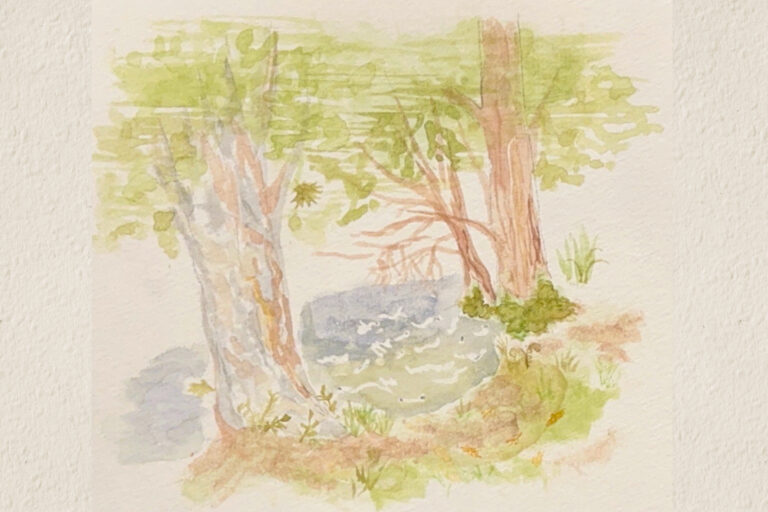
After our walk, I went off the island’s beaten path to the Opinicon’s rocky shore. I returned to this spot every day to observe the natural world around me.
Up the hill, Claire O’Neil, LifeSci 27, sat by me in the trees. As nature nourished their creativity, technology grew distant.
“My chronic onlineness is a product of mental fatigue. […] I had been studying all summer, and the school semester just ended, so I was constantly in a state of mental fatigue. At the end of the day, I didn’t have the energy to do my hobbies and creative interests. Being able to disconnect and reconnect with nature allowed me to not be mentally fatigued all the time,” O’Niel shared in an interview with The Journal.
My peers and I shared warm meals, swam in the cold lake, and sang by the fire. In these moments, the once comforting weight of a phone in my pocket became insignificant to our discovery of freedom.
I cannot remember the last time I was surrounded by friends without technology infiltrating our hangout.
For anyone in desperate need for a digital detox in a technology-dependent world, Humphreys suggests that small acts make a difference to help us stay connected to nature.
“Paying attention to a particular piece of nature — a tree outside your window, flowers growing in a patch of grass — can shift your focus away from technology to nature and help to engage you again with the natural world,” Humphreys wrote.
Although a month has gone by since I finished this course, I continue to reap the benefits of reconnecting with my long-lost friend: nature.
I am still afraid of bugs, and I hate the feeling of dirt under my nails, but I know our bond will continue to grow as I finally touch grass.
Tags
creative writing, Helen Humphreys, nature, QUBS
All final editorial decisions are made by the Editor(s) in Chief and/or the Managing Editor. Authors should not be contacted, targeted, or harassed under any circumstances. If you have any grievances with this article, please direct your comments to eic@queensjournal.ca.