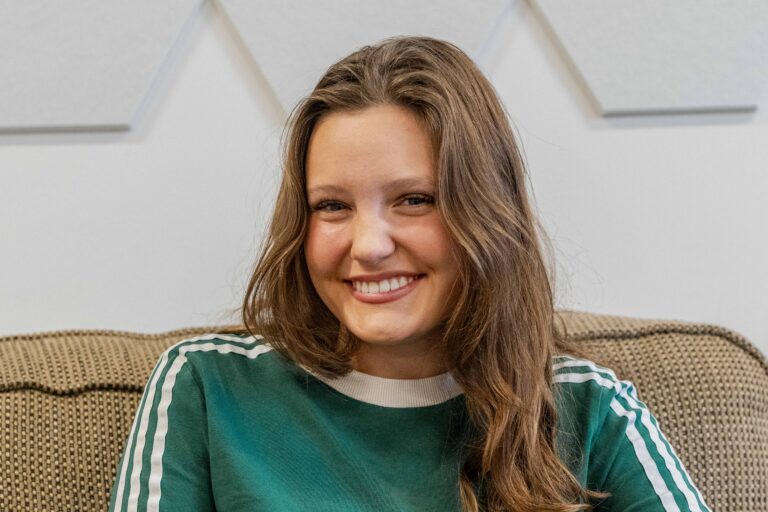
This year, I was the only girl in an all-boys unit.
What began as a random, complicated living situation has led me to a deep, profound reflection of what it means to share life and love equally with men and women—and how to tune out the gendered noise.
For context, I live in a house with 14 people. It all started when my girlfriends and I decided to move into an on-campus house with affordable rent that had two units—one for six people and one for eight. Instead of choosing one unit, we moved into both, turning the house into one interconnected explosion of chaos and young adulthood.
Going into our fourth-year, we had a lot of open spaces as a result of sublet turnover when one of my guy friends mentioned that he and his friends were looking for a house next year. Eventually, after some deliberation, we decided that they should move in with us, with most of them falling to my unit, leaving me the only girl in a six-person unit.
Growing up, I was always very comfortable hanging out with the opposite gender. As my brother was always my closest sibling in age to me and my best friend, I never overthought friendships between men and women. I was comfortable with the concept, but as move-in day drew near, I felt a lot of anxiety and shame. I worried about the basic stuff, like whether the boys would be messy or whether I’d have enough privacy.
But mostly, my concerns ran deeper—I worried about my perception. When I’d tell girls about my decision, they’d gasp about how awful that sounds and when I tried to defend the decision, I felt like a pick-me. I also had men tell me that living with all guys made me “damaged goods,” because no man would want to spend time with a girl who was constantly surrounded by other dudes.
I was constantly reminded of deep gender divides and gendered expectations, and had a fantasy of isolating myself completely in a room of pink and flowers to bask in overt femininity that I was worried was being threatened.
But when the boys moved in, my girlfriends and I welcomed them with open arms and vice versa—I never let on my concerns.
From that moment on, it was constant wine nights, game nights, and deep conversations over breakfast. In September, we all went to my cottage to celebrate my new housemate’s birthday, which was two nights of cake, swimming, ladder toss, and Wii tournaments.
I’m an avid believer that you can fall in love with people platonically, as well as romantically. When I think back to that time, I feel a wave of nostalgia because we truly all were falling in love— learning each other’s mannerisms, teasing one another, truly getting to know each other .
Recently, on my Instagram, my algorithm is constantly pushing The Atlantic’s “The Friend-Group Fallacy,” article, a thoughtful article about loneliness and the desire for a tight-knit community of friends that the writer eventually decides aren’t the norm, mostly existing within sit-coms.
While I agree that this is likely true, I couldn’t help thinking about how lucky I was. The Sunday dinners that the writer yearns for in the article are a staple at my house. It’s a comedic portrait—the 14 of us, stuffed into our eclectic living room, slurping noodle soup out of soggy paper bowls.
I do think in many ways that the girls’ and my lives would be easier and quieter if we lived in a simple six-person house. Or at least, it’d certainly be cleaner. But I can’t help believing with conviction that we’d be missing out on something special. Or at least missing out on an interesting sociological experiment.
When the girls head up to their unit, I’ve never once felt uncomfortable or alone. I’ve always felt treated with utter respect and care, like a true friend.
Obviously, the friendships between men and women are always going to have certain parts of one another that we can’t breach or that we may not fully understand about each other’s experiences, but I don’t think that that makes our friendships less valuable.
With my girlfriends, we wear our hearts on our sleeves. We spill over with love—always hugging, always verbally telling one another how much we love each other. My housemates show love in different ways that are quieter but contain just as much depth. Love in our house is performed and displayed through action, consistency, and presence.
My chef housemate always makes sure I’ve eaten before a night out and always cooks enough for me to try some. My chill housemate always makes time to watch our shows: Attack on Titan and A Knight of the Seven Kingdoms. My caring housemate always takes care of my cat without even being prompted to. He’ll play with her constantly, feed her, shower her in kisses—whenever I can’t find her, I always know where she’ll be. My clown housemate always knows how to cheer me up, dragging bits to make me laugh until my stomach hurts. My sassy housemate likes to tease me. No matter what, grab me by the shoulders and give me a little shake, letting me know he’s there.
A few days ago, while lying around in the living room and drinking wine, I asked my friends what I should write about and shared with them all the ideas I had. One of my friends piped up, saying she’d been watching a lot of New Girl and suggested I write about my unit, how it connects to our broader home, and ultimately write a happy article. “There’s a lot of sadness in this life, but there’s a lot of joy in this house,” she said.
She’s right. There’s a lot of sadness in this life. There are expectations, assumptions, and pressures that try to tell us what our relationships should look like.
There’s a poem by American poet Ada Limon, called “Accident Report in the Tall, Tall Weeds,” about a man she knows who’s obsessed with plane crashes and knows everything there possibly is to know about them. She writes: “It was almost a year before I learned that his brother was a pilot. I can’t help it; I love the way men love.”
I, too, love the way that men can love, and I realized this year that societal gendered expectations obscure the value of male-female friendships and prevent us from recognizing the different, but equally meaningful, forms of love that exist.
Tags
Housemates, Postscript, Student life
All final editorial decisions are made by the Editor(s) in Chief and/or the Managing Editor. Authors should not be contacted, targeted, or harassed under any circumstances. If you have any grievances with this article, please direct your comments to eic@queensjournal.ca.
Judith Tracey
Great article!