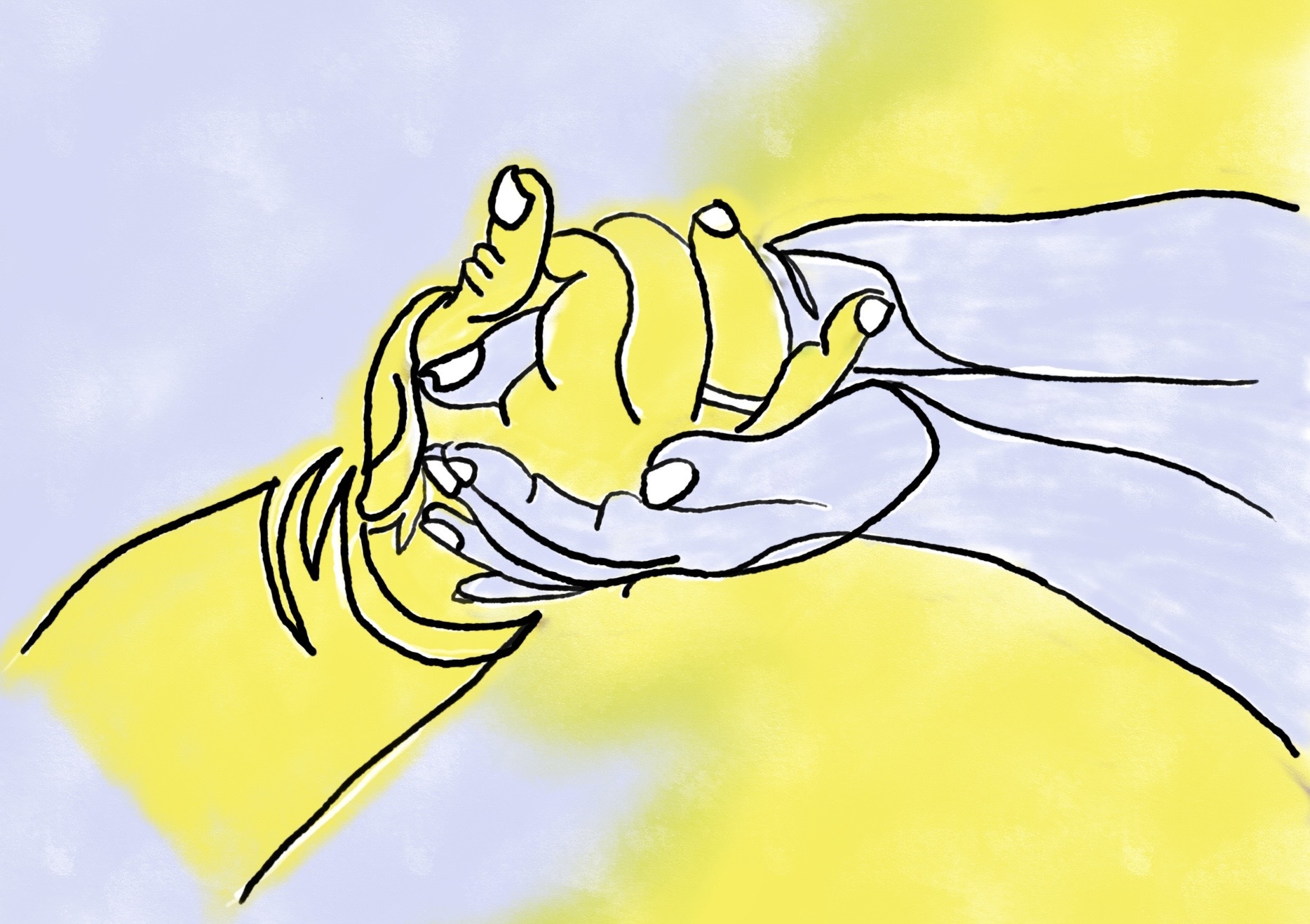
While most students worry about midterms and meal plans, young caregivers at Queen’s are quietly juggling a second, heavier life—managing medications, navigating hospitals, and carrying the emotional weight of a loved one’s illness, often without even realizing that caregiver is the word for what they’ve become.
And naming that role is the first step. Johns Hopkins Medicine defines a caregiver as “someone who provides assistance in meeting the daily needs of another person,” a responsibility students like Youths for Hospice co-founders Lucas Perri, HealthSci ’28, and Jay Hung, HealthSci ’27, know intimately. Through Youths for Hospice and Queen’s Young Caregivers Community (QYCC), they’re working to make those unseen experiences visible. Founded in 2022, Youths for Hospice aims to support and raise awareness for youth caring for loved ones receiving hospice palliative care—care focused on easing suffering and improving quality of life for people with advanced, end-of-life illnesses, according to Perri.
Kingston local Jane* lost her husband of 64 years, John*, nearly two years ago. Before his death, he received palliative care at Kingston General Hospital (KGH) before moving home for his final two weeks, where he could spend his last days in familiar comfort.
“We were able to have John in one of the front windows [at home] overlooking Lake Ontario, looking out to Woolfe Island which he was very familiar with from his childhood spent in Kingston so that went very well,” Jane said in an interview with The Journal. She said watching the island brought John a deep sense of comfort—perhaps even more than it had in his childhood. Those quiet moments by the water eased his final days.
“It’s a common misconception that hospice palliative care is a sad place. Most people think of hospice and palliative care as just a space of dying, but hospices and palliative care units are actually very happy spaces because everybody’s trying to improve quality of life,” Perri said in an interview with The Journal.
He also noted that many people assume caregiving and palliative care are concerns only for the elderly—a misconception echoed by Queen’s student Roxy Adam, ArtSci ’26.
“I haven’t heard the term [young caregivers] before. Usually when I think of caregiving, it’s in the context of a profession or old age,” Adam said in an interview with The Journal. Adam explains their reaction reflects a broader stigma: how society often imagines illness and end-of-life care as experiences reserved for old age, even though that’s far from always true, according to Adam.
This year, to encourage more open conversations and thorough understanding surrounding young loss and palliative care, especially amongst youth and children, Perri and his younger brother co-authored and published a storybook called Someone I Love is Dying in Hospice—What Should I Expect?
“There’s bright colours and pictures in the book that the kids can relate to. It aims to make them feel like loss isn’t something that’s not normal because it is,” Perri said. He frequently discussed how loss, hospice care, and caregiving isn’t often openly talked about which makes it harder for youth to identify what they’re going through and seek support.
“Death is one of those topics that we’re all afraid of talking about and sometimes you just need to break the ice somehow. I mean, we’re all headed one way,” Jane said. However, Perri and Hung note that the taboo that surrounds conversations of death also shrouds conversations of caregiving in general.
Both Perri and Hung were interested in pursuing activism and advocacy for young caregivers as a result of their personal experiences because they wanted youth to have outlets that they felt they didn’t initially have.
“When I was in grade 9, I was taking care of my mom because she was very sick. As well, my grandfather was put into hospice palliative care. It was very difficult to navigate the loss and I had no idea where to start,” Perri said.
These sentiments of confusion or loss were felt in a similar fashion by Hung as well.
“In 2019, I became a young caregiver to my mom. She was diagnosed with late-stage cancer. I experienced the unique barriers attributed to being a young caregiver, like the isolation and loneliness that came along with not really having peers that related with me,” Hung said in an interview with The Journal.
To mitigate the lack of conversation surrounding caregiving, Youths for Hospice provides a caregiver identification quiz to help students reflect on whether or not they are caregivers. They also offer caregiver guides as resources, including one created by their partner, Ontario Caregivers Organization (OCO).
“I think most people who are caregivers don’t even realize that they are caregivers until someone identifies them,” Perri said, stressing the importance of identification.
After discussing what young caregiving was to Adam, who hadn’t heard the term before, she realized she’d experience as a young caregiver. In her second year, she spent two months taking care of her grandmother after her knee surgery, including administering her medication, moving her from the bed to the bathroom, making her meals, translating the physiotherapist from English to Romanian, and more.
“Now that I think about it, I guess I have been a young caregiver, I just never had the word for this experience,” Adam said. After reflecting more on her own experience of caregiving, Adam emphasized that resources for young caregivers is of the utmost importance.
“I only had to [take care of my grandmother] for a two-month span and while I didn’t have school or work to worry about, because I was on winter break, and yet it was incredibly straining and stressful…If this was long term, as it is for many young caregivers, I feel it would have significantly strained my mental health and interpersonal relationships. I empathize with the mental and physical toll that these situations can have, as such resources for young caregivers are not only valuable, but essential,” Adam said in an interview with The Journal.
Alex McDonald, ArtSci ’26, also has experience caring for an ailing grandmother that has made her more empathetic to the caregiving experience. “Last year, when she broke her shoulder, I spent many weekends travelling to and from Toronto, spending time with her in the hospital and liaising between doctors, specialists and my mother,” McDonald said in a statement to The Journal. [Taking care of me grandmother] gave me a new appreciation for students who have daily caregiving commitments. I can only imagine the challenge of balancing school, work, self-care, and caregiving for another person.”
Perri and Hung emphasize that when more students recognize themselves as young caregivers, conversations about caregiving become easier to start—much like Adam, who only understood her own experience once she had the language for it. Perri notes that many young people struggle to identify themselves as caregivers or seek support because caring for family is often seen as simply expected.
“People treat [caregiving] as a given, but in reality, there’s lots of effects on you. You start to sacrifice parts of yourself. That’s the issue and that’s why self-identification needs to be done because when you identify yourself then you’re able to seek help and go find resources that can allow you to restore the well-being you once had,” Perri said.
Adam shares that the same assumptions shape her own view of caregiving—especially within families, where helping a loved one is seen as a given, even when it quietly demands more than a young person can realistically give.
“There is family obligation at play; you must help your family and your elders. This may lead to taboos, such as questions like “why should caregiving strain you?” or “why do you need support”, or even “why make this about yourself?”. I think taboos surround these topics because young caregiving in many cases is expected as a given, giving it a label makes it concrete and real,” Adam said.
For Hung, caregiving initially carried a similarly rigid meaning. When he began caring for his mother at just 13, he slipped into negativity and despair, overwhelmed by a sense of victimhood in the wake of her diagnosis. “Yet, as I matured and throughout my caregiving experience, I realized that my role was to support my mom as well,” Hung said. “I think it was tough balancing the two things. Sometimes I felt like I neglected myself and I felt like there was nobody around me that had gone through a similar experience.”
However, Hung told The Journal that getting involved with QYCC helped broaden his understanding of caregiving and connect him with other youth in similar situations, easing the isolation that often accompanies the role. Because of this, he believes QYCC’s greatest strength lies in its outreach and community building. As co-president, he hopes to expand that work this year by developing a peer support program in partnership with the Ontario Caregivers Organization (OCO).
Resources like QYCC’s peer support are crucial, Perri notes, because caregivers often have so few places to turn—largely a result of the limited open dialogue around caregiving.
McDonald echoed a need for more dialogue. Reflecting on her own experience caring for her grandmother, she said the short-term strain made her realize how essential strong support systems are for students who shoulder caregiving responsibilities every day.
“I think students who have caregiving responsibilities may feel different to other students, they may lack the time or energy to participate in the same social activities as other students. I would imagine a support group or more services would be appreciated, I think there is likely a whole cohort of people who are in search of resources,” McDonald said.
The importance of support groups isn’t lost on Jane either, who has joined a group at her church for women whose husbands are dying or have just died. “We’ve been able to support one another with references and have lunch with one another, which has been good from the grieving standpoint,” Jane said.
Participating in extracurriculars centered on caregiving has helped both Hung and Perri reflect on empathy and the universality of caring for others, even in the face of illness or loss.Perri notes that conversations about loss, palliative care, and caregiving are vital because these experiences touch everyone in some form. That universality, he says, makes open dialogue essential—so people can feel better prepared, supported, and understood when they inevitably encounter caregiving or grief in their own lives.
“At the end of the day, at some point in their lives, every child, everyone, will be a caregiver at some point and everybody will deal with loss. That’s the universal experience of being human,” Perri said.
Hung mentions that when having conversations surrounding loss, caregiving, and hospice care, it is important to exercise humility and compassion to reduce that emotional distance between caregivers and non-caregivers.
“I think it’s important to recognize that young caregivers are students like you and like me. They have the same fears about school, assignments, work, and more,” Hung said. “But we also experience unique barriers that affect us and it’s important to acknowledge that since we’re young, we haven’t lived much life yet, so caregiving can be almost intertwined with our identities.”
The stories shared by Hung, Adam, McDonald, Perri, and Jane remind students to lead with compassion; so much of caregiving happens quietly, out of sight. Initiatives like QYCC and Youths for Hospice help bring those hidden experiences into the open, creating room for understanding to grow.
*Names changed due to safety concerns
Tags
caregiving, Healthcare, hospice
All final editorial decisions are made by the Editor(s) in Chief and/or the Managing Editor. Authors should not be contacted, targeted, or harassed under any circumstances. If you have any grievances with this article, please direct your comments to eic@queensjournal.ca.