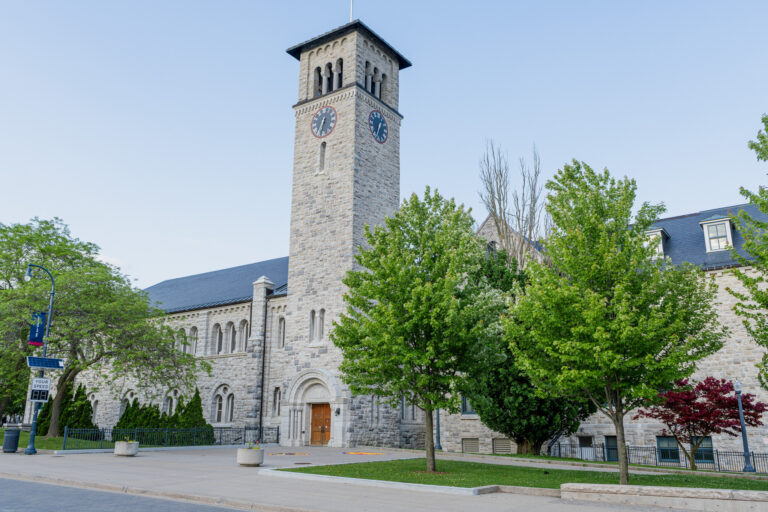
Two students who recently graduated have received international recognition for undergraduate research inspired by their programs and professors.
On Sept. 16, Queen’s undergraduate students Leo (Han) Yang, ArtSci ’26, and Vaishnavi Suganthan, ArtSci ’26, were announced as winners of the 20th World’s Best Undergraduate Awards (GUA).
The GUA is an international awards program recognizing undergraduate research across 25 academic categories. Thousands of submissions are reviewed by academics and industry specialists each year, with 26 global winners and 17 regional in 2026.
The program has four categories: global winners, regional winners, rising circles, and highly commended.
Leo (Han) Yang, Global Winner
Yang was announced a Global Winner for his paper The Limits of Recognition: Artistic Superfluity and Paris Salon in the 1860s.
In an interview with The Journal, Yang explained his interest in research began in his third year at Queen’s, when he decided to pursue an independent study to prepare for his Philosophy, Politics, and Economics (PPE) dissertation.
Yang’s first research paper examined how the First World War and the Great Depression shaped French and British philosophical traditions. The project grew to approximately 100 pages and left him “super into” research, he said.
After completing several additional research projects, Yang turned his attention to art history, his minor, and began developing his undergraduate thesis under the supervision of Allison Morehead, department head and director of the fine art program.
Yang said getting an art history minor required some persistence. As a PPE student, he was initially unable to add the minor but advocated for a way to fit its requirements within his degree. A change to Queen’s degree structure eventually allowed him to pursue his minor.
Yang was initially interested in French art and impressionism. He spent time exploring different research topics before deciding to examine the relationship between political and economic developments and the emergence of impressionism in 19th-century France.
His 2026 award-winning paper focused on the 1863 Salon des Refusés, an exhibition established after the official Paris Salon rejected numerous works that departed from traditional artistic standards.
Yang explained that the exhibition was a turning point in the art world by allowing the public to evaluate artwork rejected by established artistic institutions.
Rather than examining impressionism as a product of changing artistic styles, Yang sought to show how broader political and economic developments, such as industrialization, shaped the movement’s emergence.
His research also took him to Paris, where he was able to see some of the artwork he was studying in person.
Now pursuing a master’s in political science in London, England, Yang said he’s considering eventually pursuing a PhD while continuing to explore his interest in art and museums.
Vaishnavi Sugantha, Regional Winner
In an interview with The Journal, Suganthan said her interest in international relations, along with encouragement from her professors, inspired her to pursue independent research during her fourth year.
Suganthan said courses examining international issues and political theory encouraged her to apply theoretical concepts to contemporary problems.
Suganthan won the Regional Winner Global Undergraduate Award for her paper, Colonial Legibility: Indigenous Misrecognition in Immigration and Asylum Systems.
Her paper focuses on the colonial identity theory, arguing that governments force Indigenous Peoples into categories that fail to reflect who they are.
The paper introduces the concept of colonial legibility, which examines how governments use legal classifications, documentation, and surveillance to define and regulate Indigenous identities.
Suganthan uses examples including the Tohono O’odham Nation, whose traditional territory crosses the U.S.-Mexico border, and Canada’s Indian Act to examine how state borders can conflict with Indigenous understandings of identity, belonging, and sovereignty.
She concludes that Indigenous Peoples should not be forced into specific categories to be recognized by the government; rather, human identity must be recognized with a legal exterior that crosses borders.
“Indigenous Peoples should not have to fit into government-driven categories for their political identities, community, and sovereignty to be recognized,” Suganthan said.
She said her research initially focused on immigration enforcement in the United States, but she became increasingly interested in how governments use legal categories to determine identity and belonging.
Aspiring to pursue law, Suganthan is currently working on her master’s with the ultimate goal of helping others. She said she hopes to pursue a career that allows her to combine her interests in research, writing, and international law.
Tags
undergraduate research, World's Best Undergraduates
All final editorial decisions are made by the Editor(s) in Chief and/or the Managing Editor. Authors should not be contacted, targeted, or harassed under any circumstances. If you have any grievances with this article, please direct your comments to eic@queensjournal.ca.