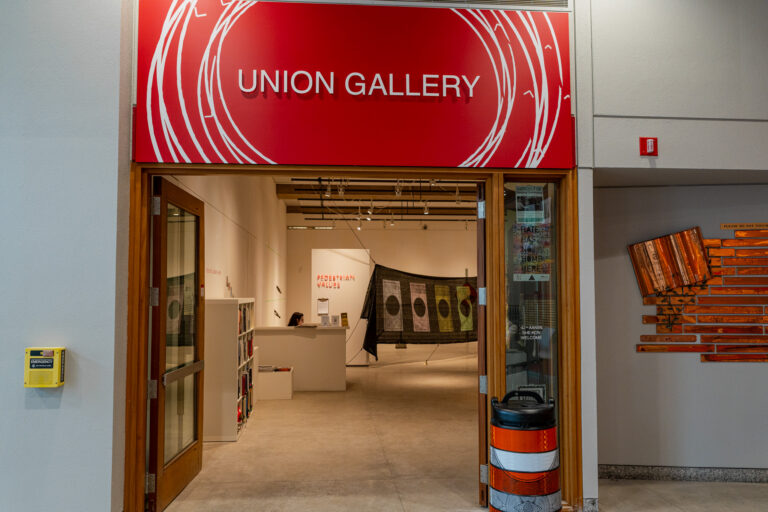
The city around you is quietly teaching you how to think about value. In , urban infrastructure becomes a site for critique.
Created by visiting artist Cassie Paine, the exhibition runs in the Main Space at Union Gallery from March 3 to May 9. Through sculpture, installation, and printmaking, the show examines how capitalist and colonial value systems are reinforced through the built environment. Drawing from her experience growing up in Windsor, Ontario—a post-industrial border city shaped by auto manufacturing—Paine explores how economic precarity and urban development inform how people relate to space. Using altered materials like traffic barrels, construction mesh, and cast coins, the exhibition critiques systems that prioritize profit and growth over collective well-being.
Pedestrian Values’ ideas are rooted in both personal experience and broader observation. Growing up in Windsor, Paine was exposed to “a specific capitalist and colonial perspective of land ownership,” she said in an interview with The Journal. This perspective was reinforced through education, policy, and everyday interactions with the city.
A recurring visual motif throughout the exhibition is the banknote pattern from the board game Monopoly. Enlarged and embedded into objects like construction mesh and scattered coins, the imagery acts as a direct critique of capitalist systems.
The game itself, which rewards players for accumulating wealth and bankrupting others, becomes a metaphor for how value is taught and internalized from an early age.
The materials and processes behind the work are central to its meaning. Paine incorporates metal fabrication, bronze casting, and screen-printing, alongside interventionist strategies that alter familiar elements of public space. These methods allow her to both replicate and disrupt the visual language of urban infrastructure, encouraging viewers to reconsider objects they might otherwise overlook.
One element unique to this iteration of the exhibition is the inclusion of works produced during a plaster coin workshop hosted by Union Gallery.
“Participants were invited to carve coins reflecting shared values and social needs, which are now displayed as part of the installation. This addition introduces a collaborative dimension, expanding the exhibition’s exploration of value beyond critique and into collective reflection,” Paine explained.
Paine sees art as a way to open dialogue rather than provide definitive answers. While engaging with political and economic systems carries a responsibility, she emphasized the importance of reflection and critical awareness. “There is a responsibility of artists to critically engage with the world around them,” Paine said.
At the same time, Pedestrian Values acknowledges the complexity of that engagement. Paine reflected on her own position within the systems she critiques, noting that participation in capitalism is often unavoidable. This tension is embodied in the work “Deconstruct/Reconstruct,” which features a bronze excavator bucket merged with a three-dimensional scan of her hand. Attached to a scaffolding structure, the piece invites viewers to physically interact with it, reinforcing their own involvement in cycles of construction and extraction.
Through this interactivity, Pedestrian Values asks viewers to consider their relationship to place. Rather than presenting a singular message, the exhibition encourages ongoing reflection, both within the gallery and beyond it.
“I hope that the exhibition prompts the viewer to critically engage and consider their environment,” Paine said.
Ultimately, the work challenges what’s often taken for granted. By reworking the materials and symbols of urban life, Pedestrian Values reveals how deeply systems of value are embedded in the spaces people move through every day.
Tags
Art Exhibition, exhibition, Pedestrian Values, Union Gallery, Visual art
All final editorial decisions are made by the Editor(s) in Chief and/or the Managing Editor. Authors should not be contacted, targeted, or harassed under any circumstances. If you have any grievances with this article, please direct your comments to eic@queensjournal.ca.