Queen’s is centering “community and relationship building” in its approach to the National Day for Truth and Reconciliation (NDTR), which takes place on Sept. 30.
According to a statement from the Queen’s NDTR Working Group, the theme of this year’s programming emphasizes ongoing relationships based on respect, reciprocity, and collaboration.
The working group said building relationships between Indigenous and non-Indigenous people requires community members to be present when stories are shared, remain willing to “learn and unlearn,” and consistently uplift Indigenous communities.
The focus changes annually. In 2024, Queen’s centred its programming on education and encouraging members of the community to further their own awareness, while the 2025 theme focused on respectful engagement in reconciliation work and with Indigenous communities.
This year’s programming includes the fifth annual Indigenous Art Exhibition at Union Gallery, an educational exhibit in Mackintosh-Corry Hall, the student-led Orange Heart Golden Project at the JDUC, and a Sacred Fire on Agnes Benidickson Field on Sept. 30.
The vice-principal’s office said that decisions about which events and initiatives are included in NDTR programming are made by the working group in consultation with the Queen’s community.
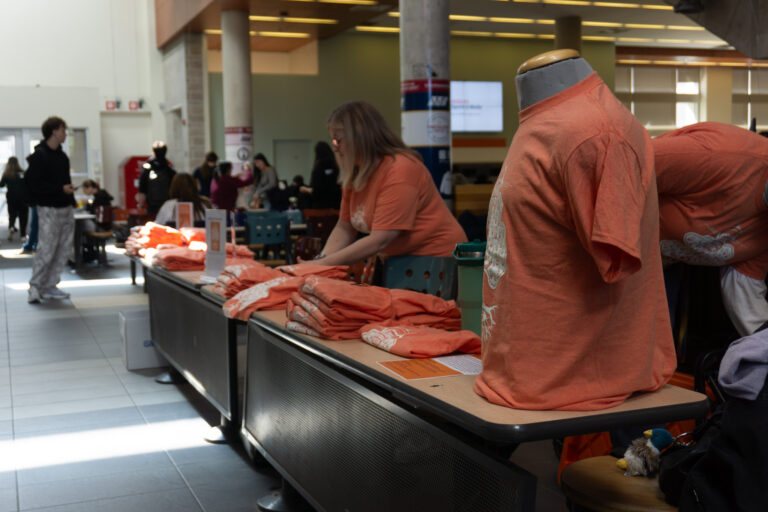
A new Orange Shirt design is also part of this year’s observance.
The Working Group invited local Indigenous artists to submit designs earlier this year, ultimately selecting Rooted Remembrance, by Mazinbii’ige—Kaiya Mongrain, ConEd ’26, who is currently pursuing a master’s degree in aquatic ecology at Laurentian University.
Mongrain, who is from Bear Island, home of Temagami First Nation, said she learned about the opportunity through a call for artists posted by the Office of Indigenous Initiatives.
“I decided to throw my hat in, so to speak, and offered myself and my talent up to the office, and the working group decided that my art was selected,” Mongrain said in an interview with The Journal.
Rooted Remembrance depicts a tree emerging from smudge smoke rising from an abalone shell. According to the office of the vice-principal, the imagery represents cleansing, remembrance, growth, continuity, and the transmission of cultural knowledge across generations.
The statement said the smoke transforming into branches connects to cultural practice with memory, while handprints incorporated into the design create movement through the smoke.
Shirts were sold in the Queen’s Centre Atrium from Sept. 22-24, with another sale planned for the 29th. Shirts will also be sold at Agnes Benidickson Field before the Sacred Fire on Sept. 30. Proceeds will be donated to the First Nations Child & Family Caring Society.
Mongrain described Sept. 30 as a day for both reflection and remembrance.
“Do your own research. Do your own in-depth look at the histories and listen to a lot of the Indigenous Peoples and survivors,” she said.
Asked what meaningful reconciliation from a university should look like, Mongrain pointed to keeping a relationship with Indigenous students and the broader Indigenous community.
“Personally, I believe that there’s always more room for collaboration and the strengthening of those relationships,” she said.
Mongrain pointed to Queen’s commissioning Indigenous artists and connecting with the broader community as examples of relationship building, but said those relationships need to be strengthened over time.
She said Queen’s has “come a good way,” while adding there remains more the University could do to connect with the broader local Indigenous community.
“Making sure that the support is very much met and maintained, I think is really important,” Mongrain said. “Especially if they want to foster a space for Indigenous students to feel comfortable, especially on campus.”
Tags
National Day for Truth and Reconciliation, NDTR, Orange Shirt Day, September 30
All final editorial decisions are made by the Editor(s) in Chief and/or the Managing Editor. Authors should not be contacted, targeted, or harassed under any circumstances. If you have any grievances with this article, please direct your comments to eic@queensjournal.ca.