This article discusses sexual violence and may be distressing to some readers.
Queen’s student groups are calling for greater action against sexual violence as allegations involving seven former Cornell University fraternity members have drawn international attention.
A former Cornell student, identified in court documents as Jane Doe, filed a civil lawsuit in September against Cornell University, seven then-members of the Chi Phi fraternity, and other defendants. The lawsuit alleges she was sexually assaulted after consuming alcohol and drugs at the fraternity house in October 2024. The defendants have denied wrongdoing, and no criminal charges have been announced.
The case was initially investigated in 2024 without criminal charges being laid. The criminal investigation was reopened in September following the lawsuit.
Cornell conducted a separate internal investigation involving more than 50 interviews with 32 witnesses. Its process resulted in expulsions and suspensions, while other respondents weren’t found responsible for sexual misconduct. Cornell has also agreed to an independent review of its handling of the case.
According to reporting from The Cornell Daily Sun, the allegations and Cornell’s response have prompted widespread protests. Thousands of students, faculty, and community members gathered at Cornell on Oct. 5 in support of survivors and to demand changes to the University’s approach to sexual violence.
At Queen’s, the AMS, the Arts and Science Undergraduate Society (ASUS), the Residence Society (ResSoc), and AMS Peer Support Centre have posted statements on social media in response to the case.
In a statement to The Journal, Social Issues Commissioner Eshal Ali, HealthSci ’27, said the AMS “unequivocally stands against any acts of sexual or gender-based violence and stands alongside survivors of sexual violence.”
The AMS said its exploring sexual violence prevention initiatives on campus following the attention surrounding the Cornell case.
“However, we recognize that increased awareness does not necessarily translate into a reduction in sexual violence,” Ali said.
The AMS said it’s reached out to Queen’s Sexual Violence Prevention and Response Services (SVPRS), faculty societies, and the Society of Graduate and Professional Students (SGPS) to discuss further action.
Early discussions include the possibility of a permanent installation in the JDUC containing student statements of solidarity with survivors and commitments to combating sexual violence.
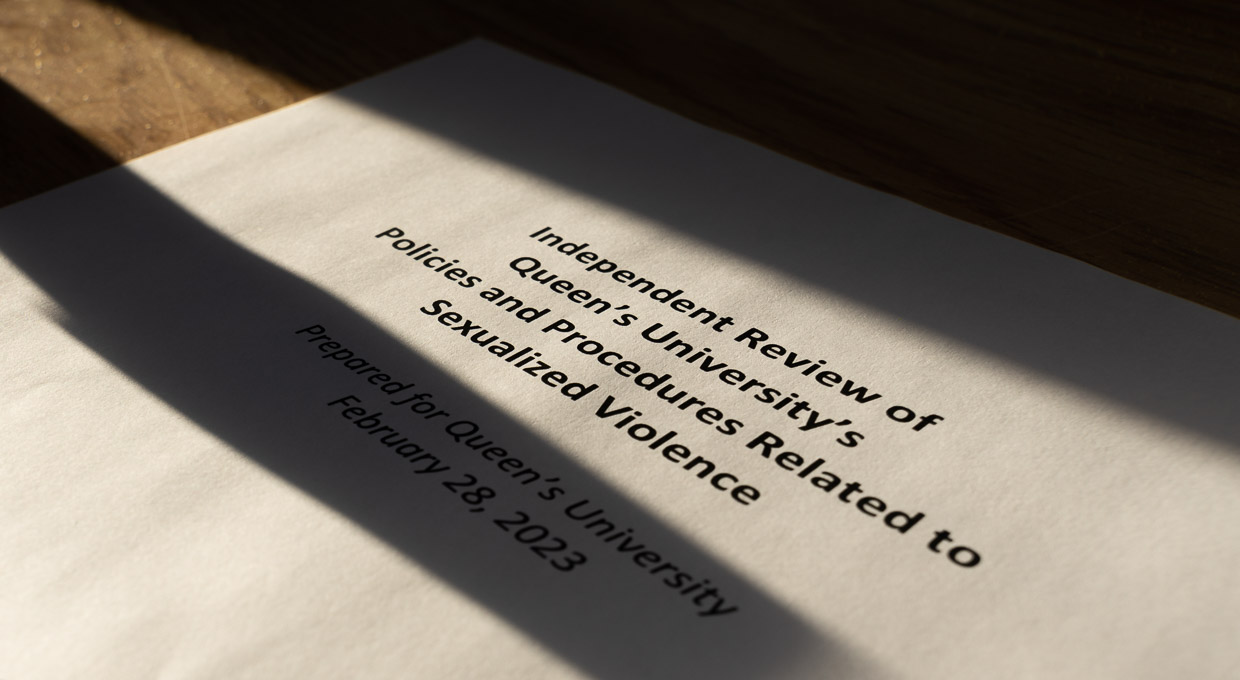
Queen’s sexual violence policy under review
The University’s Policy on Sexual Misconduct and Sexual Violence Involving Students is currently undergoing its regular review.
The Student Code of Conduct is also expected to undergo review later this year, according to the AMS. Ali encouraged students to participate when the policy opens for public consultation.
In a statement to The Journal, Queen’s said SVPRS provides confidential, trauma-informed support to students who have experienced sexual or intimate partner violence at any point in their lives. Students aren’t required to make a formal complaint to access the service.
SVPRS provides safety planning, connections to on-and off-campus resources, and information about University and police reporting options.
All incoming students, faculty, and staff are required to complete “It Takes All of Us,” an online program addressing sexual violence, consent, bystander intervention, and resource for survivors, according to the University.
Queen’s said when a student is found responsible for sexual violence under University policy, disciplinary outcomes are determined based on the nature and impact of the conduct. Sanctions can include a requirement to withdraw from the University.
More than 200 students accessed SVPRS
According to Queen’s 2025-26 Sexual Violence Prevention and Response Annual Report, 237 people accessed SVPRS during the reporting period, including 218 students. Of those accessing the service, 147 were new clients and 90 were returning clients.
Sexual assault and sexual harassment were among the most commonly reported experiences, each identified by 34 per cent of people accessing SVPRS. The report also recorded an increase in disclosures related to intimate partner violence, with 30 reports compared to 13 the previous year.
The report also distinguishes between students accessing support through SVPRS and formal complaints made through the University’s sexual violence policy.
During the 2025-26 reporting period, 15 student complaints were addressed through the University’s sexual violence policy process. Those complaints involved 20 categorized violations of the policy.
Tags
Cornell 7, sexual violence policy, SVPRS
All final editorial decisions are made by the Editor(s) in Chief and/or the Managing Editor. Authors should not be contacted, targeted, or harassed under any circumstances. If you have any grievances with this article, please direct your comments to eic@queensjournal.ca.