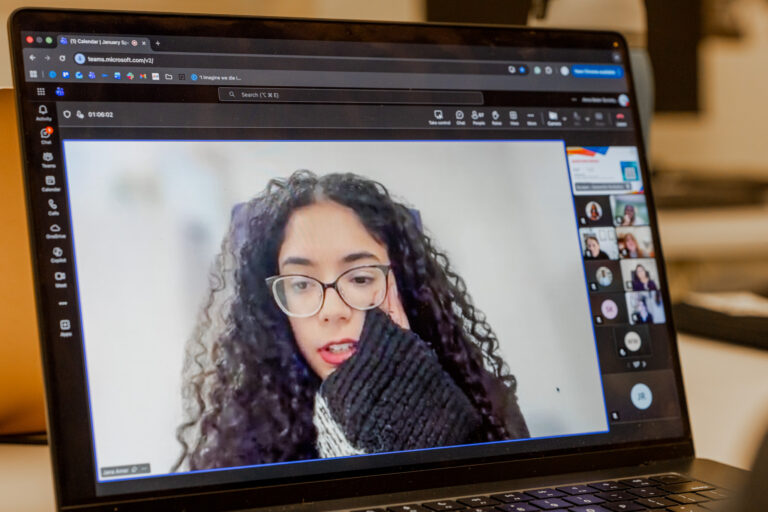
On Wednesday evening, palpable tension was felt even through the screens as Assembly members and students listened to reports detailing AMS President Jana Amer’s mismanagement of the presidential portfolio credit card.
What was originally scheduled to be brought to Assembly in February, according to acting chair of the Board of Directors Eshal Ali, to “allow adequate time for management to complete its review and brief the board, particularly given the exam period and a holiday break, [and to] ensure the Board could prepare an appropriate summary for Assembly,” was instead called as a Special Assembly on Jan. 28 over Teams by Vice-President (University Affairs) Alyssa Perisa.
READ MORE: AMS President’s credit card revoked following unauthorized personal use
“I’ve called the Special Assembly to clarify circulating questions and ensure that students are informed on the affairs of the corporation. I didn’t consult with the Board of Directors or my executive team when making this decision, but I know that it was the right one,” Perisa emphasized in her report. “I didn’t act as a Board Director in this decision. I was acting solely as the Vice-President of University Affairs within my responsibility to advocate on behalf of students.”
Perisa said her rationale for calling a Special Assembly was to keep the larger student body informed. “Students deserve to be aware of the actions of our leadership and the affairs of the corporation,” she said. “The corporation isn’t separate from the Society, although their responsibilities differ, they must work together to ensure we are serving our students and fulfilling our mandate.”
President’s Report
Amer kicked off the Assembly with the President’s report, saying she’s “glad to have this opportunity to clear the air,” and to “clarify the rumours and misinformation,” around the Presidential credit card expenses. She didn’t specify the exact nature or details of the rumours pertaining to the expenses.
Before giving any further information, Amer wanted Assembly and students at large to understand how the AMS credit cards and expenses processes operate.
“There are three main corporate credit cards, including the President’s, and they’re used operationally across our senior management teams, meaning these cards can be used [with] purposes from multiple staffs in departments across the organization,” Amer said. “Each month, a statement is then issued, and the executive that’s responsible for this card is then responsible for ensuring that the receipts are submitted and each transaction is coded accurately to the correct budget line.”
Amer then claimed that over the Fall term, she’d fallen behind and “misprioritized” managing the presidential credit card.
“What has happened in my case, is this throughout late October, during a very busy period and additional workload for me, including the fall referenda and back filling vacant positions within the AMS and conducting mid-year hires, I fell behind on submitting the receipts and ensuring that the transactions were quoted and attributed accurately,” Amer said.
“When I’d attempted to clear the backlog and had attempted to submit a large number of receipts at once, some of the coding was incorrect, and that batch of receipts from presidential purchases, as well as purchases made by other staff and departments within the AMS using the card, that combination of delayed documentation and coding errors created a lot of confusion during reconciliation and caused a significant burden for our staff and leadership to verify and resolve the items that should have been properly documented and coded as they occurred, and I take responsibility for that.”
Amer didn’t provide details on the total number of receipts submitted, how many were incorrectly coded, or how many expenses belonged to other AMS offices or departments.
In her report, Amer acknowledged and apologized for misjudging the prioritization of the presidential credit card due to the fall referenda. “I’ve already apologized to the AMS staff and to the board, and I do so again today, and since these concerns were raised, we worked closely with the AMS controller and management to review these transactions in question and provide documentation and explanation for all AMS related expenses,” she said.
The Credit Card Expenses & AMS Board of Director Documents
The first report, A1 – Management Response to Board of Director Motion, detailed $27, 225.50 in total purchases across 154 transactions on the President’s corporate credit card from May 1 to Oct. 27.
According to the report, Controller Alison Crain met with Amer on Dec. 11 to “review all transactions without supporting receipts. The President provided evidence showing that the remaining transactions without receipts were, “without a reasonable doubt, considered an AMS expense.” The report noted, however, that, “$263.38 of the $640.70 that the President repaid to AMS, as personal expenses, was the President’s decision to pay for expenses where she couldn’t find missing receipts for identified AMS expenses,” the report read.
As of Dec. 18, the report states that $1,762.61 in transactions, 42 of the 154 total transactions made, remain without receipts but have been confirmed as AMS expenses.
“In reviewing those purchases, we identified a transaction that was a personal expense that had mistakenly been placed on the AMS credit card, which was then reported and repaid immediately when it was identified,” Amer said. “The total amount that was repaid was $640 that total includes a personal transaction, as well as an additional $263.38 that I chose to repay for additional transactions for which receipts couldn’t be located at the time, even if the expenses were identified as AMS related.”
She said the repayment for additional transactions was done as she’d “felt responsible for the backlog and the situation and didn’t want uncertainty to be administered when it comes to AMS funds that are being accounted for.” Amer explained that all other transactions have supporting receipts or were otherwise identified and verified as AMS purchases, stating that “there’s been no financial impact to the AMS and all AMS funds are accounted for.”
Amer reiterated the end of the A1 report, stating “situations like these where purchases are missing, documentations are consistent with some of the challenges that are faced by all executives in obtaining receipts for all charges made by AMS employees on their cards.”
On Oct. 27, the president’s corporate credit card limit was set to zero.
“This measure was taken because it was the only credit corporate credit card with an outstanding backlog to ensure that all outstanding items could be resolved for purchases that are requiring a card have now been routed through existing card holders with the same requirements that the business purposes be provided in advance and that the receipts be submitted immediately following the transaction,” Amer said.
According to report A2 – Management Response to BOD motion 2 Re Dec 12 2025 (1), Amer may only use a corporate credit card under specific conditions. The President was given the names of individuals who hold a corporate credit card, the Vice-President of Operations, the Vice-President of University Affairs, the General Manager, and the Controller, and may use their cards at their discretion.
“The corporate credit cards may be used for corporate purchases of the President, provided the President clearly indicates the purpose of the purchase in advance, and provides a receipt to the cardholder immediately following the transaction occurring. Failure to provide a receipt will restrict further use by the President of another AMS employee’s corporate credit card,” A2 reads.
At the end of her report Amer said she takes “full responsibility for my role in this situation, regardless of my intent, and I regret the burden that this has created for staff, as well as the reputational impact and trust more broadly, and I’m committed to working with everyone on hopefully earning that [trust back] and ensuring that there are clear processes, and follow through, and that there’s transparency within the appropriate governance frameworks.”
Vice-President (Operation) Report
Following Amer’s report, Vice-President (Operations) Elena Nurzynski recalled her version of the events that have transpired since Oct. 27 when she and Perisa were informed by “AMS Controller that the President’s credit card was frozen in response to outstanding receipts and uncoded transactions dating back to May 1.”
She claimed that “upon receiving this information, myself and VPUA Perisa immediately took action to inform the Board Chair, and began substantiating the missing receipts and reviewing the expenses to code them to the correct accounts.”
Nurzynski said that Amer was given a deadline to review and substantiate the missing receipts to “resolve the matter on her own,” however, these deadlines weren’t met due to “misprioritization” and informed the President that they’d be escalating these matters to the Board.
“VP Perisa and I then worked with the General Manager to escalate these matters to the AMS Board of Directors, which is the AMS highest governing body for financial matters, we felt it was our responsibility to bring these significant concerns and address them through this governing body.”
Accordingly, Nurzynski said that the Board was able to address and handle the situation, “as management works diligently to ensure the matter was corrected.”
“Moving forward, I want you all to feel secure that we have implemented changes as an organization to significantly minimize the risk of this being replicated in future years,” Nurzynski said.
After Nurzynski’s remarks, Vice-President (University Affairs) Perisa reiterated the same sequence of events and details outlined in her report without introducing new information asides from her intentions in calling Special Assembly.
Question & Discussion Period
Following the reports, the Assembly moved to question period, where Assembly members could each ask a question or submit an anonymous question via a QR code displayed on the screen. An anonymous question asked what the upcoming credit card policy would include and how the AMS would prevent future “misspending of the AMS finances.”
Acting Chair Board of Director Eshal Ali responded that the AMS would implement corporate credit card training alongside a formal policy. She said a formal credit card policy’s currently being developed and will be brought to the Board for approval prior to the next executive term. According to Ali, the policy will outline guidelines for card usage and consequences for inappropriate use. This information has also been highlighted in the A3 report.
Rector Niki Boytchuk-Hale, directed a question to Amer, asking whether the AMS or Amer would be prepared to disclose the credit card transactions to “completely clear the situation.” After Amer initially appeared to miss the question, Boytchuk-Hale repeated it, asking whether she’d be willing “in the next 24 hours, or whenever it’s manageable, in a quick time frame to publish to Assembly, the record of the AMS president’s credit card transitions.”
Amer responded that she “doesn’t have the authority to do that.”
The last question submitted through the QR code, asked why the president’s credit card limit had been set to zero for the remainder of the school year, to which Ali said the decision was made due to “significant delays” in receiving receipts, which Ali characterized as “misprioritization.” She added, because the AMS must maintain complete documentation for its audit; the decision was then made to set the credit card limit to zero as of Oct. 27 to prevent similar issues from occurring in the future.
Motion to Release the Credit Card Statements
The Assembly then passed a motion to move into a discussion period to allow for a more productive conversation. During the discussion, Boytchuk-Hale returned to her request that the credit card statements be publicly released.
President of Commerce Society Prem Mehta-Spooner subsequently introduced a motion that read: “First, identify the individual, or individuals, or office, or offices with responsibility for and the authority to release the MasterCard credit statement and that this information be publicly available.” The motion didn’t specify a timeline for when the statements would be released or made available.
Commissioner of External Affairs, Edlira Ballaj, spoke to the motion, saying she wanted to “clarify” her understanding of the situation. She said the situation didn’t seem to have “to do with misspending or mismanagement of the transactions,” but rather with “the submission of the receipts and how that was managed and how the oversight of that occurred.”
Ballaj added that she was unsure of how “beneficial” releasing the statements would be and said she believed doing so could ultimately create more confusion for students unsure of how AMS finances work.
In response, Mehta-Spooner reiterated the rationale behind the motion saying that releasing the transactions could provide clarity on whether the purchases were AMS-related or not and said it would help address any rumours circulating on campus.
The motion was later amended in the meeting to clarify who’d be responsible for making the statements public and to specify that the Board of Directors must provide an explanation if it decides the statements can’t be released.
The final amended motion read: “The AMS identify the individuals or offices responsible for and with the authority to release the MasterCard credit card statement and make this information publicly available, and further that if the AMS Board [of Directors] is unable to release the statement, that AMS Assembly receive a written explanation through a memo detailing the reasons why.”
The motion passed unanimously, and discussion continued with the Arts and Science Undergraduate Society representative asking whether, given the issue of misprioritization of the president’s duties, Assembly members could trust Amer to lead the AMS for the remainder of her term.
In response, Amer reiterated that her focus has been on “Supporting my team and ensuring that they can get through fall referenda.” She added that, in that context, she’d regarded reviewing the receipts and coding “more of an administrative task,” which she said had “kind of fallen on the back burner while I was trying to ensure that all referenda were happening.”
The Journal asked several clarifying questions, including one directed to Amer during question period about whether the credit card charges involved a single transaction or multiple incidents. Amer clarified that it was “one full purchase that was like an accidental, personal expense.”
Later, the Computing Students’ Society Vice-President (Operations) Jasmine Zangeneh directed a question to Perisa about the timing of the issue, asking why it was brought to Assembly now rather than on the previously agreed-upon date in February—or earlier—given that Perisa had been aware of the matter since October.
Perisa clarified that she’d initially intended to follow the Board’s direction on when to discuss the issue. However, as rumours began circulating, although the nature of these rumours weren’t specified, she said, “I wanted to ensure that we could get it as soon as possible, and with the February open session, that wouldn’t have been the case. So, I made that decision alone to ensure that [upon the decision that ] it should come to open assembly that I could have that open assembly be as soon as possible.”
The Assembly adjourned at 6:55 p.m. with a unanimous vote of approval for the motion that AMS Assembly received the minutes of Dec. 12. Board open session, the agenda of Jan. 12. Board open session and its associated appendices, A1, A2 and A3 updates and the agenda of Jan. 24 open Board session.
–With files from Jonathan Reilly, Senior News Editor at ‘The Journal’.
Tags
AMS president, AMS VPOPS, Board of Directors, Credit card, VPops, VPUA
All final editorial decisions are made by the Editor(s) in Chief and/or the Managing Editor. Authors should not be contacted, targeted, or harassed under any circumstances. If you have any grievances with this article, please direct your comments to eic@queensjournal.ca.
anon
“Ballaj added that she was unsure of how “beneficial” releasing the statements would be and said she believed doing so could ultimately create more confusion for students unsure of how AMS finances work”
classic Jana’s clique
Anon
I like seeing assembly members standing on business. Kudos to you, FacSocs!
Anon
Misinformation and rumours shouldn’t be in quotation marks. The Journal spread an exaggerated, false version of this story all across campus before the initial reporting, and made multiple corrections to the original story. This is why people distrust the media!
Anon
Attended the assembly and was glad to see all of the faculty societies coming together to hold the AMS accountable!
Anon
Does Edlira even realize how absurd she sounds? Would be a bit better if she wasn’t so publicly friends with Jana. Or at least if her statement made sense… Like the AMS can just make sure the documents are released in a way that is student-friendly so students can easily understand them.
At the least, they should be released to assembly for review from the FacSoc teams