Kitchenuhmaykoosib Inninuwug, Ont.—After crossing the tarmac in the early morning sun, we boarded a dimly lit, 18-seat Wasaya Airlines plane on the last leg of our journey, which brought us from varying parts of the province.
Spewing information about emergency exits and pointing with two fingers, the pilot asks if there are any questions.
From behind me, one of the others said nervously, “Yeah, uh, I’ve never been on a bush plane before.” All around us laughter broke out and the pilot ducked into the cockpit.
A lady in front of us with a long, dark braid down her back turned around and reassured him: “This is not a bush plane.” We were flying into Ontario’s north to lead literacy-focused day camps, through a new project, an initiative of James Bartleman, the Lieutenant Governor of Ontario, and managed by Canada’s oldest literacy organization, Frontier College.
Funding for the project came from private corporations, the Ontario government’s Literacy and Numeracy Secretariat and from various colleges and universities. All summer long, camps are being run in 28 communities across the Nishnawbe-Aski Nation territory, a regional organization of about 45 communities that spans almost two-thirds of the total land mass of Ontario.
My team has been stationed in Kitchenuhmaykoosib Inninuwug (K.I.), a community of about 800 people living on the northeastern shore of Big Trout Lake, 600 kilometres north of Thunder Bay. It is accessible only by plane and winter road.
From the air, the few roads in K.I. trace dusty ruts in the textured, green mass of forest. Clusters of buildings at the end of the long peninsula look like matchboxes.
Upon arrival, it was as obvious to us as to everyone else, that we were new to all of this.
The first few days were a steep learning curve as we struggled to find our way around the community and the culture.
The kids are far more outgoing than their elders. They run up to us at the general store and knock on our front door just to get a look at us.
My curly blonde hair stands out and draws attention, little fingers and comparisons to Barbie.
In the exaggerated light and dark of Northern Ontario, one year becomes one day.
The sun slowly rises from December to June, and for the other half of the year, it’s always setting, as each day the sky becomes darker earlier.
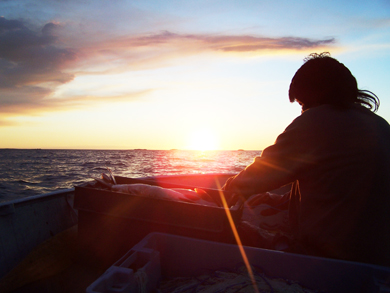
This time of year, the western sky is a yellow glow all night long. By midnight, only five stars are visible—the glow in the west is too bright to reveal any more.
In the mornings, I listen to the local radio station, as a man speaks in the low, flat tones of Oji-Cree mixed with English words like “bingo,” “Jesus,” and “rummage sale.” Outside, pickup trucks fly by with kids and teenagers standing in the back, leaning against the cab.
One family has a few lawn chairs set up in the truck bed, where the kids will sit and read books as they drive through the community.
From Monday to Friday, we run day camps each morning and afternoon with between 15 and 30 kids.
We try to sneak reading and writing into more “fun” activities like bingo, scavenger hunts and songs.
The ability of each child is different, but generally the kids are two to three years behind their Southern Ontario counterparts in areas like comprehension, writing skills and recognizing letters.
Our training taught us that Aboriginal children are often very visual in their learning style and stronger than children of other cultures in this area.
I was still caught off-guard when a 13-year-old, non-reader with fetal alcohol spectrum disorder, pointed out a large crow’s nest I’d never noticed, on a path I travel every day.
The kids here have a curiosity, a fearlessness, that you don’t see in children in Ontario’s south, who spend their days being traded between daycare, babysitters and their parents’ watchful gaze.
Although southern Ontarians might shudder at the thought of a four-year-old swimming alone, here it would be quickly pointed out that she is not alone—she’s with her six-year-old brother, and maybe at the dock she will meet some cousins and neighbours who will also serve as caregivers while she swims.
The idea of children being raised by a village is very much put into practice here, to varying degrees and with varying outcomes.
In K.I., the kids swim all summer long–no matter what the weather–starting in the first week in June.
They jump off the partially sunken band dock, opposite a float plane tied to the other side of the dock. The plane becomes their jungle gym as they swing from bars that support the wings and make cannonballs into the cool, clear water.
The constant western breeze makes goosebumps on their brown skin when they get out but they air dry, soaking up the warm sun all summer long.
Though there are four weeks left until I again cross the dusty gravel tarmac and board a plane heading south, I already know that the view from there will be very different than when I first arrived.
It will be like saying goodbye to a new friend, whom you’ve only just begun to know.
I will see more than dusty roads and boxy houses; instead I’ll remember a little boy holding a book upside-down, the special place where I like to sit beside the lake and a community where family comes first, and everyone is family.
All final editorial decisions are made by the Editor(s) in Chief and/or the Managing Editor. Authors should not be contacted, targeted, or harassed under any circumstances. If you have any grievances with this article, please direct your comments to eic@queensjournal.ca.