On the fifth floor of Victoria Hall, Abhay Katoch, Sci ’25, still hadn’t put sheets on his bed.
His parents had driven him roughly three hours to Kingston, helped unload two boxes and a suitcase, then left to move his sister into another residence. Katoch carried his belongings upstairs alone, dropped onto the bare mattress and fell asleep.
When he woke, he spent about an hour unpacking. Then he sat beside the books he had brought from home, wondering what to do next.
He put on his shoes and started walking through the building. On his floor, an open door caught his attention. He glanced into an L-shaped room, apologized for intruding, and was invited inside.
There, he met Will and Remy. Five years later, they’re still good friends.
Four storeys below, on the first floor of the same building that September, AJ*, ArtSci ’25, was also trying to meet people.
AJ had never spent more than two weeks away from home. University had seemed enormous in his imagination, but arriving in residence felt surprisingly ordinary.
“It felt kind of anticlimactic, because in my head it was cut out to be this whole big thing,” AJ said in an interview with The Journal. “And then you get there and it’s like, okay, now what?”
He propped open his door, knocked on every door on his floor and tried, he said, “to be as social as possible.”
Five years later, he isn’t in touch with anyone from that floor.
The two students arrived in the same building, in the same September, and followed much of the same advice given to incoming first-years: leave your room and introduce yourself. An accidental glance through an open door led Katoch to a friendship that has lasted five years. AJ made a deliberate effort to meet everyone on his floor, but none of those introductions became lasting friendships.
Their experiences reflect how differently the first days of university can unfold, even among students who make similar efforts to find their place.
In a July survey by The Journal, 11 of 23 Queen’s students described their first night in residence as overwhelming, while three chose pure euphoria. Of the 13 respondents who said nothing had gone wrong, six nevertheless described feeling overwhelmed or numb.
The Journal also interviewed students who later became dons, Gaels and orientation organizers. Several recalled their own arrival as empty, overwhelming or unlike what they had imagined.
Their experiences reveal another side of the first-year transition: the students responsible for helping others settle in have often struggled with the same uncertainty themselves. For some, the support they received would shape how they treated new students years later.
Waiting for someone else to go first
Sydney Welsh, ArtSci ’27, saw how nervous first-years could be even when they appeared excited to meet one another.
As a Gael—an upper-year student who volunteers to guide first-years through orientation week—she was assigned seven chemistry students who had just met.
“They were very excited for it. But I could also tell they were all super nervous about not knowing each other,” Welsh said.
She watched them approach conversation, then hesitate.
“I saw them wanting to interact, then also being a little scared to do so,” she said.
Each seemed to be waiting for somebody else to speak first.
“I think we all know we all go through it,” Welsh said, “but no one actually realizes we all go through it.”
For students arriving in 2021, that uncertainty came with an additional challenge. Pandemic restrictions had disrupted the final years of high school, leaving many without a clear idea of what university life would actually look like.
Katoch recalled how students drew their expectations from popular culture instead.
“The college dorm scene kind of felt a lot like 22 Jump Street,” Katoch said.
“People were kind of living the stereotype of what you would expect the first week in college to be like, because no one actually remembered what it was supposed to be like.”
But first-years weren’t the only ones trying to appear confident.
Before becoming a Gael, Welsh had arrived at Queen’s knowing nobody and feeling “super-duper scared.” When she later returned as an orientation leader, she wanted the students in her group to enjoy the week as much as she eventually had.
“I wanted to go and put on a good face, so then they would be inspired to enjoy their time and love it as much as I loved my frosh week,” she said.
Months of planning for one week of orientation
For incoming students, orientation can seem like a week of spontaneous activities and introductions. Behind it is months of preparation for approximately 5,000 students.
Natasha Andrade, ArtSci ’27, president of the Arts and Science Undergraduate Society, said coordinators are hired in December and begin meeting in January. Registration opens in July, and organizers return to campus early. Some wake for buses leaving at 3 a.m., while others begin setting up the sidewalk sale at 5 a.m.
By September, months of planning have gone into a week designed to help first-years find their place.
Andrade’s own introduction to university was less eventful than she had expected. She arrived knowing just one high-school friend, who lived in another residence.
“[The first night] wasn’t super exciting or anything,” Andrade said.
Within days, that friend had made more friends than she had. Orientation gave Andrade opportunities to meet people of her own. She later returned as a leader and eventually helped oversee the week herself.
The students behind the doors
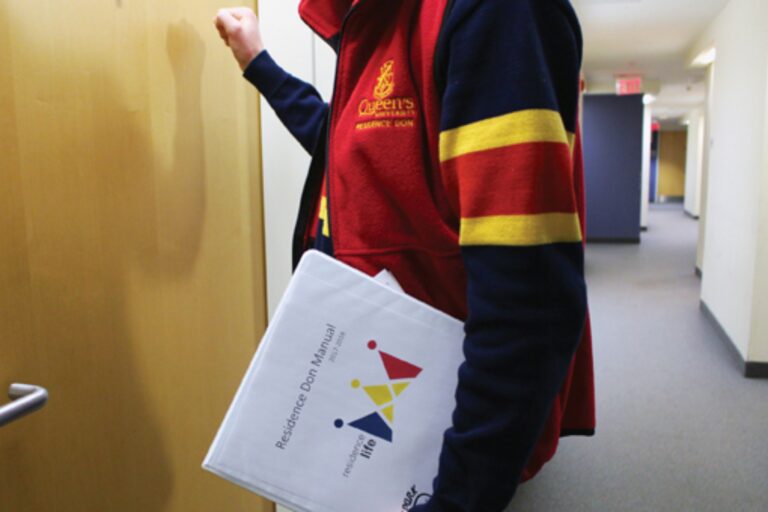
Bella Rose, Sci ’23, spent the 2020–21 academic year as a don in Victoria Hall. Dons are upper-year students who receive room and board in exchange for living in residence and supporting its students.
Rose made rounds at roughly 8 p.m., 11 p.m. and 1 a.m., listening for arguments, loud music and signs that someone needed help. Part of the job was deciding when to knock, when to intervene and when to keep walking.
Ali Bekheet, Sci ’25, who served as a Victoria Hall don in 2021, saw the role as closer to being a neighbour than an authority figure.
“I wasn’t much of a rule enforcer,” Bekheet said. “I was just there as a guide.”
He also pointed out that dons were experiencing their own transitions, even as they helped first-years navigate theirs.
“Dons are on that journey too,” he said. “While you’re getting to know first year, your don might be getting to know second year.”
Rose recalled asking other dons whether they were also having trouble getting students to attend floor meetings.
“Everyone’d be like, yeah, me, me, me,” she said. “It’s not just me. My students don’t just hate me.”
Even the students responsible for making first-years feel welcome sometimes wondered whether anyone wanted them there.
“There were a lot more times when I was a don in Vic where I could have used a shoulder and was the one providing the shoulder anyway,” Rose said.
Who gets noticed
For dons, recognizing when a student needs help isn’t always straightforward.
Rose said some students needed more support after orientation, once the initial excitement had faded and friendships began to form.
“Everybody is very social and friendly and outgoing in that first week, because everybody’s kind of in the same boat,” she said. “But then, as time progresses, people are reaching out less because they’ve settled into friendships, and then that’s kind of where the dust settles.”
Responses to The Journal’s survey illustrated how differently students could experience support. Two respondents who recalled receiving help from a don on their first night had both been crying. Another respondent reported that she and her roommate were crying but received no help, even though they felt they could have used it.
Dons also had limits on where and when they could intervene. Their rounds covered their assigned floors while they were on shift, but students could find themselves in difficulty elsewhere.
Near midnight outside Location 21, Isaac Sahota, ArtSci ’22, noticed a student sitting alone. Sahota had served as a Watts Hall don from 2020 to 2022. That night, he was off duty, in another building, and the student wasn’t one of his residents.
“This is late at night, and this is not how people just sit somewhere alone,” Sahota remembered thinking.
“And things were not okay.”
He declined to describe what happened next. For Sahota, the important part of the encounter was recognizing that something was wrong and acting without waiting to be asked.
Welsh encountered a different indication that students might need help during her time as a Gael: their absence from orientation events.
When students stopped attending, she and her co-Gael checked their roster against those who had shown up. They texted missing students to ask whether they were okay.
“[It] is easier to do with a group of seven people,” Welsh said.
Even so, residence and orientation staff couldn’t always identify every student who needed support.
During his own time as a don, Katoch noticed first-years leaving their doors open, wandering the halls and sitting beside strangers in dining halls. He also acknowledged that finding friendships could depend on “a little bit of luck.”
Bekheet encouraged students to seek out opportunities for connection, even if the people assigned to help them didn’t reach out first.
“If your Gael doesn’t reach out, show up to orientation anyway,” he said. “Someone will put you in the right place.”
He also acknowledged that even with multiple sources of support available, some students could still be overlooked.
“It’s important to realize that it’s not a foolproof system,” Bekheet said. “There’s so many nets that you can rely on, set in place. But not all of them are proactive.”
A friend first
AJ’s experience illustrates the limits of relying on students to find their own community.
He had followed the usual advice, propping open his door and knocking on every door on his floor. Yet none of the friendships he tried to build that way lasted.
He wondered whether he might have contributed to the difficulty.
“Maybe I was standoffish accidentally as well,” AJ said.
But AJ did form a connection that helped him through his first year. It was with his don, Ali Bekheet.
Bekheet was the first person AJ met at Queen’s. Over the year, they ate together, watched reality television and talked about nothing in particular.
“We had stupid talks about reality TV or whatever,” AJ said.
What stood out to AJ was that Bekheet never seemed to place himself above the students he was responsible for supporting.
“A lot of dons would treat their kids like they were above them,” AJ said. “But our don Ali—he was your friend first and foremost. He was actually your friend.”
Bekheet’s support also extended beyond their initial introduction.
“He didn’t just say that on the first day and give his number and be like, ‘Hey, text me whenever,’ and then not keep his word,” AJ said. “But he genuinely would. Every single time within, like, half an hour.”
Four floors above AJ, Katoch had found lasting friendships almost by accident. His experience also left him with a different view of the support universities could provide.
“The type of support that the university and the residence dons would sanction and provide is a little bit infantilizing in the way that it’s like gentle parenting,” he said.
Katoch questioned whether an institution could create the kind of community he had found himself.
“I got a sense of community in first year,” he said. “But I think that was something that I made for myself. It wasn’t really something that was provided to me.”
For AJ, however, the relationship that mattered most during that difficult first year had come from someone employed to help him settle in.
And Bekheet had learned his approach from a student who had once done the same for him.
How care travelled
Bekheet’s decision to become a don began with his own experience of arriving at Queen’s.
He came to Canada from abroad in 2020 and arrived late, outside the usual residence move-in period. He lived in Leggett Hall, where he spoke with his assigned don only a handful of times.
The person who made a lasting impression on him lived in another building.
Isaac Sahota was a don in Watts Hall. Engineering students from Leggett frequently visited his floor, and he made time for students who weren’t officially his responsibility.
“He was so supportive, always talked to us, made sure we were all okay,” Bekheet said. “Isaac inspired me to be a don. I wanted to be that Isaac figure for other students.”
Sahota understood how difficult the transition could be. He had arrived at Queen’s without knowing anyone, while his family lived in another country.
“I was excited. I’m going to meet new people. But there was so much emptiness,” he said.
For Sahota, walking through residence and meeting other students had been a way to escape the loneliness of staying in his room. When he became a don, he tried to approach the position in much the same way.
“I never saw don and students as Team A, Team B,” Sahota said. “I always tried to be there as a community member rather than an authority figure.”
Sahota had also been influenced by his own first-year don, whom he remembers only as Daniel.
He described Daniel as “really, really nice” and credited him with inspiring his own decision to become a don.
That influence continued through students who had never met one another.
Daniel inspired Sahota, who became a don in 2020. Sahota then inspired Bekheet, who became a don in Victoria Hall in 2021. There, Bekheet became the first person AJ met at Queen’s and someone AJ would come to regard as a friend.
Until his interview with The Journal, Sahota hadn’t known how far that influence had travelled.
During the interview, he learned that Bekheet had become a don and that a student on Bekheet’s floor had later described him as a friend first and a don second.
Sahota paused.
“It melts my heart, makes my day better, gives me another beautiful memory,” he said.
The story reminded Sahota of his own experience arriving at university, when he, too, had felt alone.
“That kid who was alone in his room was also me,” he said.
“So I’m glad we are able to help someone who was also in my position,” he added. “So it’s just helping your own self, right?”
What remained
The support Daniel offered Sahota had reached AJ years later, passed from one student to another without anyone knowing the full extent of its impact.
Bekheet didn’t independently remember the student who described him as a friend first. AJ is no longer in touch with Bekheet, and Daniel hasn’t been told where his influence eventually led.
The students who offered support weren’t necessarily receiving the same support themselves.
Sahota spent two years making himself available to other students, but wished more had reached out to him in return.
“I wish they knocked on my door,” he said.
Still, some relationships formed in residence lasted well beyond graduation.
Bekheet has returned to Kingston once since graduating—to give a former student from his floor his iron ring.
“He’s not my student anymore, but he’s my friend now,” Bekheet said.
Asked what he hoped students from that year remembered about him, Bekheet cared less about whether they remembered his name than whether they had found lasting friendships.
“I hope they’d remember me, but that’s not the important part,” he said. “I really hope that they built their lifelong connections in an environment that was supported by the work that we were doing.”
AJ, who knocked on every door on his floor without finding a lasting friendship among the students behind them, was asked what he would tell a first-year experiencing the same loneliness he had.
“I’m not gonna say, oh, everyone’s in the same boat, because that’s just not true,” he said.
By fourth year, however, his experience of university had changed.
“By the end of fourth year, I don’t think about first year at all,” AJ said. “What I do think about is fourth year all the time, and all my friends, and all the great things we did together.”
“I don’t ever think about the misery and plight. That loneliness,” he continued. “I don’t think about that, because by fourth year, you’re a whole different person and things do get better.”
Tags
dons, Dorm, first year, Residence
All final editorial decisions are made by the Editor(s) in Chief and/or the Managing Editor. Authors should not be contacted, targeted, or harassed under any circumstances. If you have any grievances with this article, please direct your comments to eic@queensjournal.ca.