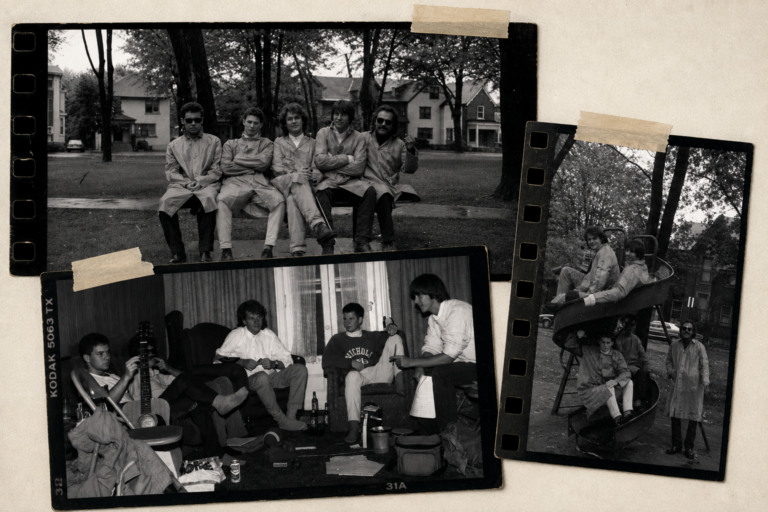
In the mid-1980s, The Queen’s Journal and The Tragically Hip worked one flight apart.
Upstairs in Queen’s student union building, otherwise known as the JDUC, Journal staff stayed through the night, cutting and laying out pages by hand. Downstairs, in the basement campus pub then called Alfie’s, a young Kingston band played into the night. In a room that wasn’t designed for concerts, students crowded around pillars. Some danced. Some kept talking.
There were no mass singalongs yet.
From Aug. 20 to 22, the City of Kingston marked 10 years since the band’s final concert with Forever Hip, a weekend of tribute performances, public art, and a singalong in Springer Market Square. It closed with a public screening of the CBC broadcast of the band’s final concert.
For the anniversary, The Journal reopened its own archives. The paper covered the band starting in 1985 through profiles, previews, and reviews, documenting its growth from a local act into a national one.
Lisa Moore, ArtSci ’86, served as The Journal’s entertainment editor in 1984-85. Moore remembers moving between the two floors while workshopping the paper, but no single Hip performance stands out in her memory.
“It wasn’t at a time when everyone knew all the lyrics to Tragically Hip songs,” Moore said in an interview with The Journal. “[We’d] never heard them before.”
Before the audience knew the words
The paper’s first known profile of the band ran Jan. 25, 1985.
The headline, “High energy dance music: It’s Tragic,” tells a reader almost everything about how the group was being understood. Gord Downie told The Journal Queen’s needed “an injection of something new and different.” The article presented The Hip as an answer to that need: energetic, local, and good for a night out.
It also introduced the musicians as people on or near the same campus as its readers. The profile identified Downie as Arts ’87, Rob Baker as Fine Arts ’86, Johnny Fay as Arts ’88, and Gord Sinclair as Arts ’85.
The article explained the band focused on covers from well-known cultural icons, including the Yardbirds, the Monkees, and Elvis Presley. It also went into the rationale for their name.
“The band’s name comes from ’Elephant Parts’, last year’s Oscar winning video from Mike Nesmith of The Monkees. The clip included a satiric plea for the ‘tragically hip.’ They liked the sound and decided to adopt it,” Catherine Harley, a contributor for The Journal, wrote in the article.
Moore remembers students talking through the sets, just as interested in the room around them as the performers onstage. The Hip had an audience, but not always its undivided attention.
A prediction of potential
Paul Faulkner, ConEd ’87, remembers leaving his first Hip show convinced the band could go far.
Faulkner wrote and photographed for The Journal from 1983 to 1987. He first saw the Hip at the Grad Club after he and a friend slipped in through a fire escape and an upstairs window.
“Back then they were sort of a dance band,” Faulkner said in an interview with The Journal. “People just went and everybody danced and it was really high energy and fun.”
The early shows drew around 100 people or fewer, he said. One thought from that first night stayed with him.
“If these guys can stay together, they’re going to be very successful,” Faulkner remembers thinking.
By the time he and another Journal writer pitched a feature on the Hip, Faulkner said the band was already being taken seriously around Queen’s and Kingston, playing campus pubs and venues elsewhere in the city.
The Q&A appeared Oct. 1, 1985 under the headline “Long-haired monsters? Just good clean boys,” calling the group “Kingston’s hottest rock combo.”
Faulkner remembers the interview at a Brock Street house as relaxed, more like talking with friends than interviewing a band.
“There was no pretense or ego,” Faulkner said.
The photoshoot that followed was just as casual.
After the interview, Downie suggested someone run to the S&R Department Store on Princess St., which closed in 2009, for matching plastic raincoats. The band went to Victoria Park, where Faulkner photographed them splashing through puddles, posing on benches, and playing golf in the rain.
“They decided they were gonna have a little bit of fun and wear raincoats,” Faulkner said.
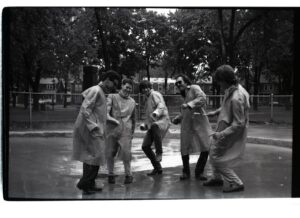
The Hip dancing in their raincoats in Victoria Park, pictured Oct. 1, 1985. PHOTO BY PAUL FAULKNER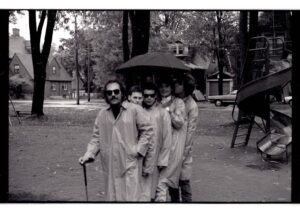
Gord Sinclair, John Fay, Gord Downie, Rob Baker & Davis Manning under an umbrella in Victoria Park. PHOTO BY PAUL FAULKNER
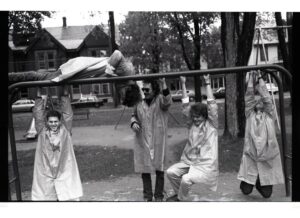 The Tragically Hip hang from the monkey bars in Victoria Park.
PHOTO BY PAUL FAULKNER
Two of Faulkner’s photographs later appeared in Michael Barclay’s The Never-Ending Present, and others were used in The Tragically Hip: No Dress Rehearsal. Faulkner said he only began to recognize their historical significance years later, when people started asking to use them.
What still surprises him is how far the band went.
“It’s just really interesting to me that they took it as far as they did,” Faulkner said.
The band people kept seeing
By the time Ramsay Duff, ArtSci ’90, arrived at Queen’s in 1986, he remembers live music on Thursdays, Fridays, and Saturdays, with different campus pubs drawing different crowds.
Seeing the Hip several times in a semester wasn’t unusual, Duff said.
“You just came to know that, ‘Oh, The Hip’s playing, let’s go see them,’ because you knew it was going to be a fun time,” Duff said in an interview with The Journal. “You knew you were going to see your friends there.”
During breaks, Duff remembers band members sitting among the crowd.
“Everybody knew them at a very personal level,” Duff said.
“For so many of the folks that were there in that ’86-’90 period, The Hip were the band that you often heard the most on campus,” Duff said. “They kind of were Queen’s house band in many ways.”
While a house band typically performs regularly at the same venue, The Journal’s archive shows the band’s reach expanding alongside that familiarity.
In October 1985, The Hip opened for Teenage Head at Fleming Field before playing another Kingston show later that night. The following year, they headlined the Oom-Pa-Pa festival at Jock Harty Arena for a crowd the paper put at about 1,000. By Homecoming 1987, a Journal review of their Alfie’s show ran under the headline “Students left wanting more Hip.”
Alayne Armstrong, ArtSci ’88, who was an assistant editor in The Journal’s entertainment section in 1986-87, remembers the Hip alongside other bands playing campus at the time, including the Raging Groovies and Guyana Kool-Aid.
Armstrong said she didn’t remember The Journal covering The Hip differently from other local bands.
She remembers The Hip as a strong live band whose repertoire was still largely cover songs. One performance even included a Sesame Street song.
“They were a band that could hold a beat, so you could dance,” Armstrong said in an interview with The Journal. “Not all bands could.”
When the originals took over
A Nov. 14, 1986, Journal review titled “Metamorphosis of the Tragically Hip” noted a lineup change. Paul Langlois had joined on rhythm guitar, while saxophonist Davis Manning was out.
The reviewer missed the old lineup’s energy but saw promise in the band’s original material.
“Although the old band definitely had more energy, the original stuff deserves a listen,” the review said.
Just over ten weeks later, a review of a Jan. 27, 1987, Clark Hall Pub show ran under the headline “The Hip mixes distinct originals with old standards.” The reviewer wrote that the band still played The Monkees, The Yardbirds, and The Animals faithfully.
“But more significantly their own songs were the best of the night,” the review said.
Armstrong said she couldn’t always distinguish the band’s originals from its covers when she saw them at Queen’s.
“This is where my memory ends,” Armstrong said. “I don’t know that I ever had a sense of what songs were theirs and what weren’t.”
Looking back, Armstrong said playing covers may have helped the band develop its own music and performance.
“Even when you’re covering something, and you bring your interpretation to it, maybe it’s also a way of building your own skills and thinking about the kind of music you want to do on your own,” Armstrong said. “A kind of a training ground.”
By January 1988, The Journal was reporting on the record contract that followed a Toronto showcase. A Journal review of the band’s debut EP that month was less enthusiastic about its lyrics, calling them “tragically lacking.” The band’s first full-length album, Up to Here, arrived in 1989.
Carried home
For Duff, the change arrived on screen.
“That house band that you knew and loved was very suddenly all of a sudden on television,” Duff said. “Being played by MuchMusic. And it’s like, ‘Wow, they’re big now.’”
MuchMusic was a Canadian music television channel. Duff remembers the band no longer being only in Kingston by then.
The students who had filled those local venues were leaving as well, graduating from Queen’s and moving on to the rest of the country.
“So many of the folks like me who were at Queen’s and experienced them, of course they graduated, and they went home,” Duff said. “And home for them was all over Canada.”
As the band’s touring map widened, it began to meet those graduates where they had settled.
“I was a graduate and suddenly they’re coming to my hometown,” Duff said. “[I’d] take all my friends and introduce them to my house band that I’m so proud of.”
Faulkner, who had photographed the band in Victoria Park years before any of that, remembers their Canadian identity as something they never performed.
“They weren’t flag-waving guys,” Faulkner said. “I don’t think I ever saw Gord Downie come out on the stage and wave a Canadian flag at the audience.”
For Moore, what the songs offered was harder to reduce to simple patriotism.
“[The songs] very much captured a kind of complicated relationship to being Canadian, that felt mature,” Moore said. “Not to be confused with sort of knee-jerk patriotism, but more of a real observation of people’s lives.”
This seemed to resonate with Canadians. When The Tragically Hip played what became their final concert in their hometown of Kingston, the CBC broadcast reached an estimated 11.7 million people, about one in three Canadians.
Predicting the rise
Armstrong prepared for her interview with The Journal by pulling out bound volumes she had kept for years and contacting people who had worked alongside her. She said their memories of those years were patchy.
“We didn’t know they were going to become famous,” Armstrong said. “I think if we had, we probably would have kept better notes.”
Armstrong returned to Kingston last spring and walked the streets with another former Journal staffer. She said reminders of the band were everywhere, from signs and public art to the pier’s namesake.
“Back then they were just another band,” Armstrong said. “They were a good band, but they were just another band.”
Before the notoriety, there were students dancing in a basement room broken up by pillars, hearing about the band by word of mouth, while one flight up, other students passed it on in print.
Tags
Canadian Music, Clark Hall Battle of the Bands, Clark Hall Pub, Gord Downie, History, Queen’s Archives, The Tragically Hip
All final editorial decisions are made by the Editor(s) in Chief and/or the Managing Editor. Authors should not be contacted, targeted, or harassed under any circumstances. If you have any grievances with this article, please direct your comments to eic@queensjournal.ca.