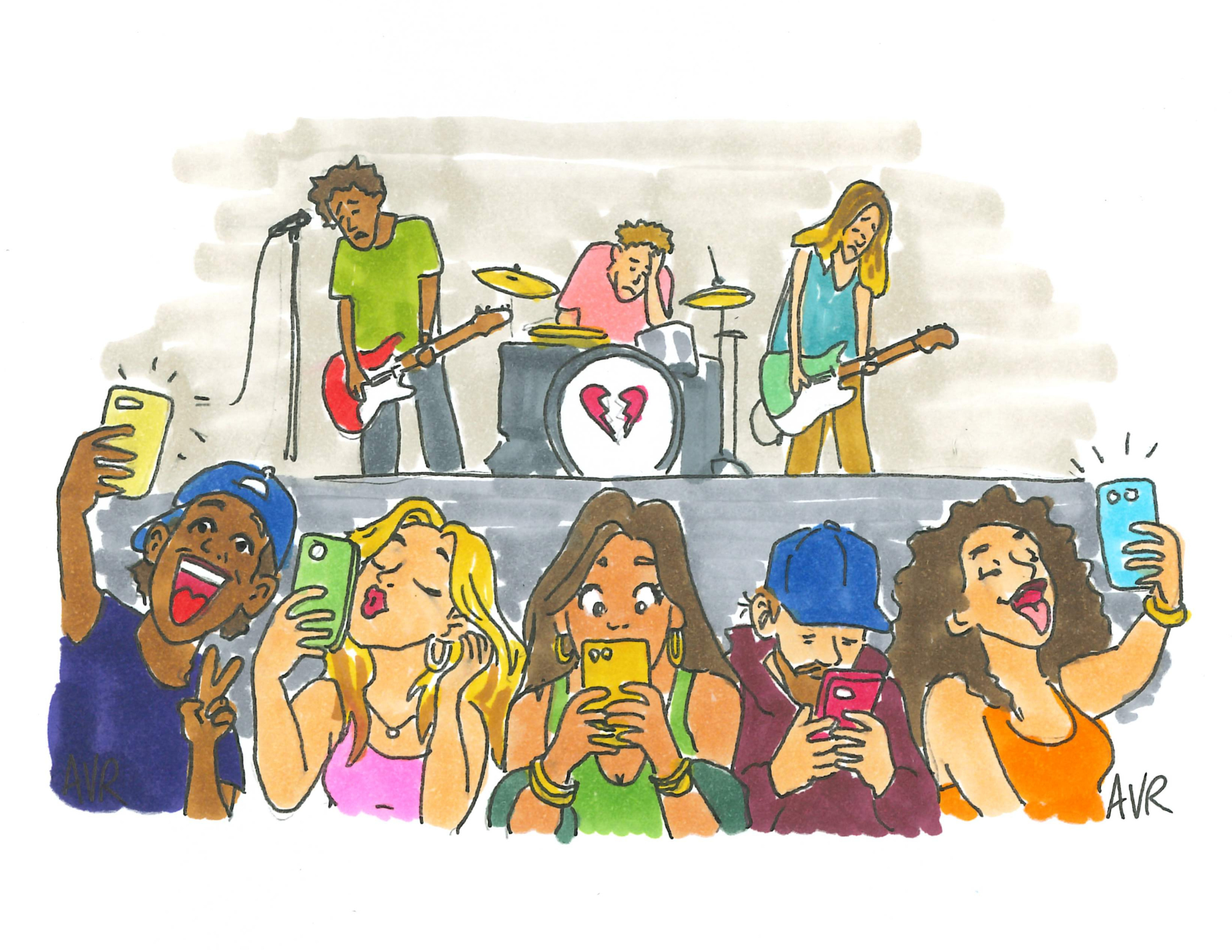
If you want to see how social media has impacted our lives, look no further than concerts.
To anyone who has attended a concert recently, the routine is predictable. The concert begins, the performer takes stage, and, like clockwork, the phones come out.
It’s so commonplace at concerts nowadays that it has spurred a debate around phone-free concerts, and it has grown loud enough that artists themselves are now weighing in. There have even been recent cases, such as Jack White’s recent show in Toronto, where cellphones were heavily restricted in the audience, with White citing the need for people to “live in the moment”.
And, while there are certain considerations one must consider — most prominently safety — it’s abundantly clear that cellphones are a massive issue at concerts, and we absolutely should make efforts to mitigate their use.
Ultimately, what makes concerts such an enthralling experience is the environment; the dancing, the singing, the community, to live in the moment, to escape for a moment. Cellphones are antithetical to this.
Set aside the fact that it’s a complete waste of money to experience a concert through a phone, as it’s something you can do for free on YouTube, cellphones actively destroy and redefine the social environment of concerts.
Privacy etiquette, anonymity, and our ability to focus on the moment are all gone through the constant fear of being recorded.
If concerts are meant as an escape from the pressures of the world, cellphones bring those issues front and center.
Part of the problem is how normalized this practice has become, to the point where it’s hardly questioned anymore and is engrained as an expectation rather than a grievance.
And it’s changing the environment of concerts.
Crowds are obnoxiously obsessed with the perfect shot for Instagram, and it’s obvious that the once-vibrant environment of a concert crowd is being replaced by a soulless mass who care more about a fleeting moment of clout than any meaningful experience of life in the moment.
Pushing and shoving used to be in mosh pits; now it’s to create the perfect angle for a shot. Privacy etiquette, anonymity, freedom, all gone with the constant presence of cellphones at these events.
And, in the end, the result isn’t even beneficial. Nobody ever watches the videos they take at concerts, and the temporary bit of social media clout is fleeting at best.
There’s also the simple fact that we can’t actually multitask and trying to simultaneously experience and document a performance means that we do neither properly.
But above all the mechanical effects, it also makes concerts feel, for lack of a better word, fake. We are there in body, but not in mind. And it’s not just in concerts, it’s everywhere.
Tourism, nightlife, everyday interactions; all of us live for and are conditioned by cell phones.
We live for social media rather than living genuinely, and what gets lost is the ordinary courtesy that made public space bearable in the first place.
It’s an epidemic of a lack of authenticity, where actions are so clearly catered towards an online environment that we often forget to experience life in real-time.
It’s our catered social media feeds paired with our lack of self-awareness and humility. It’s vicarious living through fictitious social media algorithms.
This is a problem for the younger generation at large. We are addicted to our phones, and we were conditioned into that addiction rather than choosing it. The result is that we show up to things in body, but not in mind. What we lose is genuine connection, along with the ambiguity and privacy that made the initial spark of that connection possible.
— Journal Editorial Board
Tags
addiction, Concert, Social media
All final editorial decisions are made by the Editor(s) in Chief and/or the Managing Editor. Authors should not be contacted, targeted, or harassed under any circumstances. If you have any grievances with this article, please direct your comments to eic@queensjournal.ca.