This article discusses racism and slavery, which may be distressing for some readers.
For many Canadians, the national story of slavery begins and ends with the Underground Railroad. A History Exposed: The Enslavement of Black People in Canada dismantles that myth.
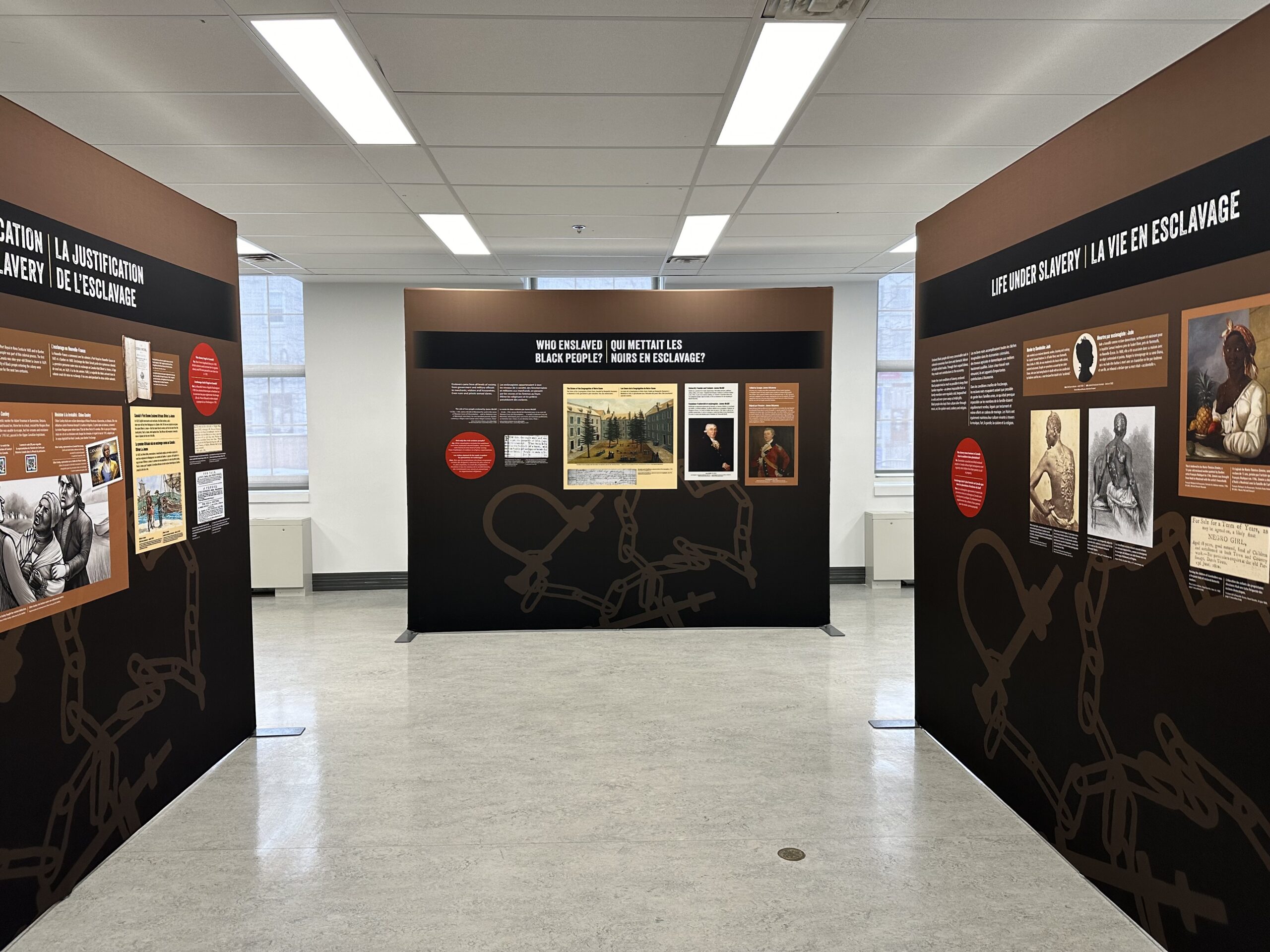
Originally developed by the Canadian Museum of Immigration at Pier 21 with guest curator Afua Cooper in partnership with the Black Cultural Centre for Nova Scotia, the travelling exhibition is making its stop in Kingston from Jan. 14 to May 22. Displayed at Kingston City Hall’s Market Wing Cultural Space, the exhibition confronts viewers with the often-overlooked realities of slavery in what is now Canada.
Structured across several double-sided panels, the exhibition moves from the global context of the transatlantic slave trade to specific biographies. It traces the history of enslavement from New France through British North America until abolition in 1834, emphasizing how deeply embedded the institution was in colonial economies and social life.
Historic records such as sale notices, court documents, and drawings accompany the panels’ text, serving as stark reminders of how normalized slavery was in Canadian society. Several reproduced newspaper advertisements announcing the sale of enslaved people are particularly jarring. It’s one thing to learn slavery existed here, but it’s another, very much more real and hard feeling to see it marketed in plain print, reduced to a simple transactional exchange.
Another striking visual element of the exhibition is a black rectangle painted onto the gallery wall, measured to reflect the space allotted to enslaved people aboard ships crossing the Atlantic. Visitors are invited to compare their own bodies to it, creating an immediately sobering effect.
The exhibition also highlights figures like Marie-Josèphe Angélique, executed in Montréal in 1734 and now central to scholarship on Black resistance in Canada. Her story is presented not as an isolated tragedy, but as part of a broader system of racialized control. In featuring her life, the exhibition resists portraying enslaved people solely as victims. It emphasizes the violence of slavery while highlighting the importance of defiance.
Importantly, the exhibition refuses to soften its language. Visitors are warned about racist terminology drawn directly from archival sources, a choice that feels necessary. Sanitizing historical records or omitting them would risk repeating the erasure the exhibition seeks to confront.
Seeing the exhibition in Kingston carries particular weight. The city is steeped in Loyalist history, presenting this exhibition in City Hall prompts difficult questions about which local histories are preserved permanently and which are relegated to temporary displays.
I left the exhibition feeling productively unsettled. A History Exposed educates with clarity, trusting archival records to speak for themselves, resulting in an exhibition that is as challenging as it is essential.
Tags
A History Exposed, History, Kingston City Hall
All final editorial decisions are made by the Editor(s) in Chief and/or the Managing Editor. Authors should not be contacted, targeted, or harassed under any circumstances. If you have any grievances with this article, please direct your comments to eic@queensjournal.ca.