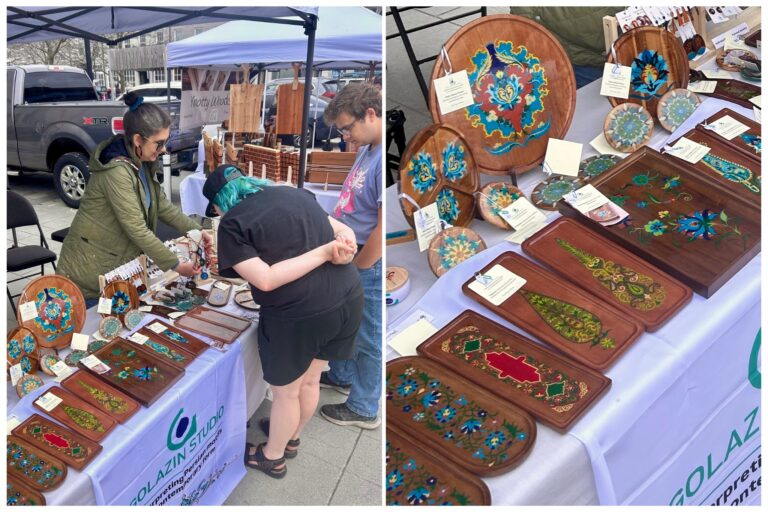
On Saturday afternoon, Golazin Moghadam sat behind a folding table at the Kingston Market Square.
Two years ago, Moghadam had a gallery of her own in Tehran. Now, she answers questions from visitors who stop long enough to look at her Kingston Market Square booth. Wooden trays, bowls, candles, incense holders, and jewelry were arranged in careful rows in front of her, many decorated with Persian floral motifs in shades of ocean blue and gold.
Around her, vendors stood ready to greet, explain, and sell as shoppers moved from one table to the next.
May 16 marked only Moghadam’s second week bringing Golazin Studio to Kingston’s Market Square. Before coming to Canada, Moghadam had built a life around art back home, even amassing an Instagram following of over 17,000 people. According to her, visitors can find a fuller record of her paintings and studio work there.
At the age of four, Moghadam created her first painting: a wooden house set amid nature. Her mother preserved the painting, and it has been cherished amongst Moghadam’s family ever since.
“The understanding that art was not simply a hobby came early,” Moghadam said in an interview with The Journal. “Even when other possibilities existed, I kept returning to painting because it gives me a way to express parts of myself that cannot always be explained directly.”
After studying art in university because she “wanted deeper knowledge,” Moghadam built connections, shared her work, and made her own opportunities. By the time she immigrated, she ran her own gallery, represented established Iranian painters, and taught her own students.
The hold that art had on Moghadam did not weaken with time. When asked what happens when she goes too long without creating, her answer came slowly.
“Art is not just work for me; it is a way to find peace. When I don’t create for a long time, I feel like… a part of me goes silent.”
Yet, it is not the gallery or the painters she represented that Moghadam misses most about Iran.
“What I miss most about Iran is my students,” she said. “I loved watching them discover themselves through art, seeing their inner world begin to appear in what they made.”
It was exciting to see students experience what had kept Moghadam returning to art since the age of four. “Art is a way to express emotions that language cannot; art is part of who I am,” she said.
Teaching had been her way of giving students what art had given her — self-discovery and a way to speak from that same discovery. Since leaving, the connection has been harder to maintain due to internet restrictions in Iran, which have made it difficult to reach the students she taught.
Not all of the life Moghadam had built in Iran could be brought over.
However, since coming to Canada, she has been dedicated to rebuilding what she can, beginning with the conditions required to reopen her own studio.
Moghadam takes private English lessons, in addition to reading and listening to English media to close the language gap. She volunteers to teach art to children at the Tett Centre, as she once did in Iran. And she approaches galleries and stores, travelling to markets and events — looking, in each, for the kind of opportunity that could help her rebuild a studio of her own.
One of the first came through Martello Alley, a downtown art gallery that showcases local Kingston artists. Moghadam walked in and offered one of her pieces as a gift. The gallery liked it and began selling her painted postcards for occasions such as Christmas, Halloween, and Mother’s Day.
Entries into Kingston’s art world, like Martello Alley, have given Moghadam room to think about what it means to hold together the artist she was in Iran and the artist she is becoming. She acknowledged there are moments when those two versions of herself can feel distinct, but she does not describe them as separate lives.
“I feel the two versions of myself have grown together; the Iranian part of me carries my roots, my culture, and my artistic identity. Canada has given me new opportunities, new experiences, and a fresh perspective,” Moghadam said.
That blended identity is part of what motivates Moghadam’s days behind the booth.
“Here, I can share Persian culture with a more diverse public,” she said. “I can connect with people from different backgrounds, teach them, and invite them into traditions they may be encountering for the first time.”
One of Moghadam’s favourite designs to work into her art is the Shah Abbasi, a stylized floral motif found across traditional Persian carpets. For Moghadam, it represents the beauty of Persian culture itself.
Still, immigration is not easy.
Part of its difficulty surrounds language and self-expression. When an interview question had to be repeated several times before being translated into Farsi, Moghadam apologized softly and said she wished she could answer in Farsi, where she knew she could express herself more fully.
“Starting again can mean carrying years of experience before the people around you may understand it,” Moghadam said.
“Be patient and give yourself time,” she said. “It is not easy, but your talent, experience, and artistic identity are not lost. You simply need to be seen in a new environment. Most importantly, keep going, build connections, and believe in yourself.”
That desire to be seen is given a physical place to unfold, literally, at Market Square. The same was true a few tables down from Moghadam’s booth, at Boho Bracelets.
The durability of her bracelets, Cherlyn Como explained to The Journal, comes from the double knots she uses and the strongest string she can find. Her preparation behind each bracelet was just as deliberate.
Como also described the customer interaction that has stayed with her the most. Once a man had walked up to the booth, carrying what Como described as a “dark cloud.” She said she felt it before he began to explain. When she asked what was wrong, he told her both of his parents had died, and that he had been carrying shame and guilt for a long time. Como started with sage, moving slowly around him for an aura cleanse.
In Como’s account, he told her afterward that something had lifted and that he felt lighter than he had in a long time. That exchange, Como said, has stayed with her.
Her decision to start the booth began during COVID-19, when she started doing crystal work and tarot for friends. Since then, she has been a regular at the Market Square. “They were like, I would pay for your services,” Como said. “Why don’t you offer them to everyone?”
Evidently, in Kingston’s Market Square, each booth is born from a different purpose. Where Como’s had grown from care for friends into a service that extends to anyone stopping by, Moghadam’s booth has grown from a life devoted to art and the wish to be part of someone else’s discovery of it.
Whenever giving advice to her students about art, Moghadam did not begin with talent or technique.
“Don’t be afraid to make mistakes, and don’t compare yourself to others,” she said. “Art is not only about the final result. It is about growing and finding your own voice.”
By the following Tuesday, tables would run across the square once more. The makers would be there too, waiting for someone to stop, ask questions, and discover the story behind each table.
Tags
All final editorial decisions are made by the Editor(s) in Chief and/or the Managing Editor. Authors should not be contacted, targeted, or harassed under any circumstances. If you have any grievances with this article, please direct your comments to eic@queensjournal.ca.
Golsa
As an immigrant myself, this article touched me deeply. I know Golazin not only as my sister, but also as the talented artist she was back in Iran, where she had her own gallery and taught art to many students.
I’ve visited her booth, and every time I’m reminded how much heart and soul she puts into her work. Behind that small booth is a woman rebuilding an entire life and career with incredible courage and dignity.
I have so much hope for her future here in Canada. Her art deserves to be seen by many more people. ????