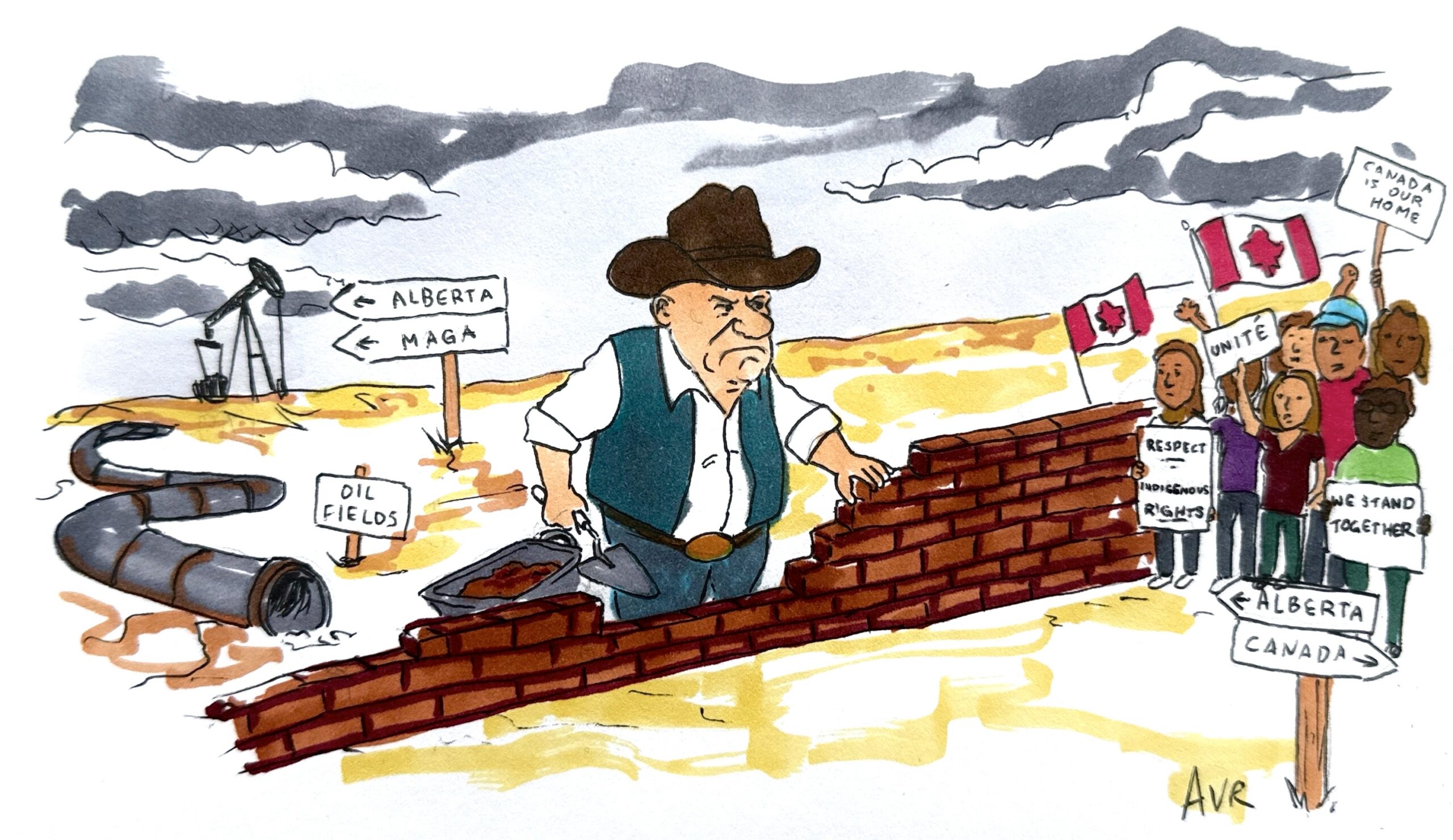
Stay Free Alberta spent two years on a constitutional argument, but forgot to check whose land it was making it on.
Court of King’s Bench Justice Shaina Leonard struck down the citizen-led petition on May 13, which sought a referendum on Albertan independence. This decision wasn’t about politics, but about principle: the province had failed in its constitutional duty to consult First Nations. The land the movement treats as an inheritance — the resources, the territory, the political identity — was never uncontestably Alberta’s to begin with.
What Stay Free Alberta has assembled is less of a sovereigntist project than a prolonged expression of frustration that has mistaken volume for substance. The rhetoric is borrowed; MAGA-adjacent in its self-pity, Americanized in its framing of federal governance as inherently tyrannical.
This is especially obvious when the Albertan independence movement is compared to other notable cases of separatism in Canada, such as with Québec. While Québec’s case of independence is unconvincing, Québec’s movement was, at the very least, contingent on cultural, linguistic, historical, legal, and political differences — something that the Albertan movement cannot emulate.
Yes, the 301,000 signatures reflect real anger, but anger is not a constitutional argument.
More damning than the procedural failures is what the movement didn’t bother to do at all. The independence project advanced as though Alberta was a settler province with the unencumbered right to determine its own political future. It is not.
The court’s ruling on Indigenous consultation was not a technicality; it was the movement’s foundational assumption exposed. You cannot claim self-determination for a settler province while the peoples whose self-determination was never recognized are not in the room. The victimhood language about Ottawa overreaching and equalization bleeding Alberta dry sits in sharp contrast to the actual, documented dispossession of Indigenous peoples that the movement declines to acknowledge.
And that’s the fundamental issue. The movement’s silence on Indigenous sovereignty is not incidental; it’s the entire point.
For every grievance the movement argues — whether unequal equalization payments, the failure to build new pipelines, or the over-regulation of Alberta’s energy industry — they are missing the point that we are on stolen land.
Alberta inherited a colonial legacy, and to assert sovereignty without consulting Indigenous peoples — the people who own the land — only further demonstrates how ideologically misplaced the movement actually is.
This is not even to suggest there aren’t certain aspects of the movement that are somewhat based on reality. For instance, the concept of “Western Alienation,” which refers to the longstanding perception in Western Canada that the Eastern Provinces — mainly Ontario and Québec — exercise a disproportionate influence in the Canadian government, is a real and documented phenomenon.
Fiscal arrangements, energy policy, and the consistent electoral irrelevance of Alberta can produce predictable resentments, and simply dismissing the movement outright likely does more to confirm the alienation than to answer it.
However, those grievances are insignificant when the movement is properly contextualized.
Alberta, contrary to what the separatists argue, belongs to its Indigenous peoples. To exclude them from the process continues to show that despite our efforts, we still haven’t kicked our settler-colonial tendencies.
— Journal Editorial Board
Tags
Canadian politics, Colonialism, Indigenous peoples, Neocolonialism, Separatism
All final editorial decisions are made by the Editor(s) in Chief and/or the Managing Editor. Authors should not be contacted, targeted, or harassed under any circumstances. If you have any grievances with this article, please direct your comments to eic@queensjournal.ca.