Queen’s leaders stress that collaboration and adaptability will determine the future of Ontario universities.
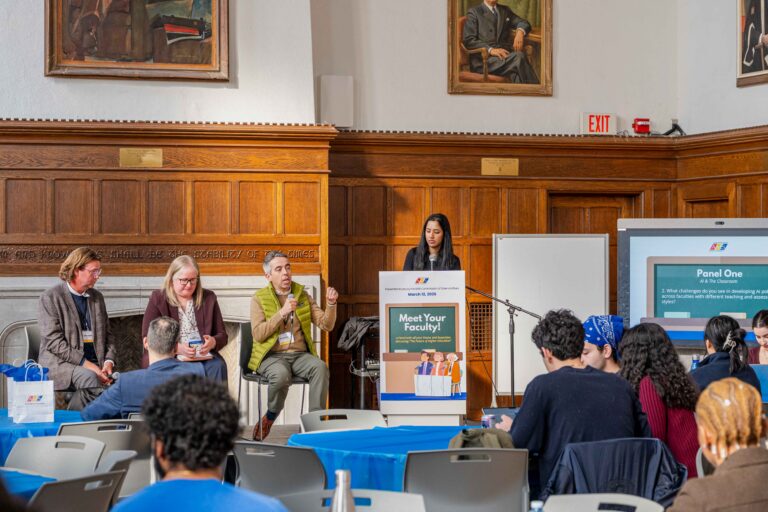
The AMS hosted a Meet Your Faculty event on March 12, from 4 p.m. to 6:30 p.m. The event was held in person at Wallace Hall in the JDUC, with about 50 students and faculty in attendance. The mixer was split into two panels, each lasting about 40 minutes, and followed by a Q&A with students and a chance to network at the end.
The event began with a land acknowledgment from the moderator and Academic Affairs Manager, Shrika Vejandla. She outlined the topics of the two panels: the first, Artificial Intelligence (AI) in the classroom, and the second, what post-secondary education will look like in the next decade.
The first panel hosted Gavan Watson, vice-provost (teaching and learning), Mark Asberg, vice-provost and university librarian, and Kate Rowbotham, assistant dean (teaching and learning). William Nelson, associate dean (teaching and learning), was scheduled to be a panellist but was unable to attend due to illness.
Despite coming from separate faculties, all panellists had similar things to say about AI in the classroom. Emphasizing that universities will need to focus less on output and broad policies to police AI and focus more on how AI can be used appropriately as a learning tool for both students and staff, university-wide.
“There are contextual elements where it’s appropriate or likely inappropriate to use these kinds of tools [AI]. And so, if we’re thinking about challenges, it’s that, maybe provocatively, I don’t think that a singular, one-style-fits-all rule about generative AI, just like any other kind of tool, would necessarily work,” Watson stated.
Rowbotham shared that a challenge with developing policy and rules around AI is the speed at which AI is developing. Explain that it’s a relatively new technology, he said, creating firm policy may fail to take into account the ever-changing landscape of AI.
“I do think a policy that is static and doesn’t take into account the rapid pace of change wouldn’t be something that would serve us particularly well,” Rowbotham said.
Asberg highlighted the importance of literacy and critical reflection while using AI. Arguing that students need to go beyond using what AI produces, but also how those outputs are shaped and created in the first place.
“That critical reflection can be about things like, what are the methods and tools that we are using? What are the embedded biases that are in there? What voices are excluded from the large-scale text sets that are the basis of how large-scale models are working? These kinds of questions are really important to ask,” Asberg said.
Panellists also emphasized that student voices are increasingly shaping how AI is discussed and governed in classrooms. Rather than top-down rules, faculty described a growing shift toward collaboration, co-creation of norms, and open dialogue about appropriate use.
The second panel featured Amy Burns, dean of education, Lisa Tannock, dean of the faculty of Health Science, and Kevin Mumford, associate dean of interdisciplinary programs for Smith Engineering.
Panellists described the next decade of post-secondary education as increasingly collaborative, flexible, and outward-facing. Though speaking from different faculties, panellists repeatedly returned to similar themes, including the need for interdisciplinary learning, stronger student participation in shaping policy, and a version of higher education that prepares students to contribute meaningfully to society beyond university.
“I would actually argue that we need to start thinking about higher education as an opportunity to give back. So, higher education provides us with this incredible opportunity to think deeply […] and become so immersed in something that we are then deemed to be some kind of an expert. And with that expertise, I argue post-secondary is really about sending people back out into the world to make a difference.” Burns said.
Mumford particularly focused on the future of interdisciplinary studies, arguing that rigid faculty structures may need to give way to more flexible and collaborative models.
When addressing the financial future of post-secondary education amid the new provincial government cuts to Ontario Student Assistance Program (OSAP), Burns discussed how the most significant structural changes will be shaped and controlled by the government. Tannock followed up by highlighting that this reality means that student civic engagement and advocacy will be especially important.
“It’s a piece of work, but vote. Register to vote and show up,” Tannock emphasized.
In audience questions, panellists rejected the idea that today’s students are less capable, arguing instead that universities must adapt to changing conditions and learning practices. They also pushed back on a strict divide between teaching and research, describing both as central to the university’s role.
“The students are amazing. You’re in a different world than the one that we went through school in, and the systems have to adapt,” Tannock said.
Tags
AI, Meet Your Faculty, OSAP, Panel
All final editorial decisions are made by the Editor(s) in Chief and/or the Managing Editor. Authors should not be contacted, targeted, or harassed under any circumstances. If you have any grievances with this article, please direct your comments to eic@queensjournal.ca.