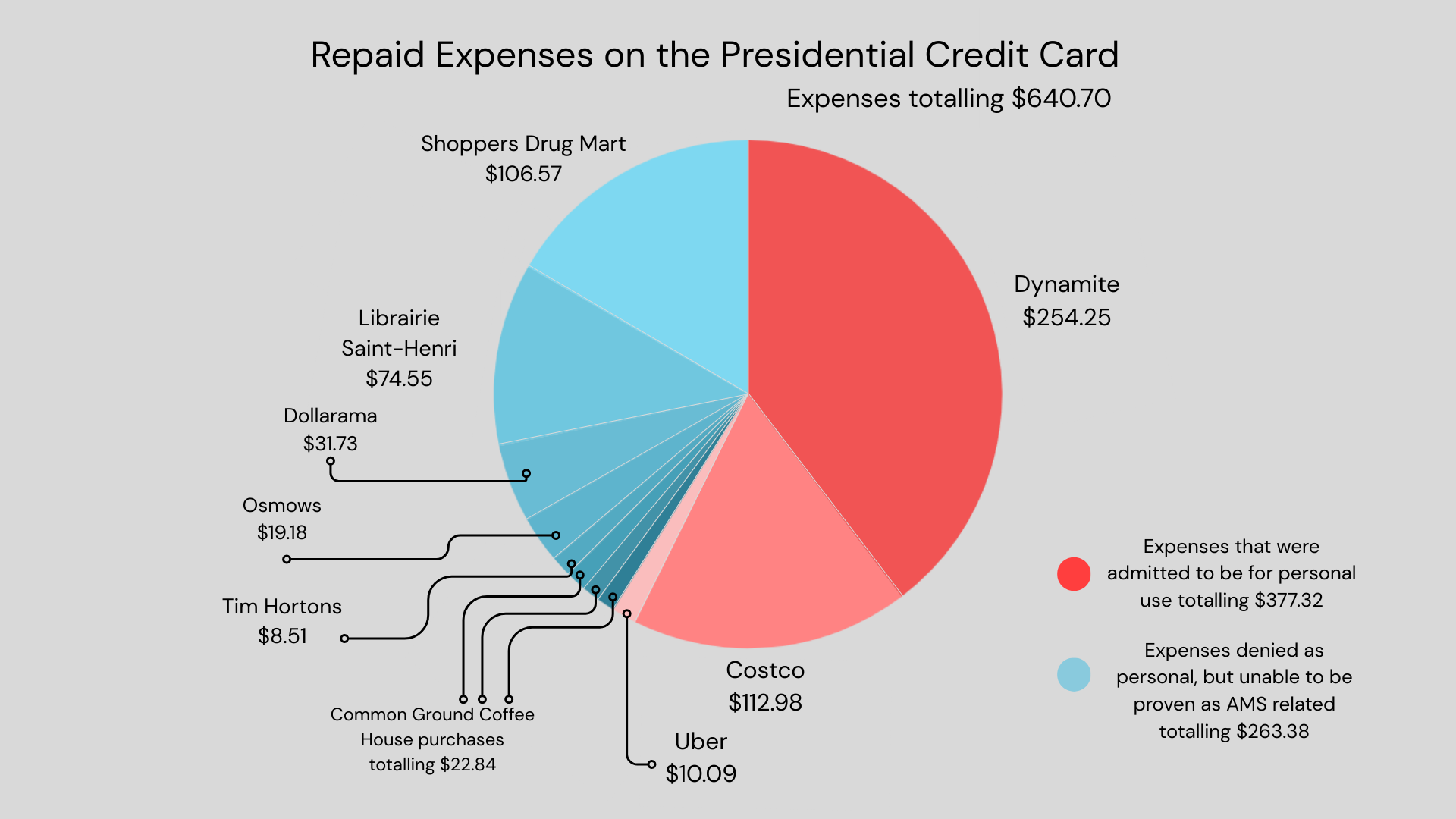
A Feb. 10 Assembly showed Dynamite clothing, Uber, and Costco comprised the three personal expenses AMS President Jana Amer admitted to accidentally placing on the presidential credit card.
This comes following a Jan. 28 Special Assembly meeting that announced her presidential card has been revoked since Oct. 27 due to delays in providing receipts, with the three personal expenses totaling $377.32. Amer has since paid those personal expenses back, alongside an additional $263.38 in card expenses that she claimed weren’t for personal use but also couldn’t be verified as an AMS-related expense, for a total of $640.70.
At the Jan. 28 meeting, Assembly passed a motion directing the AMS to release the presidential credit card statements or have the Board of Directors provide a memo explaining why they couldn’t be divulged.
At a non-special Assembly on Feb. 10, two appendices were added to the Agenda through a motion by AMS Vice-President (Operations) Elena Nurzynski. One document provided a timeline of the events relating to the credit card situation along with a detailed breakdown of the repaid expenses, and the other was a statement on behalf of the Board of Directors from Vice-Chair Eshal Ali as to why the full credit card statements aren’t being provided.
The detailed breakdown of the expenses Amer repaid to the AMS showed that, contrary to what she claimed at the Jan. 28 meeting, there were actually three expenses deemed personal, not just one. A $10.09 Uber trip on July 2, a $112.98 Costco expense on Aug. 17, and a $254.25 bill from the clothing store Dynamite on Oct. 24, all comprised the $377.32 in personal expenses.
In a statement to The Journal, Amer didn’t address why she claimed there was only one personal purchase when there were in fact three, despite specific questioning.
“The AMS card was used via a digital wallet, which increased the likelihood of accidental use during routine transactions. These sorts of accidents are not uncommon in office settings, and were remedied by AMS staff,” Amer wrote.
“The charges consisted of routine personal purchases that were mistakenly placed on the AMS card during a period of frequent AMS-related travel and expenses. Once identified, Jana acknowledged that these purchases were not related to AMS business,” Amer wrote. “Where a clear AMS connection couldn’t be substantiated, the expense was treated conservatively and addressed through internal review rather than assumption.”
The remaining $263.38 Amer repaid included a $74.55 purchase from Montreal bookstore Librairie Saint-Henri, a $31.73 purchase from Dollarama, a $19.18 purchase from Osmows, and four smaller purchases from CoGro and Tim Hortons, ranging from roughly seven to eight dollars.
Despite specific questioning from The Journal, Amer didn’t disclose the exact nature of these purchases and how they were AMS-related.
Amer’s repayments came in two parts. The $254.25 spent on Dynamite was paid back to the AMS on Nov. 20 as the vendor itself clearly indicated personal use, with the remaining $386.45 paid back on Dec. 11.
The timeline document also showed that on Oct. 24, the AMS controller informed the general manager that between the beginning of Amer’s term on May 1 and Sept. 27, $23,997.90 had been spent on the card, but $23,860.37 didn’t have receipts, which led to the decision to revoke access.
“The missing receipts reflected administrative backlog. During a high-volume transition period early in the term, several receipts hadn’t yet been uploaded, approved, or reconciled in the AMS expense system. Once identified, the AMS worked to recover documentation and improve tracking procedures,” Amer wrote to The Journal.
Of this $23,997.90, 90 per cent of these expenses took place in August and September, which is during the orientation period, an event that the president oversees.
Since the Jan. 28 Assembly, online discourse on the situation has spread, ranging from Reddit threads to resignation petitions. In order to discuss the situation in more detail, The Journal sat down with the AMS’s Board of Directors Chair and President-elect Dreyden George, Ali, and Nurzynski.
Nurzynski and George provided clarification as to why there was a delay between when Amer’s card was set to zero, which was on Oct. 27, and when Assembly was informed three months later in January.
“I think the biggest summary to get across to students is that this situation had very many procedural and legal factors and steps and compliance that we had to take,” Nurzunski said, with George adding that this was during a time when the AMS didn’t have a Secretariat.
“It takes time to gather all of the evidence and all of the facts in a clear and appropriate format, one that’s not messy and rushed or missing evidence,” Nurzynski said.
She later added that it was especially time-consuming to comb through all the presidential purchases to determine which could be identified as an AMS expense, with George adding that this all had to be done on top of their regular accounting operations.
George said it also took coordination between many of those in senior management within the AMS and was made difficult due to personal schedules, exams, and the holidays.
He also explained that the Board of Directors has what’s called a “corporate veil,” which he says is meant to protect the shareholders—who in the AMS’s case are Assembly members—from the corporate side, which is the Board of Directors.
“If [Assembly] were to make a decision in response to the president’s actions […], keeping in mind we didn’t have the full clarification of personal expense misuse, and say that weren’t to be true, that would make the Board, the student directors, open to a large liability, and the AMS open to wrongful termination suits,” George said, adding Assembly also could also be held responsible.
George explained this is why there was a delay in informing Assembly, as they had to be careful not to pierce the veil. He later added that, in his view, the Board was able to respond to this situation much quicker than other Boards typically would.
“I would love for other people to find a situation where a Board was able to respond to [a similar situation] this quickly in other corporations,” George said. “I can guarantee you probably won’t,” Ali added.
It was also explained that all of this information was meant to be released at once in the Feb. 10 Assembly, but since a meeting was called earlier, they didn’t have all the necessary documents ready to share.
They also clarified how they identified the $1,762.61 in expenses that lacked receipts as legitimate AMS charges. The review process included checking purchase timestamps, contacting the direct reports who had access to the cards, and using other verification methods to confirm the transactions.
Ali expanded that the entire credit card statements weren’t provided as she said they wouldn’t provide clarification on what were personal and business expenses, which is why they only provided specific details on the expenses that Amer paid back, adding they didn’t want to confuse students.
George added that ultimately, the Board retains authority to withhold these files, given they’re under the corporate side of the AMS, if it deems necessary. He also addressed what controls are in place to ensure that information is not being purposefully left out of the report they provided to Assembly, given that the full official credit card statements aren’t being released.
“We as a Board have hired the accounting office to be sufficient and professional in financial expertise, specifically around auditing and financial controls. So, we rely on that professional expertise to inform our opinions,” George said.
Nurzynski explained that, in the past, receipts were typically provided at the end of a month to verify purchases. She said that, in the interim, receipts are now required every two weeks to avoid potential build-up, and that this will be one of the policies they implement when a credit card policy is developed. This policy is expected by the end of the academic year.
During the Feb. 10 Assembly, a motion was passed to direct the Board to ensure this policy development includes consultation with Assembly members and students at large, with this consultation to take place in March.
Tags
AMS, AMS Board of Directors, AMS credit card, statements
All final editorial decisions are made by the Editor(s) in Chief and/or the Managing Editor. Authors should not be contacted, targeted, or harassed under any circumstances. If you have any grievances with this article, please direct your comments to eic@queensjournal.ca.
Anon
If it is our hard earned student dollars that is not going to clubs or student bursaries that actually add to campus life can we at least request a dynamite haul..
Anonymous
Dynamite Haul………
Anonymous
How does one accidentally put a company card on a personal device. It insinuates that none of the personal purchases were “accidental”…
anon
I don’t think the card was accidentally on a personal device.
the AMS doesn’t have company phones. She seems to have added it to her Apple wallet, and tapped with the AMS card instead of her personal.
not defending her, adding it to her apple wallet shouldn’t be allowed as that increases a variety of other security risks, but that was never a policy at the time, and it seems she & the rest of the team didn’t think through possible concequences.
Seems like quite a bit of carelessness, but based on the way this article reads, it doesn’t seem intentional?
Still problematic though, being careless with student dollars is.. truly the system of such a large corporation can’t be so disorganized
Anon
Who cares? Go look at club presidents… they all spend money on themselves.