For some artwork, deeper meaning comes built in.
On Sept. 6, White Pine Travels: At the Broom Factory by Noah Scheinman opened in Kingston as the first installment of White Pine Travels—a series of installations planned for the architectural pavilion. The mobile structure will travel through Ottawa before finally resting at Algonquin Provincial Park to be reassembled as park benches.
Wood for the piece comes from timber originally harvested in the Ottawa Valley, prompting audiences to consider the role of ownership, location, and material origin in artwork.
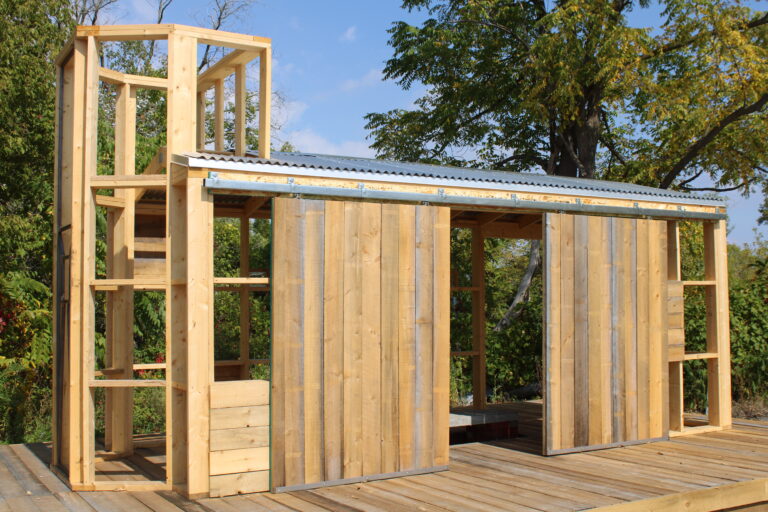
White Pine Travels is displayed at the north end of the Broom Factory’s parking lot, with little signage or fanfare. Its bare limbs and prominent tower beckoned from across the lot, drawing viewers in even without context. This is perhaps because the materials themselves are the work’s context: the timber used in the project is retracing its route back to Ottawa from Kingston.
Scheinman first acquired the timber in 2018 and traced the logs back to Algonquin Provincial Park from timber stamps, which logging companies used to use to identify their own timber. The structure at the heart of White Pine Travels is sparse: unpainted pine beams form the skeletal foundation of what could be a house, or a barn, or a shed.
The architecture of White Pine Travels was modelled after structures similar to those used in the logging industry, which are “defined by the activities that happen in and around them,” Scheinman said in an interview with The Journal.
“There’s this crazy structure called the alligator [tug], which was a logging vehicle,” Scheinman said. “It was essential that [kind of] design for utility, helping with the process of hauling logs out of the forest.” Scheinman used the alligator tug boat as a reference when designing White Pine Travels, which is where the structure’s ship-like tower comes from.
Exploring the artwork, viewers can glimpse snapshots of the logging industry’s history displayed on glass panels around the pavilion. Some depict Scheinman’s artistic process, highlighting the dual history of White Pine Travels as both bare material and constructed art.

Viewers were treated to films projected onto the structure, guided walks, and other programming at the exhibit’s opening on Sept. 6. Scheinman describes these artistic workshops as “activating” the space, which always remains free to the public.
“It’s not a commercial thing for me,” Scheinman said. “For an offbeat project like this, you obviously don’t want a lot of barriers for people who might be curious.” Indeed, the structure’s open plan and spacious pavilion call to visitors across the massive Broom Factory parking lot, rewarding them with a space to rest and contemplate.

Ultimately, Scheinman left the work up to individual interpretations. “I thought people [might] shelter under it, and I was sort of okay with it. You never really know,” he said of his artwork. “It’s really just about getting people involved.”
White Pine Travels will head to Ottawa on Nov. 4 before being “deactivated” for the winter, Scheinman said. He looks forward to it landing in its final spot at Algonquin Provincial Park in the spring.
Tags
Art, broom factory, Noah Scheinman, White Pine Travels
All final editorial decisions are made by the Editor(s) in Chief and/or the Managing Editor. Authors should not be contacted, targeted, or harassed under any circumstances. If you have any grievances with this article, please direct your comments to eic@queensjournal.ca.