Faculty members left with growing concern over the long-term plan for ArtSci.
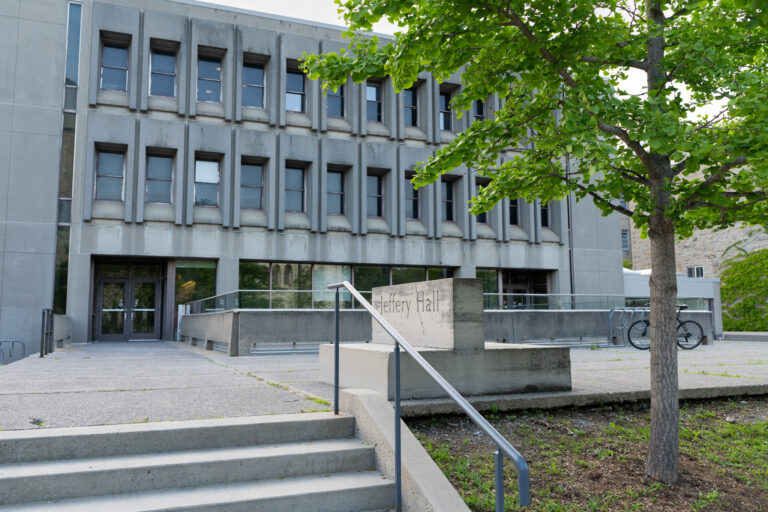
The Faculty of Arts and Science (FAS) Board met in Jeffery Hall on Oct. 24 at 2:30 p.m. The meeting included presentations of new reports, notice of motions, and a committee update, followed by faculty sharing their concerns regarding the Bicentennial Vision. After roughly two hours, the meeting concluded with a question period.
The meeting began with a land acknowledgement by Associate Dean (Graduate) and Professor James Fraser, followed by remarks from Associate Professor Diane Orihel on her petition urging the province to increase post-secondary funding. She urged all members to share and sign the petition, which was then handed out to the room for signatures.
Notice of Motions
Several notices of motions and one motion were introduced at the meeting by Associate Dean (Academic) Dorit Naaman, covering administrative calendar approvals, curriculum developments, and regulatory changes.
Naaman introduced several notices of motion, two of which focused on program changes within the DAN School of Drama and Music, including “major modification to the Music specialization” and a “Temporary Suspension of Admission into the Music Theatre—General in the Dan School.” The motions were presented without further detail and prompted no discussion from faculty, with decisions and debate to take place in future meetings.
Another notice of motion concerned a proposed revision to FAS academic regulations. Naaman proposed raising the cap on courses students can take outside the FAS from six to 12.0 units, arguing that students are increasingly seeking interdisciplinary learning opportunities.
The motion, outlined in Appendix C, was introduced for information only but sparked immediate discussion from several faculty members. Head of the Department of Art History and Art Conservation, Norman Vorano, raised concerns over lost teaching within FAS. Dan Cohen, assistant professor in the Department of Geography, asked about financial impacts.
In response, Naaman stated the proposed motion’s meant to give ArtSci students more flexibility and prevent graduation delays. She emphasized it’s not about cross-faculty teaching, which is being addressed separately through new agreements. She also stated that this was a way to “pay back” for the subvention that ArtSci is receiving.
Jordan Morelli, a professor of Engineering Physics, pushed back on the term “subvention,” arguing FAS should reject the notion that it’s being subsidized. Morelli argued that they were under-resourced, not understaffed.
“I feel this is important because the dean’s office is using this language, and I feel like the dean’s office needs to be rejecting this language, not embracing it and using it,” Morelli said. “We don’t get a subvention from the University. We’re the University.”
Finally, Associate Dean Bill Nelson proposed a motion of major enhancements to the FAS internship options under a new work integrated learning model. He shared that only 3 per cent of ArtSci students receive internships through The Queen’s Undergraduate Internship Program (QUIP) compared to 60 per cent of engineering students. The plan includes stackable four-month internships, a credit increase from six to nine units, and dedicated support for underrepresented fields.
The proposal will go to undergraduate chairs and return to the Board later this year.
The board approved a motion to adopt the 2026–2027 sessional dates, which passed without debate.
Bicentennial Vision
A discussion led by Associate Professor Alyssa King invited feedback on Queen’s Bicentennial Vision draft document, released in September of this year. This led to faculty sharing their concerns about the future of ArtSci at Queen’s.
Multiple members criticized the report’s lack of attention to teaching, arts and humanities, and sustainability. Marcus Taylor, Department Head and Professor for Global Development Studies, noted that sustainability is barely mentioned, something he feels students want to see.
Naaman then shared that she found it concerning the lack of focus on teaching in the report.
“I find it worrisome that the research and academic excellence seem to be quite well-developed, and teaching isn’t,” she said.
Following, Cohen questioned the process for identifying strategic research areas, calling it unclear and exclusionary.
Finally, several members expressed frustration that a separate Arts, Humanities, and Social Sciences (AHSS) Report, commissioned by the Principal and developed over 15 weeks, appeared largely ignored in the Bicentennial Vision, noting that ArtSci was the only faculty asked to create this report.
Question Period
During question period, Morelli raised concerns about the status of the frozen Bachelor of Fine Arts (BFA) in Visual Arts program, asking whether current students already enrolled have been given clear pathways to graduation.
Nelson replied that the program was suspended in February 2023 due to quality assurance and sustainability concerns. Also, according to Nelson, the Faculty Board approved a new BAH Visual Arts plan in February 2025 after 18 months of development, but it remains six months behind schedule in the university’s 17 to 30-month approval process.
READ MORE: Queen’s suspends Fine Art program admissions
While Nelson declined to give specifics about student support, citing privacy concerns because it’s a small program, Morelli pushed back, arguing that undergraduate chairs and professors lack the tools, capacity, and information to help students. Nelson maintained that chairs have support available.
The meeting adjourned unanimously just before 4:30 p.m., and the next board meeting is set for Nov. 21 in Jeffery Hall.
Tags
ArtSci Faculty Board, Bicentennial Vision
All final editorial decisions are made by the Editor(s) in Chief and/or the Managing Editor. Authors should not be contacted, targeted, or harassed under any circumstances. If you have any grievances with this article, please direct your comments to journal_editors@ams.queensu.ca.