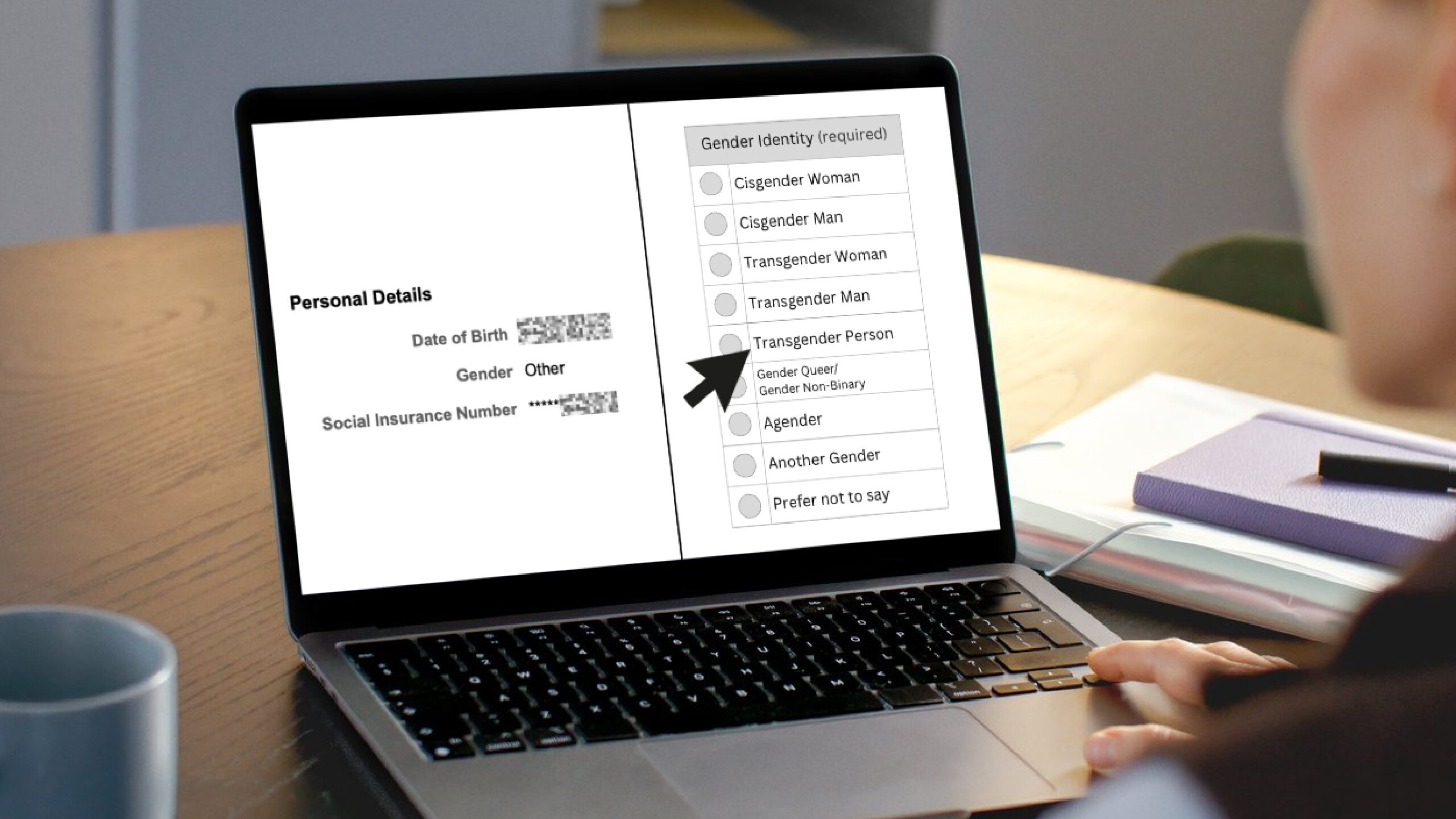
Student states that after applying to law school, her gender was changed to ‘other’ on SOLUS.
Queen’s student Emma* has raised concerns about how the Ontario Universities’ Application Centre (OUAC) collects gender identity information and how it’s recorded in Ontario University systems. Currently, when applying to universities on the OUAC website, all students must complete a personal information form, including a mandatory question about gender. The options on the form to answer the gender question include: Cisgender female, Cisgender male, Transgender man, Transgender woman, Transgender person, gender queer/gender non-binary, agender, another gender, and prefer not to say.
In an interview with The Journal, Queen’s student Emma* said she first noticed the gender identity data-collection issue while completing her law school application through OUAC.
According to Emma, she’s concerned because there’s no way for a transgender student to share their gender without effectively outing themselves. Emma said she felt confused by how the gender question was structured in the application portal. Stating the options combined gender identity with transgender status, making it impossible to indicate her gender without disclosing additional personal information.
Additionally, she discovered in her university portals that the schools she applied to, including Queen’s, University of Ottawa, and Toronto Metropolitan University, all recorded her gender data as X/Other.
“If you’re identifying as a woman or a man and you happen to be trans, there’s no other option to fill out this application without outing yourself with your trans identity,” she said.
While going through the application process, she later discovered her gender had changed within Queen’s internal student system, SOLUS, after submitting her application.
“I have transitioned at Queen’s; I’ve changed all my documents […] so everything on SOLUS was perfect. But as soon as this application was entered into the university system, they basically changed my gender from female to other,” she continued, “And that made me very upset because I put so much work into it […] and they essentially just changed it and misgendered me.”
After noticing the change, Emma said she contacted campus resources, including the Human Rights and Equity Office (HREO) and staff at the Yellow House, before being directed to the Office of the University Registrar.
“I was in touch with the human rights [and equity] office, and they connected me to the interim registrar, and she has been fantastic,” she said. “[The registrar] is really putting effort into getting this changed. They put an IT work order in, and she’s trying to connect with other University leaders.”
In a statement to The Journal, Queen’s stated that it was aware of the concerns and has since begun reviewing how the University collects and records gender identity.
“Queen’s is actively engaged in reviewing how applicant gender data received from OUAC is integrated into our student information systems. University officials are in conversation with peer institutions on this issue and are working with OUAC to explore how the gender identity question in OUAC might be structured differently to better reflect current practices and minimize unnecessary disclosure of sensitive information,” Queen’s wrote.
The Journal reached out to OUAC to discuss Emma’s concerns about why and how OUAC collects and distributes gender identity data, but they declined to comment on the situation.
Queen’s added that it’s “committed” to improving practices and systems and ensuring that all systems respect gender identity.
After noticing the change, Emma said she also contacted OUAC to request that her information be corrected across institutions.
However, she was told by OUAC that changes to the system would have to go through a voting and committee process. She was also advised that correcting her gender for the current application cycle would require her to contact each university individually.
More broadly, she said the experience raised concerns about transparency in how sensitive applicant information is collected and used. She said she chose to speak publicly to increase awareness and accountability.
“I am really struggling with how much they want to know about their applicants, and then all of this information just disappearing into a huge black box, and nobody really knows what’s being done with it,” Emma said.
As an alternative, she suggested a two-step approach to collecting gender data. This model would first ask applicants to identify their gender, for example, as a woman, then include a separate, optional question asking whether their gender identity differs from their sex assigned at birth.
She argued this format would allow applicants greater control over how much information they choose to share while still enabling institutions to collect demographic data.
*Names changed for privacy and safety reasons
Tags
All final editorial decisions are made by the Editor(s) in Chief and/or the Managing Editor. Authors should not be contacted, targeted, or harassed under any circumstances. If you have any grievances with this article, please direct your comments to eic@queensjournal.ca.
Tom
Sounds like the process was pretty inclusive. There are bigger issues to worry/write about.
Anitra Denison
THIS NEEDS TO BE DONE LATER