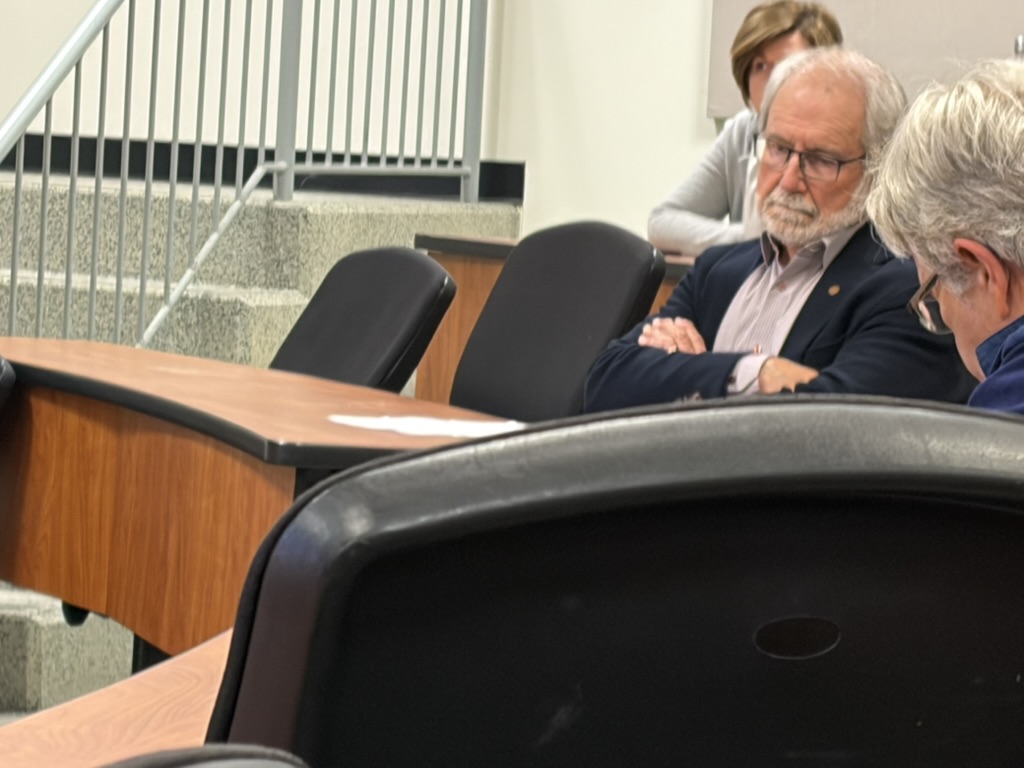
Protestors made their presence felt at a lecture on navigating campus conflicts.
The Centre for Teaching and Learning and Human Rights and Equity Office hosted Aftab Erfan, the executive director of Simon Fraser University’s Centre for Dialogue, for a talk entitled “Making Sense of Conflicts on Our Campuses in Polarizing Times” on March 10.
The talk, which drew an audience of approximately 50 people, was set to begin at 3:00 p.m., but within five minutes, during introductions, was interrupted by a group protesting the University’s refusal to divest from fossil fuels and companies doing business with the State of Israel.
Approximately 10 students held up signs, the largest one reading “No 2 Sides to Genocide.” Other signs called attention to cuts made by Queen’s to student funding.
“Patrick Deane refuses to call out the genocide in Palestine,” one masked protestor said. “Even though he took a public position before on Black Lives Matter and the Russian invasion of Ukraine.”
Principal and Vice-Chancellor Patrick Deane, who was sitting in the front row, didn’t turn to acknowledge the protestors, but also didn’t stop the protesters from speaking.

Masked protestor delivers speech criticizing Deane and the University. PHOTO BY YAEL RUSONIK
After the protestors finished talking, Paul Akpomuje, a poet and PhD candidate at Queen’s, read a poem memorializing the violence that has occurred—and continues to occur—against Indigenous peoples and their lands.
The protestors moved from the back of the room to stand behind Deane as he moved to the podium to offer opening remarks. While Deane didn’t directly acknowledge the claims made by the protestors, he gestured to their presence and alluded to how conflicts have affected on-campus life in recent years.
“I thought a couple of years ago that the University and the principles on which it’s founded would be tested by world events,” Deane said. “That’s not only proven to be the case, but the problem has escalated considerably. I think the important thing today is to turn our minds in an intentional way to that dilemma, and to the University’s commitment to free and open dialogue and discussion.”
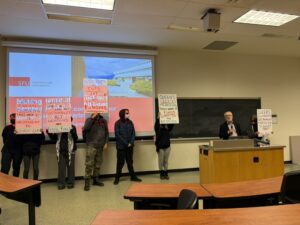
Protestors stand behind Deane as he offers opening remarks. PHOTO BY YAEL RUSONIK
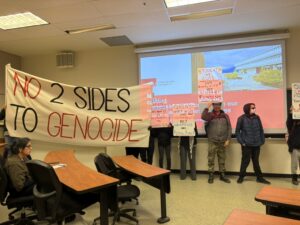
Two protestors hold up a sign reading ‘No 2 Sides to Genocide.’ PHOTO BY YAEL RUSONIK
Following Deane’s remarks, two protestors broke into another speech, accusing the administration of tolerating anti-Palestinian discrimination on campus. Again, they weren’t directly silenced, but during the speech, at 3:22 p.m., a single security officer arrived and whispered to one protester.
After the protestors finished speaking, Erfan was invited to the podium, starting her speech at 3:24 p.m., by acknowledging the protestors who stood beside her.
“I appreciate the conversation that’s clearly alive here, even though it’s very difficult to have,” Efran said. “And I would love for you also, to the degree that’s possible, to hear some of what I’m saying. It might be helpful in that way too.”

Erfan addresses the protestors behind her as she begins the talk. PHOTO BY YAEL RUSONIK
The protestors left at 3:28 p.m., as Erfan opened her slideshow and formally began the talk. The lecture was centered around how strategies for learning conflict are learned through early social environments, and shape how individuals react to conflicts later in life.
She also highlighted how emotional and neurological factors influence conflict responses, often leading people to react defensively, rather than slowing down and prioritizing productive dialogue and genuine listening.
Erfan ultimately suggested that the University should work to make its students more uncertain of their own perspectives, and willing to consider the perspectives of others.
“Yes, teach them some stuff, but in order to be more curious, make sure your people are thinking for themselves, that they’re not outsourcing their thinking, including to the people on the syllabus” she said. “And make sure there’s some space for trying to persuade each other to have some conversation about what really matters to us.”
In a brief question period that followed the talk, one audience member referenced the security guard that had entered and asked whether the protestors might have felt harassed or unsafe as a result, and how that might affect perceptions and assumptions in conflict.
Erfan acknowledged that the security guard may have made the protestors feel unsafe, but argued that he did a great job, and didn’t intervene without needing to.
“I think if we jump to say we shouldn’t bring this talk together, because we might have protesters, and it might feel unsafe for various people, then we’ll never talk, and that hurts the world,” Erfan said.
The talk concluded at 5:00 p.m.
Corrections
In a previous version of this story, The Journal incorrectly identified Aftab Erfan, executive director of Simon Fraser University’s Centre for Dialogue, as an associate member of the Queen’s School of Public Policy. They aren’t affiliated with Queen’s in this capacity.
Incorrect information appeared in the March 13 issue of The Queen’s Journal.
The Journal regrets the error
Tags
All final editorial decisions are made by the Editor(s) in Chief and/or the Managing Editor. Authors should not be contacted, targeted, or harassed under any circumstances. If you have any grievances with this article, please direct your comments to eic@queensjournal.ca.
Anon
This article is really entertaining if you imagine it as a dark comedy. 10/10, laugh a minute. Everybody played their parts admirably. Thank you to the protesters, and keep up the great work!
LOL
Is this an Onion article?