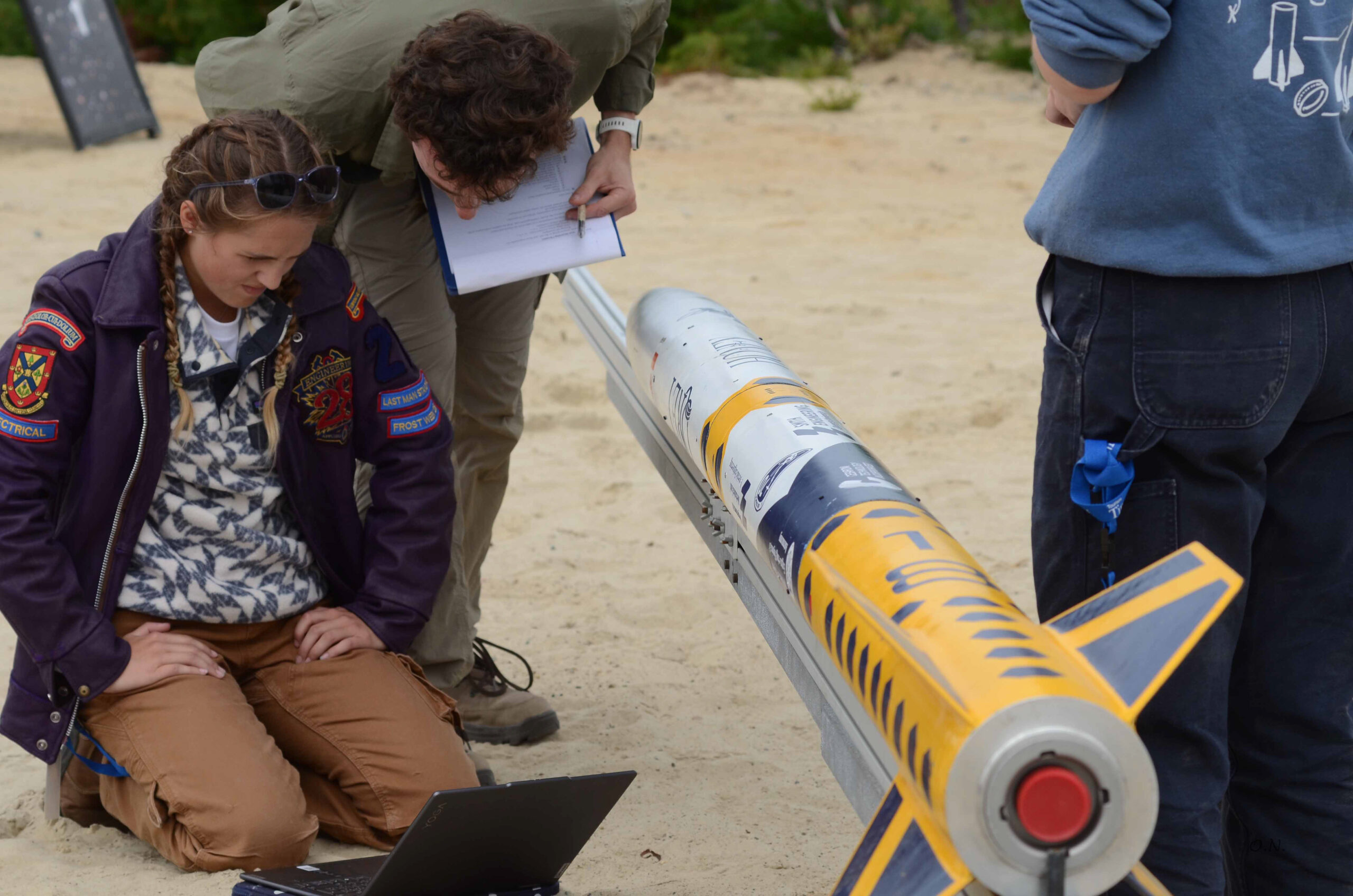
The Queen’s Rocket Engineering Team (QRET) blasted past the competition at Launch Canada 2025.
For the third year in a row, QRET has claimed a spot on the podium at Launch Canada, the country’s largest annual student rocketry competition, held from Aug. 16 to 22 in Timmins, Ontario. The students constructed a high-powered rocket that reached an altitude of 15 thousand feet and a speed of Mach 0.9, almost the speed of sound.
As one of the Engineering Society’s eighteen design teams, QRET focuses on giving students hands-on experience in space and aerospace industries. QSET boasts ten different subteams, including the rocket school—a team dedicated to teaching interested students the basics of rocketry, and launching low-powered rockets. 50 per cent of QRET’s annual $38,000 budget is covered by alumni donations, with the remainder coming from the Dean’s budget.
This year, the teams took second place in both the Basic Rocket Category, which tests complete rocket launches, and the Technology Development Challenge, which evaluates individual rocket components.
The most recent rocket, which the team had worked on for the entire 2024-2025 school year, was the first that QRET had ever flown twice. It first flew in June at the Spaceport America Cup, a Texas -based intercollegiate rocket engineering competition that the team has been competing in since 2015. Then, two months later, it took its second flight at Launch Canada.
Unlike previous rockets, which were often lost in the desert, this one had already proven itself, giving the team confidence and experience that contributed to its success at the national competition, according to Emma Fraser, QRET vice-president.
“Historically, we’ve lost a lot of rockets to the desert, either parts or full rockets,” Fraser said in an interview with The Journal. “Then it’s a whole endeavour of what do we do now for Launch Canada? So, we’re very lucky that this rocket had actually flown before, and we knew it worked.”
Fraser also spoke to the factors behind the team’s success, including how they built every component of the rocket from scratch, except for the motor.
“We design all of our electronics,” Fraser said. “We log flight data and make sure we can actually retrieve the rocket successfully. We eject our parachutes and make sure those deploy. We build our own GPS, which is more accurate than the GPS you buy off the market, which is pretty impressive.”
The past year wasn’t without challenges, as the team faced last-minute issues with its parachute system. “Every parachute has a main charge and a backup charge, and they’re on separate altimeters,” they said. “If one is broken, you have another one somewhat later that fires another charge, but ours was super delayed. The judges said it was way too much time, so we had to take the whole rocket just to change one line of code to fix that.”
In the Technology Development Challenge, QRET demonstrated its motor-focused skills by testing a rocket motor as an isolated component. The team conducted a “hot fire” test, collecting data to refine the motor for this year’s rocket, and the judges praised the results.
This coming year, QRET plans to build its own student-designed hybrid rocket motor. In turn, the team will be launching two rockets: a solid-propellant and a hybrid. Fraser encourages any interested first-years or upper years to consider joining the team.
“It’s a great place to learn and grow skills for anyone in any faculty,” Fraser said. “We have a lot of fun on the team. We do cool stuff, and we’re cool people, and we really want to make it an environment for everyone.”
Tags
All final editorial decisions are made by the Editor(s) in Chief and/or the Managing Editor. Authors should not be contacted, targeted, or harassed under any circumstances. If you have any grievances with this article, please direct your comments to eic@queensjournal.ca.