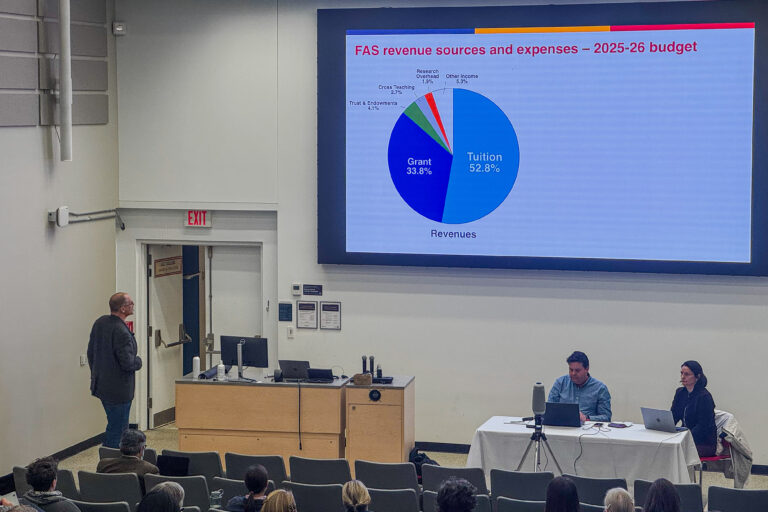
While Interim Dean Bob Lemieux spoke to the long-term financial plan for the Faculty of Arts and Science (FAS), some faculty members remain unconvinced.
On Nov. 19, the FAS held a townhall in Humphrey Auditorium, starting at 2:30 p.m., and lasting for about two hours. Roughly 70 faculty members were in attendance in person, along with another 190 online over Zoom, to hear from Lemieux about how the faculty is planning to mitigate its $35 million deficit.
A petition was circulated throughout the meeting requesting the provincial government to invest in post-secondary education by boosting the base funds of universities by 11.75 per cent annually for the next five years.
Report
The meeting began with a 45-minute presentation from Lemieux, where he started by explaining how the financial pressures Queen’s is facing, such as the $26.4 million operating budget deficit in 2025-26, are due to universities being “chronically underfunded” as a whole, along with provincial policies such as the freeze on tuition fee increases.
Lemieux then went into the details of the FAS 2025-26 budget. He explained that 52.8 per cent of FAS revenue will come from tuition, 33.8 per cent from grants, and the remaining will come from Trusts and Endowments, Cross Teaching, and other minor sources.
As for expenses, these were dominated by personnel costs with 68 per cent of expenses going to faculty salaries, 12.2 per cent for staff, 10.4 per cent for Teaching Assistants and Teaching Fellows, and 8.8 per cent for non-salary expenses.
Moving onto projections, Lemieux said that the deficit is set to remain largely the same since previous updates, adding it’s set to rise from $35 million in 2025-26 to $39 million in 2028-29. He added that despite cost-cutting measures, the efforts are mainly just accounting for the rate of inflation.
“Now, what I will tell you is that we can’t do any more cost containment. Any further cuts will make our ability to deliver our programs [difficult]. It’s already going to be hard to deliver our programs,” Lemieux said.
Lemieux also spoke to multiple efforts they’re taking to address the issue.
One issue Lemieux focused on was international enrolment. Lemieux explained that—especially in Asia—the price no longer matches the University’s global ranking to many prospective students. He added that Queen’s degree price is comparable to schools like the University of Toronto, but because of Queen’s low international ranking, the high prices are no longer sustainable. Queen’s currently sits at 191st in the 2025 QS World University Rankings. To address this, he explained they’re lowering the cost of international student tuition by $10,000 in an effort to attract more students.
He also spoke on growing non-credit programming as a long-term revenue stream. The plan is to scale up the Industrial Relations Centre’s courses by moving some of them online and hybrid to reach national and international markets and generate more revenue.
Question Period
Following the presentation from Lemieux was a Question Period. Queen’s Professor of Classics and Philosophy Daryn Lehoux kicked off question period with concerns about changing Queen’s into a school-based administrative model. At Canadian universities, school-based structures group multiple departments under a single “school” with a shared budget and leadership. Lehoux emphasized that school-based models often lead to reduced departmental autonomy and weaken shared governance.
In response, Lemieux said that changing Queen’s to a school-based model was only an idea, and he’s looking for feedback from staff.
“I’m not saying that a school model is the way to go. It’s one option, perhaps of many different options,” Lemieux said.
Several faculty members questioned whether the University’s truly doing enough to protect academic quality and institutional values amid fiscal pressures. History Professor Emily Hill raised concerns about increased class sizes and higher academic struggles from international students. Questioning what the admissions process is for international students and expressing frustration over the lack of support due to increased class sizes and a decrease in teaching assistants and faculty.
“It feels like I’m teaching two completely different audiences,” Hill continued, “support systems need to be put in place, we need to diversify.”
Lemieux agreed that there was a need for diversification, and Associate Dean (Academic) Dorit Naaman addressed Hill’s concerns over admission standards for international students. Naaman explained that the University receives average test scores in reading, writing, and speaking, but she did not say what the required average is. She then shared that lobbying is underway to advocate for a more centralized support system.
Similar to Hill’s concerns, Associate Professor Dan Cohen questioned how much work is being done behind the scenes to advocate for increased funding and support for ArtSci.
According to Lemieux, the University’s decreased funding is currently intended for planning purposes, and the drivers of funding allocations remain the same, such as enrollment numbers. He added that the current approach is “not ideal,” and that leadership would continue to advocate for improved budget modelling.
Sociology Professor Thomas Abrams pressed for greater financial transparency, saying that previous decisions, such as the Provost’s 2023 remarks on potential closures, had caused reputational damage to the University.
“Please start sending financial information in a format we can engage with,” Abrams said.
Despite the request for more transparency, Lemieux pushed back, stating that financial data is available, and that the University’s doing its best to be transparent under challenging conditions.
The divide between ArtSci and the Smith School of Business and Engineering was also discussed. Jordan Morelli, professor in the Department of Physics, Engineering Physics and Astronomy, got into a heated exchange with Lemieux, expressing discontent with how the University spends its money and with the fact that ArtSci is the only faculty that has to host town hall meetings on budget restraints.
“In engineering, they’re not having town halls. They don’t need to,” Morelli continued, “It’s only arts and science where we’re taking programs to the edge of collapse.”
Lemieux insisted that he, along with other staff, is advocating for more revenue and investment. Morelli suggested he make that advocacy more apparent to faculty.
The townhall wrapped up shortly after, with the next faculty meeting set for Nov. 21.
Tags
Faculty of Arts and Science, FAS, Interim Dean Bob Lemieux, Townhall
All final editorial decisions are made by the Editor(s) in Chief and/or the Managing Editor. Authors should not be contacted, targeted, or harassed under any circumstances. If you have any grievances with this article, please direct your comments to eic@queensjournal.ca.