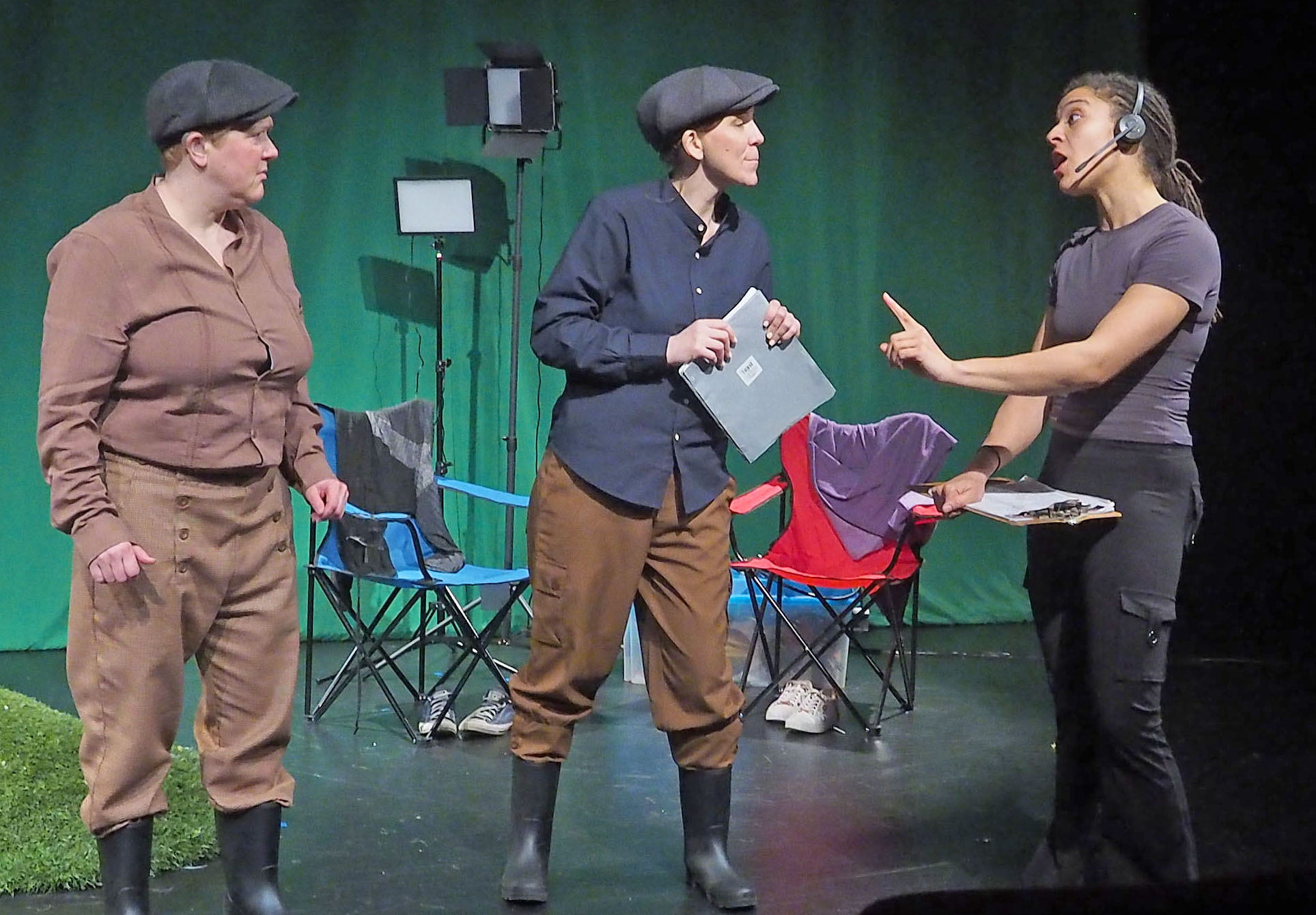
Theatre Kingston’s Hands in Her Pockets places deaf artists firmly at the centre of performance.
Written and directed by Rosemary Doyle and staged at the Kingston Grand Theatre’s Baby Grand Studio from March 12 to 21, Hands in Her Pockets functions both as an engaging theatrical work and a pointed commentary on representation within the performing arts industry.
The play centres on the friendship between two deaf film extras, Fiona and Janey, who meet while working on the set of a movie being filmed in Frontenac County. The pair bond over their shared experiences navigating an industry that often misunderstands deaf performers. Tensions escalate when Janey’s cousin Sean, who struggles with addiction, disrupts filming and is later found to have died from an overdose on set. Despite the emotional fallout, Fiona and Janey continue working under the constant pressure of an impatient and dismissive production manager.
Inspired by Marie Jones’ Stones in His Pockets, Doyle’s play reimagines the premise through a contemporary lens, following two deaf actors navigating the inequities of a film industry that frequently silences and misrepresents their experiences. Rather than directly adapting the earlier play, Doyle creates an entirely new narrative tailored specifically to performers Elizabeth Morris, who plays Janey, and Hayley Hudson, who plays Fiona, foregrounding their perspectives and lived realities. Lauren Lafayette Brooks portrays the production’s additional hearing roles, including Sean, a sharp-tongued production manager, and the fictional film’s lead actress.
The production thrives on the tension between visibility and erasure. Fiona and Janey are extras working alongside a hearing lead actor cast as a deaf character, an intentionally uncomfortable scenario exposing contradictions within casting practices and accessibility politics. The satire is sharp without becoming heavy-handed, allowing humour to coexist with critique.
Moments of miscommunication between hearing and non-hearing characters frequently draw laughter from the audience, yet the comedy is often tinged with discomfort, prompting reflection on who is permitted to tell certain stories.
What most distinguishes Hands in Her Pockets is its integration of American Sign Language (ASL) as a central storytelling medium rather than an added accessibility feature. While spoken English remains present, many of Fiona and Janey’s conversations unfold entirely in ASL, with subtitles projected onto a screen behind them so non-signing audience members can follow the narrative. This choice encourages audiences to engage visually with the performance, allowing meaning to emerge through gestures, movement, and facial expression as much as spoken word.
The intimate Baby Grand Studio performance space enhances this approach. Minimal set design keeps the focus squarely on the performers’ physical storytelling. A grassy mound, floodlight, bar table, and two folding chairs serve as the production’s only set pieces, while lighting cues signal shifts in time and location. The absence of set changes maintains narrative clarity while reinforcing the play’s stripped-down aesthetic.
Hands in Her Pockets succeeds by reframing accessibility as artistry. Rather than presenting deaf performance as niche or educational, the production asserts it’s just as theatrically rich and creatively essential as any other type of performance. The work is socially resonant and offers audiences not only a compelling new Canadian play, but also a reconsideration of whose voices get to be heard in the arts industry.
Tags
Hands in Her Pockets, Rosemary Doyle, Theatre, Theatre Kingston
All final editorial decisions are made by the Editor(s) in Chief and/or the Managing Editor. Authors should not be contacted, targeted, or harassed under any circumstances. If you have any grievances with this article, please direct your comments to eic@queensjournal.ca.