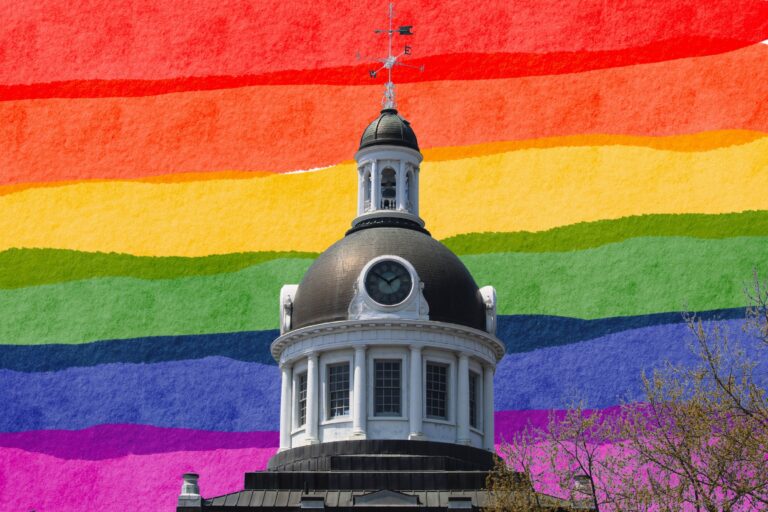
On June 13, people marched for the 37th annual Kingston Pride.
The march included drag performers in full get-up, Pride flags waving, and countless signs of support.
But Pride wasn’t always celebrated this way.
In the 1970s and 80s in Kingston, queerness was celebrated in a very different manner. Before the parades, there were clubs and coded social knowledge that formed an underground Queer community in a city where visibility carried risk.
The parades of today did not just happen. They were demanded by Queer advocates and allies until the space to openly celebrate queerness was created. It took effort. Lots of it. And many of those efforts faced rejection.
In 1984, the Queen’s Homophile Association requested from the city to proclaim a Gay and Lesbian Pride Day. Their request was denied without discussion.
After dismissal from city officials, these local advocates carved out space for themselves.
The streets that thousands parade through today were once strolled on by ten advocates and allies. While they couldn’t have a parade, there were no restrictions on a group ‘stroll.’
And so ‘stroll’ they did.
It was not until June 20, 1992, that Pride Day was proclaimed by Mayor Helen Cooper, who had rejected their original request.
Activism is the core way queer people resisted. They forced their way onto the public record when politicians neglected their requests so that now, people can celebrate Pride as they do today.
Historically, Kingston’s queer community faced hardships beyond solely a lack of recognition. The HIV/AIDS epidemic was among the most devastating.
Yet, as a community, the Kingston AIDS Project was founded. Their “Keep Six” Needle Exchange program became one of the first Needle and Syringe harm reduction programs in Ontario. These support services exist to this day as Trellis HIV & Community Care, showing the persistence solidarity can have.
Kingston’s queer community practiced togetherness by gathering in gay bars, like Robert’s Club Vogue and Red Emma’s, which is exemplary of the power that nightlife can have. Queerness was celebrated behind closed doors in safe spaces without recognition from the city or the university.
After the city’s proclamation of Pride Day, the turnout was immense. A crowd formed in support swelling from handfuls to hundreds.
Kingston Pride has only flourished since, with celebrations spanning from drag performances, to film screenings, and an annual Pride Parade. These are no longer the pipe dreams they once were, but they are celebrations that were fought for and earned.
The informal activism that took place early at Queen’s through the student-run Queen’s Homophile Association, Queen’s as an institution has embraced change and now offers structured programming through the Yellow House as well as other on-campus resources and groups.
In the early days, queerness on campus largely equated to queerness in the city. There wasn’t the degree of separation between the student and local communities that exist today.
Queer histories in the city and on campus are tightly entangled because advocation for queer rights was an issue that brought people together. Kingston’s communal queer spaces did not discriminate based off whether one was a Queen’s student or a Kingstonian. Instead, these spaces were shared and open.
Students, workers, drag-performers, and activists alike moved fluidly between Queen’s organizing spaces and downtown venues and bars.
Although there is often a stark divide between Kingstonians and students, it is important to recognize this city’s collective queer history, which cannot be reduced to either a university story or a municipal one.
The Queer community both on and off campus exists and persists today because of everyone is fighting for the same liberatory cause.
Students and locals alike continue this fight together to live in a world where queerness is accepted, making celebrations possible, turning strolls into parades.
Tags
How did we get here, Kingston Pride, Queen's Homophile Association, Queer history, Trellis
All final editorial decisions are made by the Editor(s) in Chief and/or the Managing Editor. Authors should not be contacted, targeted, or harassed under any circumstances. If you have any grievances with this article, please direct your comments to eic@queensjournal.ca.