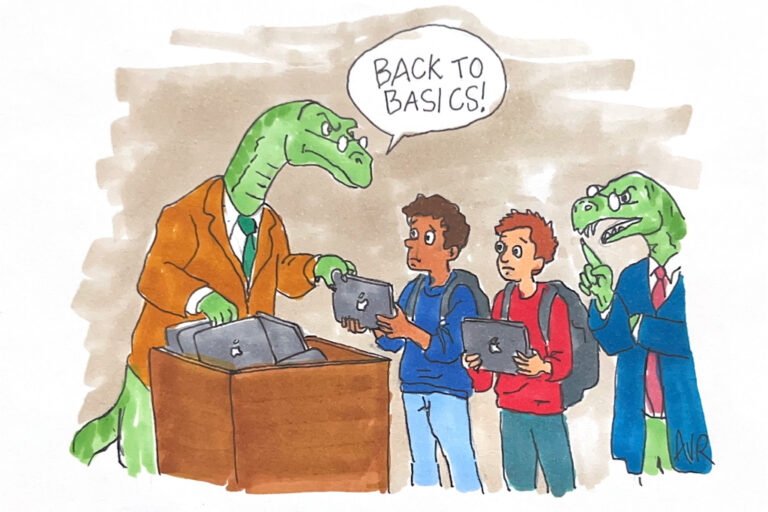
Banning laptops in classrooms creates far more issues than it claims to solve.
In August, the University of Toronto’s (U of T) law school administration sent an email to students outlining the faculty’s concern with the use of laptops in the classroom. Richard Stacey, the associate dean, cited the need for students to “critically engage” with the material, adding many classes will go “laptop-free” this year.
There is a degree of validity to this concern, and some tangential evidence that suggests students, on average, absorb information more efficiently when taking notes by hand. As university students, it’s not difficult to see that many are almost entirely reliant on laptops, and it certainly can be distracting.
However, the way to address this issue is not through a ban.
The clearest counterargument to a laptop ban pertains to students with academic accommodations. Many neurodivergent students rely on laptops to take notes in lecture, and removing laptops from lectures would actively make learning significantly more difficult for those who need it the most.
Sure, U of T could simply ask students with laptop-accommodations to move to the back of the class to avoid distracting others, but that could not only breed resentment among students but also visually ousts those with learning disabilities.
There’s also the question of context. Laptops — for better or worse — are nearly ubiquitous in lecture halls and classrooms. Almost all students rely on typed-out notes, and for many, if not most of us, it’s a critical component of our learning process.
It’s not an overstatement to say that our modern-day education is specifically catered around the laptop. Simply issuing a prohibition really feels misrepresentative of the lived experience of students in 2026.
Students should also have the choice in how they want to study — laptops, or not. We are grown adults; we certainly can think for ourselves. Most importantly, we know ourselves and what works best better than any school administration.
Hand-written notes are not inherently better for everyone and considering how much we pay to go to university, we should make the choice on how we absorb lecture material.
Furthermore, professors have clearly catered their lectures towards laptops. There is an immense amount of complicated information packed into very small time periods, and laptops are legitimately useful in writing down information as it comes through. It’s doubtful that a laptop ban would result in a reduction of materials presented in lectures, so banning laptops would simply put students at an unreasonable disadvantage.
That’s not even to suggest some limited and controlled environments couldn’t go laptop-free. Tutorials and seminars, where the primary emphasis is on dialogue, would be a great example of that. However, all the complexities of this discussion — including the concerns surrounding accommodations — are simply swept away.
Over 76 per cent of students at the U of T Students’ Law Society (SLS) said that the policy won’t “benefit” their education, with 54 per cent flatly saying it would be “ineffective”. We agree, and not only that, we also certainly don’t want this policy coming to Queen’s.
There are legitimate ways we can approach this issue, and the concerns are at least somewhat legitimate, but it should be up to students to choose.
— Journal Editorial Board
Tags
All final editorial decisions are made by the Editor(s) in Chief and/or the Managing Editor. Authors should not be contacted, targeted, or harassed under any circumstances. If you have any grievances with this article, please direct your comments to eic@queensjournal.ca.