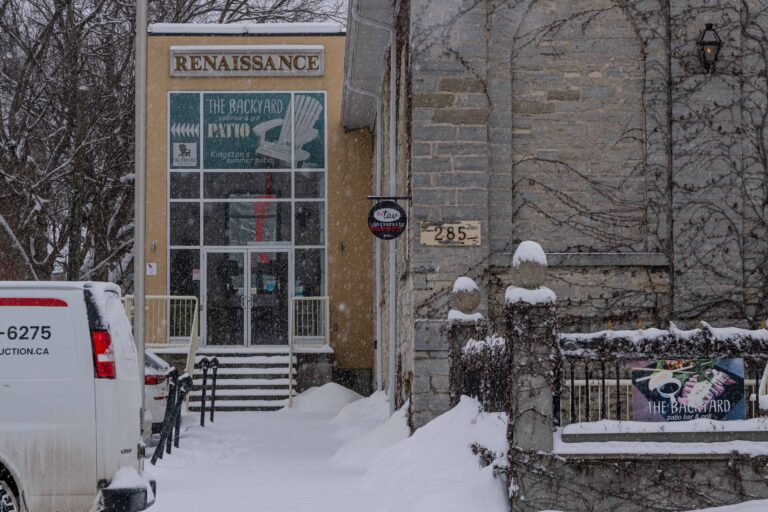
Kingston’s sole dedicated gay bar, Bottoms Up, has closed its doors after only six short months.
Since the early 1970s, Kingston has seen a number of gay bars come and go. Bottoms Up was the first dedicated gay bar in Kingston in nearly 20 years, with many establishments long preceding it. After six months, the bar has closed for good this pride month, on June 18.
Before closing, the bar hosted its first and final Pride After Party, marking a bittersweet end of an era that brought in over 100 guests. It was the venue’s busiest night since opening in January.
Paul Fortier, co-owner of Jessup Food & Heritage and founder of Bottoms Ups, told The Journal his bar, Bottoms Up, has gone “bottoms down.”
The bar hosted a Kingston Economic Business Mixer on June 18 as its final official event.
For Fortier and his partner, the venture was inspired by a mission to create a dedicated 2SLGBTQ+ space in Kingston after witnessing the city’s queer nightlife scene dissipate over the years.
“As we have grown older, we were saddened by the fact that there had been no dedicated ‘gay’ establishment in Kingston for the last 20 years; particularly when many clamoured for one,” Fortier said in an interview with The Journal.
Motivated by nostalgia and a sense of community, they made the decision to rebrand their under-utilized venue, the University Tavern, into a dedicated gay bar this January.
The University Tavern, located on the lower level of the Renaissance building, served the city well as a popular hub for university students. After the failure of Bottoms Up, Fortier noted the venue will be reverting back to the well-known University Tavern, remaining part of Kingston’s nightlife scene.
As Bottoms Up’s journey comes to an end, The Journal took the time to reflect on the elusive history of queer nightlife in Kingston.
The secretive era of “gay-tolerant” spaces
The rapid rise and fall of Bottoms Up follows a long history of queer spaces in Kingston.
Before the concept of dedicated, openly gay bars existed in Kingston, the city’s 2SLGBTQIA+ community built social networks within mainstream establishments. From the 1950s through the 1970s, local patrons subtly negotiated space in “straight” drinking establishments.
These early environments were shaped by a delicate balance: venues needed to be recognizable enough for queer people to find each other, while remaining low-profile enough to blend into the crowd.
Historically, Kingston served as a geographic anchor.
“Kingston, since the 70s and into 2010 had a reputation of meeting in the middle,” Fortier told The Journal.
“For those in the LGBTQ community who wanted to socialize and not travel to Ottawa, Montreal or Syracuse, Kingston was a viable option and drew from the regional community,” he stated.
During the 1950s and 1960s, the list of “gay-tolerant” bars in Kingston included local establishments such as the Elbow Room, the Cat’s Meow, the Indian Room, the Wagon Wheel, The Grand, Chez Piggy, and the Black Sheep Inn.
One of the most popular hubs for gay men during the 1960s and 1970s was the Cat’s Meow, situated off the lobby of the LaSalle Hotel on Princess Street. It was designed as a long, narrow room with entrances at both ends, allowing customers to casually enter from Princess Street, scan the room, and leave through the back lobby. The bar sat approximately 18 people.
Campus catalysts and the first dedicated 2SLGBTQIA+ spaces
A critical turning point toward public visibility occurred on October 2, 1973, when a letter signed by “Three Campus Homophiles” was published in The Queen’s Journal.
The letter was written in response to a piece titled “Fred Fudpucker” that had run in the engineering student paper, Golden Words. The student authors pointed out Queen’s is one of the few universities left in North America which still does not have its own homophile association.
By late October of 1973, the Queen’s Homophile Association (QHA) was officially born, and by 1977, the QHA was successfully organizing licensed dances in the basement of the Queen’s Law School.
These events regularly drew crowds of upwards of 150 people, at least half of whom were women, and many others who travelled from the broader Kingston community and surrounding rural towns.
This growing desire for open socialization paved the way for Kingston’s first dedicated gay bar. In the early 1980s, The Office opened its doors on the corner of Montreal Street and Queen Street. It operated in the upstairs section of 46 Montreal Street – the building that housed the Plaza.
The Office represented a shift from the secretive spaces of earlier eras, allowing local patrons to socialize openly. Over the next 15 years, the building at 46 Montreal St became a revolving home for various queer spaces, culminating in Dreammakers, a dedicated lesbian bar that operated until 1997.
Following the initial success of The Office, the 1990s brought an expanded commercial queer nightlife scene to Kingston.
“Robert’s Club Vogue then 477 was a popular bar and club in the 90s,” Fortier recalled. “Then came Wally’s in the west end and later Shay Foo Foo on Princess Street downstairs from the former Don Cherry’s.”
Yet, beneath the busy weekend crowds lay a challenging financial reality.
“While they were well attended on Fridays and Saturdays, they all struggled financially,” Fortier explained. “It is difficult to survive with one or two busy nights a week, and those nights would last for 3 or 4 hours of strong business.”
By 2009, Shay Foo Foo closed its doors for good. The well-known gay bar disappeared from Kingston’s nightlife scene, leaving a multi-decade gap.
In its absence, the community turned to pop-up events. As Fortier noted, there was Beers for Queers over the last ten years, hosted by Monte’s at Tir Nan Og on most Saturday nights. “While the kick off was strong with great DJs and lots of dancing, this too faded in popularity and proved to be not viable,” Fortier said.
How technology and mainstream integration changed nightlife habits
The decline of dedicated queer bars in Kingston is not unique to the city; it mirrors a broader cultural shift influenced by technology and changing social norms.
“With the introduction of Grindr in 2009, the gay male community separated, finding that social media provided a more effective and discreet way to connect with like-minded individuals,” Fortier observed.
“Clearly the rise of dating apps and increased mainstream acceptance of our lifestyle has had an impact and there is no longer that need for a community meeting place,” Fortier said.
For previous generations, gay bars were an essential community hub. They served as the primary physical space where individuals could feel safe expressing interest in someone of the same sex. Apps effectively distributed that role into the digital world.
At the same time, a broader socio-cultural shift toward mainstream acceptance began altering nightlife habits. There was “a greater acceptance and integration of members of the LGBTQ community into mainstream bars and clubs,” Fortier explained. “I remember earlier days when two men dancing together in a club would lead to their eviction. These days have passed.”
Reports cite this intersection of digital dating, soaring commercial real estate costs, and inflation has made running a niche identity-based venue an incredibly risky business venture across Canada. When community members can connect from home and socialize comfortably in general establishments, the economic incentive to sustain a dedicated gay bar decreases.
“Today, I know that there are many members of the LGBTQ community in Kingston that wish to live a very discreet life and would never be seen out in public at any gay affiliated event or establishment despite their orientation,” Fortier said.
“Still, members of the LGBTQ community call for a dedicated bar.”
The final curtain for Bottoms Up
It was against this complex historical background that Paul Fortier and his partner, Denis Leblanc, attempted to bring back a dedicated space for the community.
Fortier trusted his decades of experience operating different venues around Kingston, mentioning to The Journal that Jessup Food & Heritage has been operating restaurants in Kingston since 1994.”
“We were first to hold pride events, drag shows and fly the pride flag on our establishments. While we never hosted a ‘gay’ bar per se, our venues were widely frequented by members of the LGBTQ+ community as it evolved over the years.”
The decision to rebrand their venue stemmed directly from watching the city’s nightlife options shrink. But upon opening, Fortier and his partner “realized it was a long reach to success.”
“Twenty years without a gay bar is telling,” he said.
As the initial excitement of opening Bottoms Up gradually slowed down, Fortier and his partner ran into the same financial walls that faced venues decades prior.
“Since opening attendance has dwindled to a hand-full of customers who come and go on the Saturday night which is the only night open,” Fortier explained. “With few customers, we covered the costs of staff, DJ, go-go [dancer], overhead and product. It was unsustainable.”
The venture was also met with varied community feedback, highlighting different ideological perspectives within Kingston’s modern 2SLGBTQ+ community.
“Bottoms Up was met with a variety of reviews,” Fortier said. “The typical my porridge is too hot, and my porridge is too cold and the anticipated nastiness of segmented radical elements in our community that are against anything that smells of commercialism.”
The era of Bottoms Up came to a close on June 18, following a well-attended event that served as a closing celebration. “While our recent Pride After Party saw more than 100 guests, we realized that this would be a bang-up ending for our failed attempt,” Fortier said.
Despite the struggles and ultimate closure, Fortier maintained a positive outlook, emphasizing “nothing ventured; nothing gained!”
Upon reflection, Fortier hopes the experience of Bottoms Up is “telling to those who advocated for opening a local gay bar and a warning to those who may consider it in the future.”
With the space now set to be used “for other purposes,” Kingston is once again without a dedicated gay bar.
Tags
Bottoms Up, clubbing, gay bar, Night life
All final editorial decisions are made by the Editor(s) in Chief and/or the Managing Editor. Authors should not be contacted, targeted, or harassed under any circumstances. If you have any grievances with this article, please direct your comments to eic@queensjournal.ca.