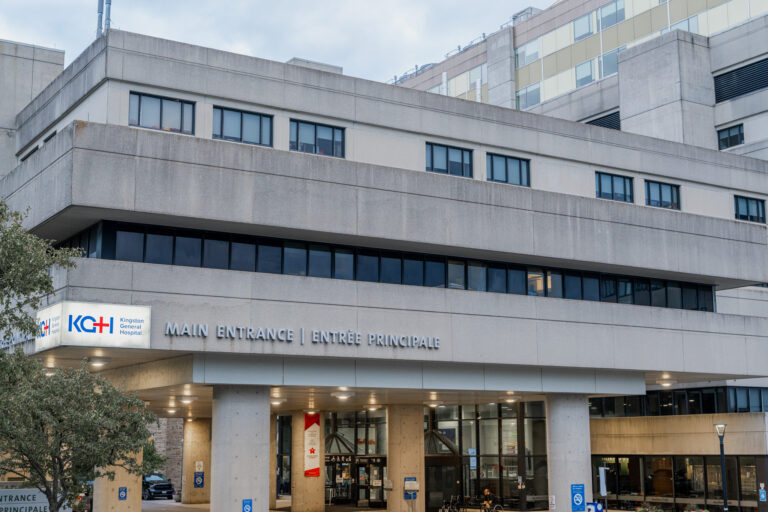
For years, many people with unexplained bleeding disorders have faced long, frustrating journeys to diagnosis, sometimes for decades. Now, a new genomic testing study at Kingston Health Sciences Centre (KHSC) aims to close the diagnostic gap and deliver answers faster for patients who otherwise might never receive a clear diagnosis.
Inherited bleeding disorders, conditions where blood doesn’t clot normally, can be difficult to diagnose. Standard laboratory testing detects abnormalities in roughly 30 to 40 per cent of cases, leaving a large portion of individuals without clear answers despite debilitating symptoms.
Heavy menstrual bleeding, unexpected surgical bleeding, frequent bruising, fatigue, and iron deficiency can all be signs—but often go unrecognized or misunderstood.
In an interview with The Journal, Dr. Paula James, a professor in the department of medicine at Queen’s and the clinician-scientist leading the study, highlighted the challenges in diagnosing bleeding disorders.
“When a patient is referred to my clinic with a bleeding disorder, I can only get to a diagnosis with the existing standard tests about half the time, and that’s pretty consistent globally.”
James suggested that the diagnostic rate may be even lower. “It’s quite common to end up—and some studies even show that it’s more than half of the time that you don’t get a clear diagnosis. It may be up to 70 per cent.”
The pilot study led by James uses whole-genome sequencing to examine hundreds of genes linked to clotting and platelet function. Early findings suggest genomic testing can identify clinically relevant results in 20–30 per cent more patients than standard diagnostic methods to offer diagnoses that would otherwise remain elusive.
Genomic sequencing also has the potential to reveal inherited patterns and risk factors that might influence both diagnosis and treatment. For many families, understanding the genetic basis of a disorder can reshape long-term health planning and connect relatives who may also be affected.
“There may be other people in the family who have unexplained bleeding, so making a diagnosis in one person has really positive trickle-down effects because then maybe we’ve actually sorted things out for other affected family members,” James added.
Clinically, genomic information allows for more targeted treatment. “We have treatments and things that we can do, from a general point of view, to treat or prevent bleeding,” James explained.
“But if we get to a specific diagnosis—let’s say there’s a specific clotting factor that’s missing—I could provide a concentrate of that specific clotting factor to treat or prevent bleeding rather than using something more general. So, it allows us to be more targeted and more specific with our approach.”
According to James, the research highlights not only inherited disorders, but also long-standing gaps in the diagnoses for women.
“A very clear reason is a lack of attention by the healthcare system and by science in general to women’s health,” James said.
Historically, even basic benchmarks have been poorly defined.
“When you talk to medical students or physicians, historically, there’s been a lack of understanding of a basic thing like what’s a normal menstrual period and when does bleeding become too heavy. It’s only recently that we’ve actually started to study and define those kinds of things,” James added.
Still, there’s a shift in momentum. “Those things are really shifting, though, and it’s actually quite an exciting time to be involved in a study like this,” James noted.
Despite the promise of genomic testing, cost remains a major barrier. Genomic testing isn’t currently funded through our provincial health plan, but James’ team is currently collecting evidence through their randomized controlled trial to help change that.
“What we’re hoping to do with this study is to provide evidence to advocate at an Ontario level for it to become standard of care and for it to be funded, and I actually think we are probably a year or two away from that. So, I think we’re getting close,” James said.
Although the team is currently analysing a defined panel of genes known to be associated with bleeding disorders, they have access to participants’ full genomic data. “We could start to discover genes that we maybe haven’t thought of before that might be relevant,” James added.
The goal extends beyond Kingston and even beyond Ontario.
“If we can set a precedent in Ontario that this funding would be provincially funded and available, I do think it would be adopted across the country,” James noted. “And hopefully globally too.”
For patients long left without answers, that shift could mark the difference between uncertainty and clarity—and between generalized care and precision treatment.
Tags
Academic research, Clinical Trial, genomics, KHSC
All final editorial decisions are made by the Editor(s) in Chief and/or the Managing Editor. Authors should not be contacted, targeted, or harassed under any circumstances. If you have any grievances with this article, please direct your comments to eic@queensjournal.ca.