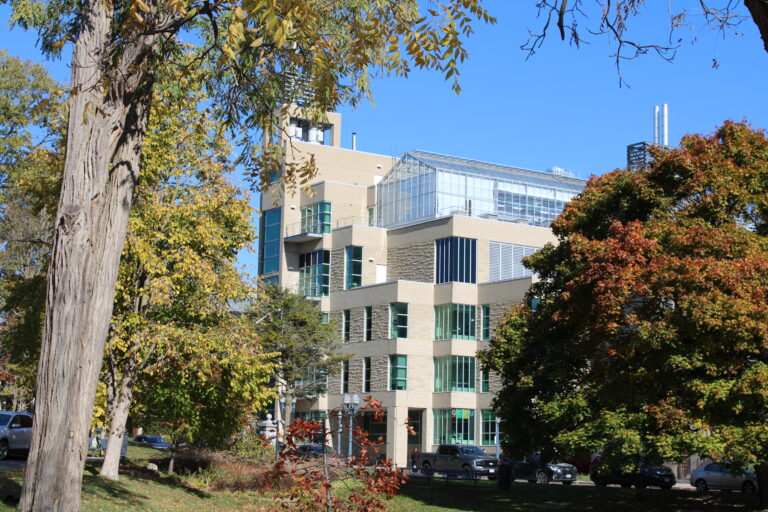
A $690 million nationwide funding initiative announced on Oct. 22 is allowing the University to strengthen its research capacity across various disciplines.
Queen’s has welcomed three renewed and five newly appointed Canada Research Chair (CRC) chairholders, Dr. Kristine Spekkens (Physics, Engineering Physics, Astronomy), Dr. Amy Latimer-Cheung (Kinesiology and Health Studies), Dr. Sari van Anders (Psychology), Dr. Kristin Moriah (English Literature and Creative Writing), and Dr. Emily Oby (Biomedical and Molecular Sciences).
The federally funded CRC program is designed to support world-leading researchers across Canada, providing long-term funding to advance ambitious projects while attracting and retaining top research talent at Canadian universities.
Within the CRC program, Tier 1 researchers, defined as “acknowledged by their peers as world leaders in their fields,” receive $200,000 annually for seven years, while Tier 2 chairholders, being researchers with “the potential to lead in their field”, receive $100,000 per year for five years.
According to the official CRC press release, of this total amount, over $482 million will be distributed through the Research Support Fund (RSF), which supports the indirect, behind-the-scenes costs of research–facilities, research services, and regulatory requirements support. For the 2025-26 academic year, Queen’s has secured approximately $10.8 million through the RSF.
At Queen’s, this year’s cohort includes a majority of female researchers from wide-ranging fields, from astrophysics and disability studies to Black feminist arts and neural rehabilitation.
***
Among the newly appointed chairholders are Spekkens and Latimer-Cheung, recognized for their work in gas-rich galaxy structures and quality physical activity promotion and disability, respectively.
In an interview with The Journal, Spekkens explained mapping atomic gas and its significance to understanding galaxy evolution.
“Stars form out of gas. A galaxy like our own Milky Way looks the way it does because of the availability of gas and the way it’s been able to form stars over cosmic time. The connection between galaxies and their dark matter halos is really well probed by gas distributions.”
Spekkens noted that gas distributions extend deep into dark matter halos—massive, invisible structures that envelop galaxies, making them powerful cosmic tracers. “My research uses the gas distributions in galaxies to try to understand how galaxies evolve and the connection to dark matter.”
The Tier 1 CRC appointment allows Spekkens to cultivate a research environment at Queen’s that supports early-career researchers while leveraging Canada’s access to cutting-edge telescopic and computing technology.
“The real opportunity provided by the CRC’s the opportunity to bring in some fantastic researchers and to help mentor some fantastic students,” Spekkens continued. “It [CRC] provides… a research environment here at Queen’s that’s really sort of second to none in the world.”
***
As Spekkens’ research looks up to the stars, Latimer-Cheung’s research stays grounded in kinesiology and equitable access to quality physical activity for people with disabilities.
Estimating that about 27 per cent of Canadian adults have a disability, Latimer-Cheung highlights that many face both limited opportunities and unsatisfying experiences.
“Quantity’s about access, but quality participation is when somebody is finding it satisfying and enjoyable and experiencing outcomes that are important to them,” Latimer-Cheung said in an interview with The Journal.
Latimer-Cheung previously held the position of a Tier 2 chairholder. The upgrade to Tier 1 has come at a “perfect” time for her team as it aligns with the launch of the Canadian Disability Participation Project supported by the Social Sciences and Humanities Research Council, which expands her research to sport, exercise, active play and a wider range of disabilities.
The increasingly growing appointment of globally recognized female researchers as CRC chairholders reflects a greater involvement of underrepresented groups in the sciences.
In just the last ten years, the gap in the representation of women within the CRC program has grown from 31 per cent to almost 51 per cent, according to CRC program representation statistics.
Latimer-Cheung said, “I never really thought about the impact of being a woman in science. I had incredible female mentors who broke down barriers for me. Now, this award means I can be more present in everything I do–pursue research excellence in a way that’s healthier and promotes my well-being.”
“Within STEM, physics is one of the fields where women and other minorities are most strongly under-represented,” Spekkens added. “The sky is for everyone–science is for everyone.”
Tags
Academic research, federal funding, STEM, Women in Science at Queen’s
All final editorial decisions are made by the Editor(s) in Chief and/or the Managing Editor. Authors should not be contacted, targeted, or harassed under any circumstances. If you have any grievances with this article, please direct your comments to eic@queensjournal.ca.