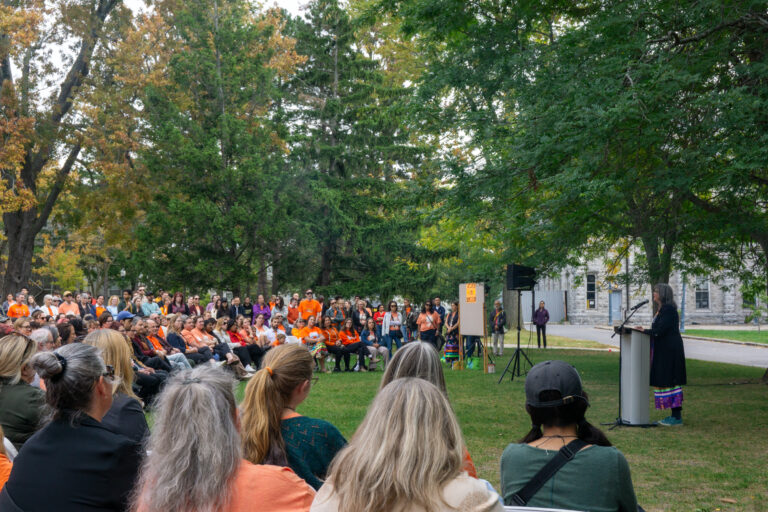
A Sacred Fire burned at the Agnes Benidickson Field on Sept. 30 at 1 p.m., as the Queen’s community gathered to mark National Day for Truth and Reconciliation (NDTR).
Approximately 300 students, Queen’s varsity sport teams, faculty, and staff stood before the Sacred Fire, many in orange shirts, to commemorate residential school survivors and honour the Indigenous children who could never return home.
This year’s firekeeper was Sebastian De Line, a teaching fellow of Haudenosaunee, Métis, and Cantonese descent in the Department of Languages, Literatures and Cultures. De Line tended to the flames throughout the ceremony and was responsible for placing tobacco offerings into the fire.
Throughout the ceremony, speakers representing different Queen’s communities shared their personal and institutional reflections on reconciliation.
“What are we going to do now that we know the truth?” Shelagh Rogers, 16th chancellor of Queen’s University, said in her speech. “How are we going to work together to make things better?”
Rogers spoke about the importance of recognizing the experiences of residential school survivors and remembering the lasting harms of the residential school system.
“It is not enough for us to raise flags, hold commemorations, and then carry on,” Principal Patrick Deane said in his remarks.
Deane focused on the word “for” in the NDTR, explaining that the day should not be viewed as a single moment of reflection, but as part of an ongoing process toward reconciliation.
He said universities have a responsibility to understand the role of education in reconciliation, as residential schools used education to suppress Indigenous cultures.
AMS President Dreyden George, the first Indigenous AMS president at Queen’s, focused his remarks on Indigenous students and their role in creating change on campus.
READ MORE: Meet Dreyden George, the first Indigenous AMS president
George said Indigenous students have taken on leadership roles to push for progress toward Indigenizing campus spaces and advocate for accessible support services for Indigenous students.
“The community that collectively contributes to our advancement is what ultimately reigns most important,” George said.
Vice-Provost (Student Affairs) Corinna Fitzgerald said Indigenous students “should not carry the responsibility” of teaching others about their cultures and experiences. She encouraged members of the Queen’s community to take responsibility for their own learning and support a more inclusive campus.
Associate Vice-Principal (Indigenous Initiatives) Lisa Maracle closed the speeches by discussing the emotional weight NDTR can carry for Indigenous Peoples.
In an interview with The Journal, Rose Espien, MD ’30, an Indigenous student from Gitxsan Nation, said the Sacred Fire is a starting point for people who want to learn more.
“It is a foot in the door kind of thing,” Espien said.
She said NDTR is about reflecting, learning, and enacting change toward equity, while recognizing past and ongoing trauma in Indigenous communities.
“An apology is following through on actions,” Espien said. “And that is the truth of reconciliation.”
In an interview with The Journal, Lauren Harhay, Kin ’28, said she found it inspiring to see Indigenous voices represented throughout the ceremony, particularly George’s.
“One of the biggest things that stuck with was that the AMS president is actually Indigenous,” she said. Harhay said George’s speech showed how reconciliation at Queen’s can go beyond recognizing past harms by giving Indigenous students a stronger voice on campus.
Elijah Ward, a Kingston community member from Saddle Lake Cree Nation who attended the ceremony, said attending a Sacred Fire is an opportunity to give thanks to those who came before him.
“It reminds me to remember them and keep on their fight for generations beyond us,” Ward said. He said he offers tobacco and a prayer for himself and his loved ones whenever he attends a Sacred Fire.
Ward described this year’s ceremony and its speakers as positive steps toward reconciliation, but said the University has a responsibility to continue that work.
“Reconciliation is a bridge, and both of us need to cross it,” he said.
— With files from Emmet Paradis
Tags
National Day for Truth and Reconciliation, Orange Shirt, Sacred Fire
All final editorial decisions are made by the Editor(s) in Chief and/or the Managing Editor. Authors should not be contacted, targeted, or harassed under any circumstances. If you have any grievances with this article, please direct your comments to eic@queensjournal.ca.