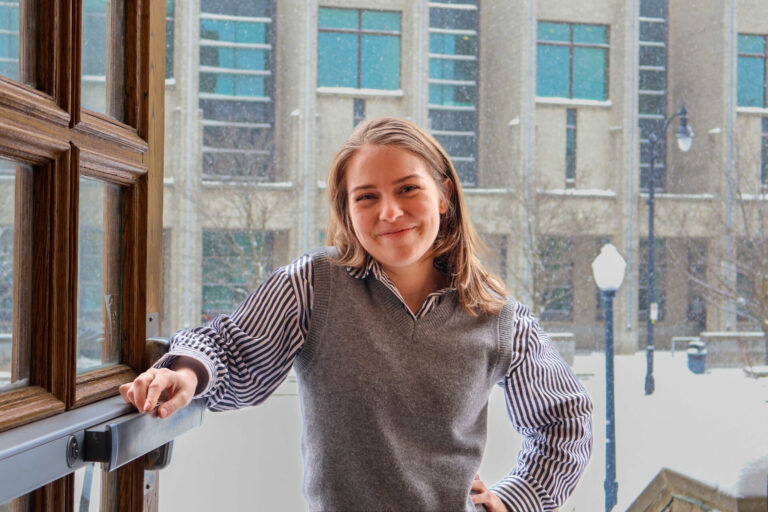
I think a lot about the past Rectors. How their elections played out, the issues that defined their term, what they said in their convocation address, how they approached committee work, and how their time in office shaped who they became.
I especially find myself thinking about the women who’ve held this role. The list of Rectors is long. The list of women isn’t: I’m the seventh in over a century.
The job is complex and demanding, and I cringe acknowledging that the women before me faced additional challenges simply because of their gender. I’m grateful to serve at a time when those barriers feel more subdued, if not entirely gone.
Looking across the list of Rectors since 1913, women tend to appear in clusters, serving back-to-back terms before long gaps return. I’ve had the pleasure of being in contact with some of them: Alex da Silva’s tenure occurred during my first year at Queen’s, and Kelley McKinnon serves on the Rector’s Advisory Committee. From time to time, I hear from others as well over e-mail or LinkedIn.
In 1986, Kelley McKinnon broke the glass ceiling. Her term also coincided with that of Queen’s first female Chancellor, Agnes Benidickson. There’s a great photo of the two of them on stage in Grant Hall at convocation. It would be another 36 years before two women would hold these roles at the same time again—Chancellor Rogers and myself.
Left: 1989 Convocation / Right: 2024 Convocation—same chairs, new robes!
Antoinette Mongilo, the third woman elected in 1990, wrote to me recently. She described how the experience instilled courage: “I found myself thinking, if Queen’s believed in me, then perhaps I was capable of more than I had imagined. Coming from a blue-collar, working-class immigrant family, these experiences were especially impactful. They gave me confidence navigating professional environments and reinforced the importance of relationship-building—skills that have proven invaluable in both my professional and personal life.”
Seven men would precede Antionette before Johsa Manzanilla in 2006. Writing to me while awaiting the arrival of her third baby, Johsa detailed that the “typical” rector had long been some combination of male, graduate student, and white. “While I reveled in being able to disprove their prejudice by simply existing, and doing my best to serve my fellow students, it was definitely not easy having to constantly deal with microaggressions questioning why I was, and how did I get to be, here.”
Occasionally, I come across an old speech in my office or a news article online from one of the women who’ve come before me. Leora Jackson wrote in 2010 about the tenacious realities of tuition fees, capital projects, and affordability in publicly funded universities. Alex da Silva supported QBACC during their first successful divestment campaign in 2019. It’s striking how the same campus issues come back around (or never leave) and how I can look back at strong examples of leadership and governance to help guide me.
It wasn’t until the 1960s that women could freely walk into the JDUC, where my office resides, so it’s no wonder it took decades to see a cultural shift in who was being elected. Now, our student population identifies over 50 per cent female, and that’s becoming visible in rooms where decisions are made.
Tags
International Women's Day, Rector's Digest
All final editorial decisions are made by the Editor(s) in Chief and/or the Managing Editor. Authors should not be contacted, targeted, or harassed under any circumstances. If you have any grievances with this article, please direct your comments to eic@queensjournal.ca.