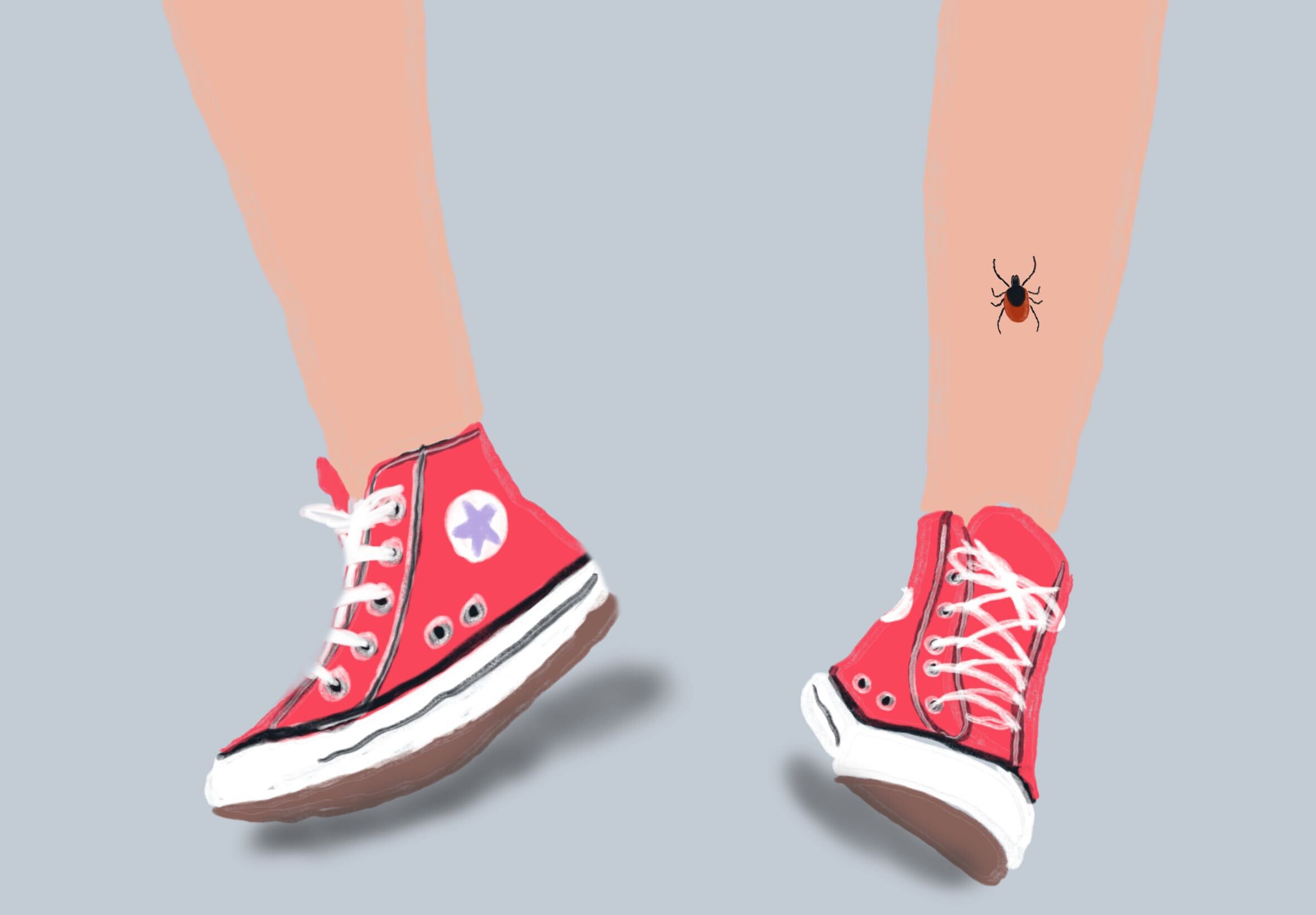
The first warm weekend in Kingston usually means crowded patios, studying on the pier, and more time spent outdoors. But as temperatures rise, so does something less visible: the risk of tick bites, and with them, Lyme disease.
Once considered relatively rare in Canada, Lyme disease is becoming an increasingly relevant concern for students spending time outdoors. There were 5,809 reported cases nationwide in 2024, according to the Public Health Agency of Canada, and the incidence has been increasing since 2009.
The disease is a bacterial infection caused by Borrelia burgdorferi and transmitted to humans through the bite of infected blacklegged ticks. Early symptoms can include fever, headache, fatigue, and a characteristic bullseye-shaped rash. If left untreated, it can spread to the joints, heart, and nervous system.
According to Robert Colautti, an associate professor in Queen’s Department of Biology, the rise in Lyme disease can be attributed, in part, to climate change.
“Lyme disease is carried by blacklegged ticks, and their northward expansion is largely enabled by warming temperatures,” he said in an interview with The Journal. “Less harsh winters improve their survival, allowing populations to establish in areas where they were previously rare.”
As Colautti explained, tick populations also depend significantly on host animals throughout their life cycle. Adult ticks feed primarily on large mammals, especially deer, while younger ticks feed on small mammals such as mice.
“Deer are very important for tick reproduction,” Colautti said. “When you have a large deer population, that supports a larger tick population.”
However, not all animals contribute equally to the spread of Lyme disease. White-footed mice are extremely effective carriers of the bacterium, increasing the likelihood that ticks become infected when they feed.
These factors, warmer winters, abundant deer, and reservoir species like mice, create conditions that allow Lyme disease to spread. As Colautti noted, the increase shows how closely human health is related to environmental change.
For students, risk varies depending on location. Blacklegged ticks tend to inhabit forest understories, particularly areas with leaf litter and moderate moisture. Because they are vulnerable to drying out, they often remain close to the ground during hot, dry conditions and become more active when temperatures are milder.
According to Colautti, one of the more notable Kingston sites where ticks have been observed is Lemoine Point Conservation Area. Although urban areas near campus generally present a lower risk, wooded trails and conservation areas, especially outside the city core, can increase exposure.
Public understanding of Lyme disease has evolved alongside its spread, though not without confusion. Although Lyme disease itself is a well-established medical condition, debate persists around “chronic Lyme disease,” a controversial diagnosis that is largely unsupported by mainstream medical organizations. This may make it more difficult for students to distinguish between established science and emerging or disputed claims.
At the same time, research continues to advance. On March 23rd, pharmaceutical companies Pfizer and Valneva announced that a Lyme disease vaccine candidate demonstrated over 70 per cent efficacy in a Phase 3 clinical trial, with no major safety concerns identified.
However, Colautti also emphasized that Lyme disease is not the only concern. Ticks in Ontario can carry multiple pathogens, including those responsible for anaplasmosis and babesiosis. As a result, a negative Lyme test doesn’t necessarily rule out a tick-borne illness.
“There’s more recognition that ticks carry other pathogens as well,” he said. “So, it’s important to be aware of that risk.”
For Queen’s students, the takeaway isn’t to avoid the outdoors, but to be informed. As warmer weather draws more people outside, simple precautions, such as wearing protective clothing, using insect repellent, and checking for ticks after time in wooded or grassy areas, can significantly reduce the risk of exposure.
Tags
Climate change, Lyme disease, public health
All final editorial decisions are made by the Editor(s) in Chief and/or the Managing Editor. Authors should not be contacted, targeted, or harassed under any circumstances. If you have any grievances with this article, please direct your comments to eic@queensjournal.ca.