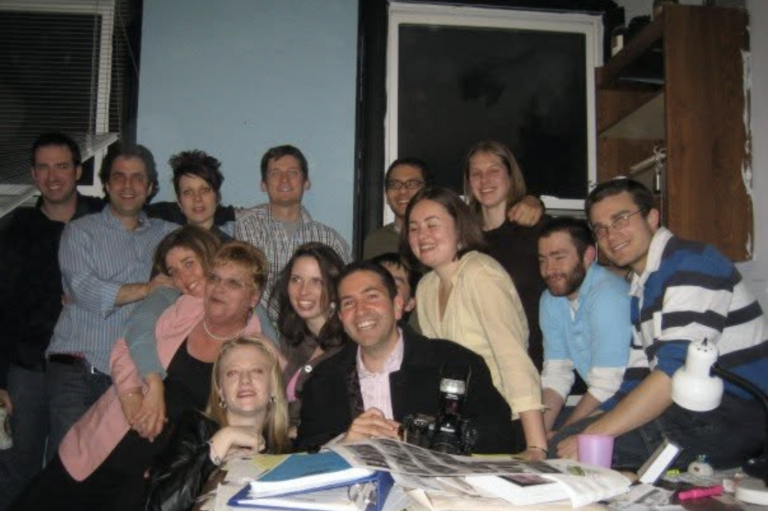
Gabriele King, known as Gabe by generations of Journal staff, was a “calming presence” for almost three decades.
King worked at The Journal as the paper’s business administrator, with her career spanning from 1984 until 2012. A permanent staff member among a team of students, King provided support and a sense of continuity to generations of Journal mastheads.
On Oct. 12, King died of cancer in Kingston’s Providence Care Hospital.
To reflect on her 28-year legacy, The Journal spoke with former editors-in-chief during King’s time at The Journal to hear how she impacted their experiences.
Her time at The Journal began when volume 112 Editor-in-Chief John Stackhouse, Comm ’85, brought her onto the team.
“[Hiring her] was literally one of the first things I did as editor, and she was fantastic from day one,” Stackhouse said. “She, as generations saw afterwards, was more committed to The Journal, and especially to its people, than I think anyone could have anticipated.”
While King carried out a number of administrative tasks to ensure the business side of the paper was running smoothly, those were not her only responsibilities. Her greatest impact, arguably, was the emotional support she provided to generations of The Journal staff.
“She hadn’t worked in a student environment […] or a news environment, so that was fresh to her. She didn’t claim to track the issues that we were tracking, or read the paper, but she had a great sense of people and was very protective of the people at The Journal,” he said. “We needed that, but we needed it more than we probably appreciated.”
After graduating, Stackhouse visited The Journal and King on multiple occasions.
His favourite memory over the years was during King’s retirement party in 2012, as he was able to see, first-hand, all the relationships King had developed during her time at the paper.
“It was just so joyful for me to see all that she had built over many years. I mean, I didn’t know all the editors that followed, but their attachment to her, and her to them, was really special,” Stackhouse said. “The students come and go, but Gabe is the one who stayed.”
The retirement party was hosted by Jake Edmiston, ArtSci ’12, and Clare Clancy, ArtSci ’11, the co-editors-in-chief of volume 139.
Edmiston explained they felt “daunted” to step into their roles, not only because of the workload, but because it was King’s final year at The Journal and they wanted to give her a “proper send-off.”
The co-editors ended up renting Portsmouth Historic Hall for the night. Many alumni returned, and Edmiston remembers it as “packed.”
“Everybody has their accomplishments when they run the paper, and that was ours. I think we sent out Gabe well, and it wasn’t just our accomplishment. I think the entire alumni network came and showed up for her,” Edmiston said.
This impact on alumni was something Edmiston felt after his time at The Journal too, explaining he still looks back fondly on his memories of King in the old Journal house.
“There are places you can go in your mind where you feel sort of safe and warm, and The Journal house [King] created is one of them for me,” he said. “I realize I’m not even there anymore, but I can think in my head of walking in and turning the corner and seeing her at her desk, and just feeling sort of lighter.”
Edmiston moved from the Toronto area to Kingston for university and was “deeply homesick.” When he began his term as editor-in-chief, he and Clancy went to King’s home for dinner.
“I remember she cooked for us,” Edmiston said. “She made me feel like I was with family. […] She became like my family.”
Marissa Nelson and Eric Morris, both ArtSci ’99 and co-editors-in-chief of volume 125, also threw a historic party during their tenures. For The Journal’s 125th anniversary, Nelson and Morris hosted a celebration in Grant Hall.
Nelson described King as “ecstatic” and “giddy” that night, as she was so happy to see “her kids” again.
“She was delirious with the 125 [party]. […] Even the other day, we talked about it, and she was like, ‘That was so amazing.’ It was a good party,” Nelson said.
Thinking back to the late nights preparing the paper, mixed with the generally tumultuous experience of being a student, Nelson referred to these production nights as a “pressure cooker.”
“You’re trying to get everything done, and you’ve still got exams, and relationships, and all of these things happening at once,” Nelson said. Through all of it, she said King served as a “calming presence” and a “shoulder to cry on.”
“I think back to her being an adult in the midst of these all-nighters and pizza boxes and breakups and drama and all of the rest of it,” Nelson said.
Nelson visited King while she was in hospice and recounted a conversation they had about King’s experience working at The Journal.
“I can’t imagine being her. I said that to her in hospice, and she kind of laughed, and she said, ‘I loved it.’ And she had this little glint in her eye. I think she loved being around young people on the cusp of life,” she said.
When Nelson found out through Facebook that King was in hospice, she had the idea of creating a document for alumni who worked with King to write messages about the impact she had on their experiences. In just a few days, over 50 alumni wrote an individual message.
“I’m so grateful that everybody took the time to write. She saw them all. She read them. She loved them. In some ways, it was reflective of the community that The Queen’s Journal, through the years, creates,” Nelson said.
She simply wanted King and her sister to “have a document to show her how loved she was.”
King’s younger sister, Patricia Armson — who stayed at King’s bedside in Providence until she died — read King stories from the document every day.
For Armson, the document reminded her that King’s strength came from “believing in people, giving them encouragement, and embracing them.”
Over the last few years, the two sisters were able to spend a lot more time together as Armson moved back to Kingston. Armson referred to King as “so fun” and “full of surprises.”
King was the eldest of four children, with two younger brothers and her younger sister, Armson, by seven years. Armson remembered King as a “mother hen” figure who looked out for her younger siblings — both taking care of them and setting them in line — language she also used to describe King’s relationships with Journal staff.
“She wasn’t just a mother hen to them. Yes, she listened to them, but she was a force of motivation and success in showing them a way for them to be all that they could be.”
King also encouraged students who visited The Journal, even if they weren’t staff members. Volume 117 Editor-in-Chief Ian Stewart, ArtSci ’90, described King as a “safe landing place for anyone that walked through the door.”
He pointed out that first-year students would often come to The Journal’s office feeling shy and nervous, not knowing if it was the right place for them.
He added that while he was one of these students, King had a unique way of comforting people.
“Gabe could see I was insecure. I didn’t know what I was doing, but she immediately sort of got up, came around her desk, […] and said, ‘You’re welcome here.’”
Her support extended beyond just lending a listening ear. Stewart described her as “very no-nonsense,” and said she always made sure things got done.
“She was very protective of everyone that was in The Journal, […] so if there was a problem, she was the first one to step up and defend you.”
Some of his favourite memories of King didn’t take place in the office, though.
“Gabe used to always host these […] barbecue bonfire kind of things in the summer. They were really boozy, debaucherous sort of affairs. [But] seeing her out of an office setting — the warmth and the kindness in her smile were just brilliant,” he said.
Once Stewart finished his term as editor-in-chief, he went on to pursue a career in journalism and foreign correspondence. While on an assignment in Sierra Leone in January 1999, Stewart was shot in the head when a suspected rebel opened fire on the vehicle carrying him and several colleagues. Stewart was critically wounded, and fellow Associated Press journalist Myles Tierney was killed.
After months of being in the hospital, he returned to Queen’s later that year to give a career talk, where he and King reunited.
“I was walking with a cane, so she saw me in a very broken-down state, and that was a really emotional thing, but she just stepped in right where things had left off. It was like we had never been apart,” he said. “[I was] trying to manage walking through slushy snow with a cane, and I remember her by my side holding my arm to make sure I didn’t slip and fall.”
Throughout the years, alumni consistently described King as family. For generations of passionate, hardworking, and often overwhelmed Journal staff, “she was a mom away from home,” Stewart said.
Tags
‘Journal’ alumni, Commemoration, History, The Journal
All final editorial decisions are made by the Editor(s) in Chief and/or the Managing Editor. Authors should not be contacted, targeted, or harassed under any circumstances. If you have any grievances with this article, please direct your comments to eic@queensjournal.ca.