Provost Matthew Evans signals a positive stance on Artificial Intelligence (AI) in academia.
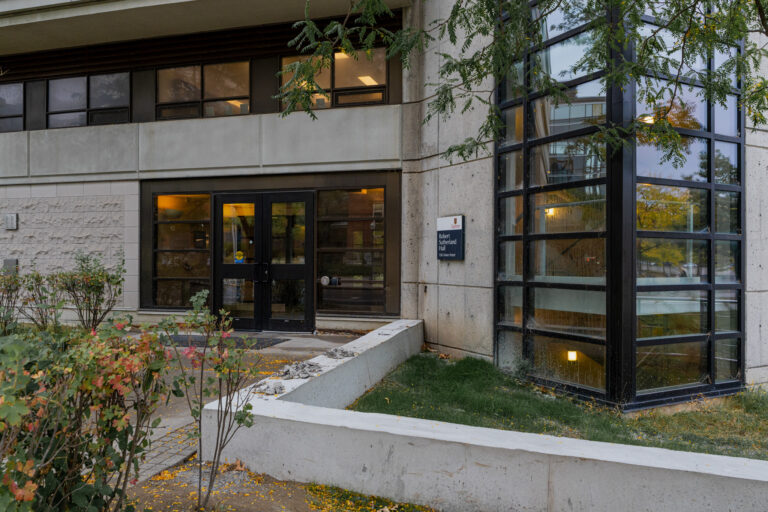
The University Senate held its second meeting of the academic year on Oct. 30 at 2:30 p.m. and concluded by 4 p.m. The meeting was held in person at Robert Sutherland Hall, and members could also join online via Zoom. Principal Patrick Deane chaired the meeting and engaged in discussions with senate members about the Bicentennial Vision, the Principal Report, AI in academic policy, and several other orders of business outlined in the agenda.
Reports
The meeting officially kicked off with the Principal Report, shared by Deane. He first discussed Prime Minister Carney’s recent speech on the upcoming Federal Budget at the University of Ottawa, noting it signalled a focus on skills, innovation and higher education.
In Evans’ Provost Report, he detailed his recent trip to China and his international engagement efforts. He noted that exchange programs and recruitment were one of the few ways the school could make extra revenue. He also shared that he had signed a new exchange program agreement while travelling.
“We signed a double degree program and an exchange agreement between Smith School of Business and Hong Kong University of Science and Technology,” Evans said.
Bicentennial Vision
The meeting’s informal session centred around a consultation on the Bicentennial Vision, Queen’s strategic direction to 2041. Deane described the draft as a product of months of internal consultation that began last January, and said the two key themes of the report
were “impact and leadership.”
After his brief remarks about the Bicentennial Vision, he opened the floor to discussion, and several members raised concerns and questions about specific language in the report, its practical application, and the consultation process.
Senator Karen Rudie questioned the language “strategic agility” in hiring, worrying that such phrasing may signal intent to bypass collective bargaining and hiring processes.
“Nimbleness and agility sound like code for a quick hire that obviates the usual process,” Rudie said.
Deane replied that there was “no intention to subvert the normal process,” emphasising the phrase “collaborative processes” in the document signals a continued commitment to collective agreements.
Another senator, Petra Fachinger, criticized the exclusion of “equity and diversity” in favour of the broader term “inclusion,” citing that the language reminded her of the 80s. She also challenged how Queen’s defines “what we do best,” asking, who decides what Queen’s does best.
She also called out the University for clumping together reconciliation, inclusion, and sustainability in the report and questioned why they were grouped together, why there was no mention of equity and diversity, what the consultation processes were, and why all three topics, particularly sustainability, were so briefly mentioned in the report.
In response, Deane said he would consider everything and that he thought she was right in thinking it’s “strange,” but reiterated that it’s meant to be conceptual categories that are “fundamentally important.”
Lastly, some senators voiced that the report needed to have a stronger stance on academic freedom and needed to reaffirm the importance of post-secondary education. Deane agreed firmly and emphasized the need to articulate a “clear value proposition” in the final vision.
Question Period
The senate meeting finished up with a question period. AI was a main topic of discussion, as Senator Samantha King asked whether formal AI policies would be created and whether they would go through the Senate.
Evans replied that any policy impacting academic matters would be reviewed by the Senate. During his response, he also stated that the thinking around AI has changed.
“The thinking has changed over the last couple of years from essentially saying AI is this kind of monstrous thing […] to really say, well, AI is a tool,” he said. “It’s something that we should be using and students should be using.”
Evans then emphasized the need to “rethink assessment” in light of AI’s growing role in student and academic work. Stating that the University can’t ignore it and that the future of how to assess a student’s understanding might need to be adjusted and changed, but did not clarify what those changes might look like.
The next Senate meeting will be held on Nov. 27.
Tags
All final editorial decisions are made by the Editor(s) in Chief and/or the Managing Editor. Authors should not be contacted, targeted, or harassed under any circumstances. If you have any grievances with this article, please direct your comments to eic@queensjournal.ca.