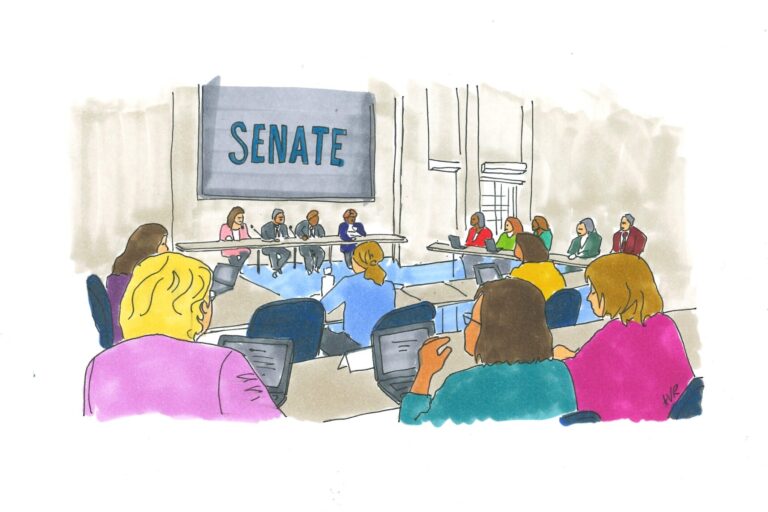
Senate returned for its first meeting of the academic year, introducing new members to the University’s academic governing body before turning to discussions on student financial aid, climate action, AI, and academic programming.
Senate met on Sept. 24 at 2:30 p.m. in Robert Sutherland Hall, with senators also able to participate online.
The meeting began with Principal Patrick Deane welcoming senators and recognizing the passing of Professor Emerita Karen Dubinsky and third-year environmental studies student Samuel Lowe with a moment of silence.
University Secretary Rebecca Coupland then gave senators an overview of Senate and its place within Queen’s governance structure.
Queen’s operates under a tricameral governance system consisting of Senate, the Board of Trustees, and University Council. Senate is the highest academic governing body, while the Board oversees its business affairs. University Council serves as an advisory and ambassadorial role.
Senate’s responsibilities have expanded since Queen’s was established in 1841. Today, it determines academic matters affecting the University as a whole, including approving new academic programs and units, academic policies, degrees, and research plans.
Principal’s report
Deane delivered his Principal’s Report, describing the University’s financial outlook as more positive following the Ontario governments post-secondary funding announcement in February, while raising concerns about the changes to the Ontario Student Assistance Program (OSAP).
Deane said the University is looking at additional ways to support students affected by the changes and identified fundraising for student financial aid as a priority.
“It remains critically important that access to the University be as free as possible for students who have the qualifications, regardless of their financial situation,” Deane said.
Senate approves program and accommodation changes
Senate also approved the Major Modification: Bachelor of Education (BEd) and Diploma in Education (DEd), effective May 1, 2027. The changes include a pathway allowing current education students to complete their program through a shorter, condensed route.
The Major Modification: Executive Master of Business Administration (EMBA), was also approved, effective August 2027. The program will streamline its core courses, expand elected options, and reduce the number of required units from 60 to 52.5.
Senate approved the Major Modification: Bachelor of Health Sciences (General) program, effective Jan. 1, 2027. The change will allow students in the General Bachelor of Health Sciences program to receive a “with professional internship” designation on their degree after completing a QUIP.
Senators also approved a New Graduate Diploma in Health Ecosystem Leadership and Innovation through the Faculty of Health Sciences, effective Jan. 1.
A change to the University’s Academic Accommodations for Students with Disabilities Policy was also approved, creating a dispute resolution process for students whose accommodation requests can’t be satisfactorily resolved through the existing process. The change took effect immediately.
The dispute process was developed following a 2024 review of academic accommodation and was identified as a priority by the University’s Academic Accommodation Interim Working Group.
Large language models
The longest discussion centred on a draft set of principles governing large language models (LLMs) in teaching and learning.
Vice-Provost (Teaching and Learning) Gavan Watson said the principles were developed following consultations with every faculty board, Queen’s University Library, and Student Affairs.
Watson described LLMs as systems that generate text by predicting likely patterns in large amounts of existing language. He said the University chose the term “large language models,” rather than AI to describe the technology more specifically.
Instead of establishing one University-wide rule determining when students are allowed to use tools such as ChatGPT, the draft is intended to guide faculties, programs, and instructors as they decide how LLMs should be incorporated into teaching.
One proposed principle would require programs to identify disciplinary skills students should develop and demonstrate, while another would call for some assessments to be protected from LLM use to provide direct evidence of student learning.
The approach wouldn’t ban LLMs across courses. Instead, it would distinguish between situations where the technology could form part of learning and those where students need to demonstrate their own knowledge or abilities.
Watson emphasized the document remains a draft and will return to Senate for eventual endorsement.
The meeting concluded at 5:27 p.m.
Tags
2026 OSAP Changes, AI Discussion, Queen's Senate
All final editorial decisions are made by the Editor(s) in Chief and/or the Managing Editor. Authors should not be contacted, targeted, or harassed under any circumstances. If you have any grievances with this article, please direct your comments to eic@queensjournal.ca.