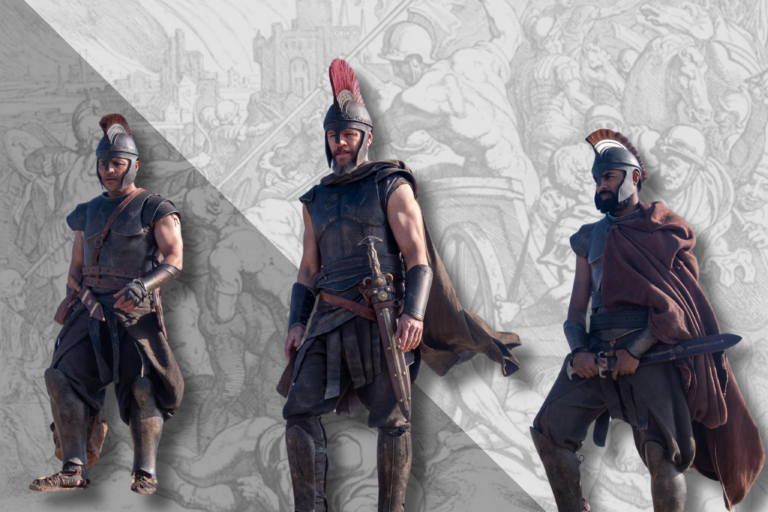
Unfortunately for classicist purists, Christopher Nolan’s mythic action epic blends antiquity with modernity.
Before director Christopher Nolan’s adaptation of The Odyssey, Homer‘s poem was composed and performed by rhapsodes, “song-stitchers” who preserved oral traditions by singing poetic works. After centuries of circulation, the story was recorded by scribes onto papyrus scrolls. Millenniums later, The Odyssey, released on July 17, has changed once more. Now, it is designed to be watched on IMAX 70MM screens with a three-hour long runtime.
For fans demanding entertainment, it’ll be the best night of your summer. But for armchair scholars, time to get your notepad and textbooks out. Although adaptations anticipate division, audience reactions are clashing more than the Trojans and Spartans.
Preserving the epic’s core plot elements, Nolan’s summer blockbuster follows Odysseus (Matt Damon), the presumed-dead king of Ithaca, on his return home after the Trojan War. After deceitfully breaking Zeus’ law, Odysseus fights against mythical creatures as punishment for defying the Gods.
Deviating from Homer’s original characterization, Odysseus’ heroic identity is burdened by guilt. As classicist and translator Emily Wilson critiques, the film depicts a “modern psychiatrized” Odysseus who no longer cares for glory in battle. Expanding upon his mental anguish, Nolan’s Odysseus seeks to redeem himself for the slaughter of Troy and his own men that he sacrificed in pursuit of victory.
Matt Damon’s portrayal of a veteran tortured by his past flawlessly depicts a man reckoning with trauma before his homecoming. His version of Odysseus may only return after he restores what he lost in the war. This is a modern projection about the morals of ancient warfare that adds new psychological depth to Odysseus’ painful experiences. While it’s a welcomed change for the complicated warrior, opinions worsen concerning Nolan’s translation of Homer’s Odyssey.
Inspired by Emily Wilson’s contemporary translation, Nolan controversially retells the Ancient Greek epic through Modern English. Much like Ridley Scott’s Gladiator, his approach deviates from historical accuracy in favour of modernizing language to make it accessible to contemporary audiences — creating dissonance between the story’s history and our current world.
As Ancient Greek characters speak with American accents and colloquialisms, they worship Olympian deities while fighting legendary Greek myths. Although it’s a Hollywood blockbuster and not a classics course, it should still be a responsibility for filmmakers to honour the story’s original languages, cultures, and worlds.
While The Odyssey prepared for its theatrical release, Robert Eggers announced that his upcoming horror film, Werwulf, is in Middle English. With the help of Oxford scholars and dialect coaches, Eggers struck a balance between old worlds and modern audiences.
Whereas in The Odyssey, Nolan’s decision to write a period-specific piece as a universal story presents a battle of incongruency between antiquity and modernity when dialect detaches from culture. For example, Odysseus’ battle cry is “Let’s go,” a modern exclamation that never appears in Homeric prose.
Beyond the story’s emotional turmoil, The Odyssey‘s soundtrack pulls heartstrings as music harmonized narrative disparities.
Composing for his third collaboration with Nolan, Academy-Award winning musician Ludwig Göransson blends the modern world with ancient Greece through his contemporary archaic soundscape and in turn masters the film’s recurring theme.
Göransson reconstructed traditional Greek instruments to pull audiences into Odysseus’ world, with lyres representing his legendary bow, and auloi representing the winds that carried him home. During battles, synthesizers distort heavy bass which roars through the theatre, shaking seats to give a feel of Zeus’ thunder. A signature aspect of his style, the soundtrack’s electronic elements fuse present-day musicality with tradition.
Following his contributions to Nolan’s thriller Tenet, rapper and singer-songwriter Travis Scott appears on the soundtrack as the bard, Demodocus. While rapping about the Trojan War with his staff, Scott connects The Odyssey back to its oral storytelling traditions — a parallel origin to rap. As a thriving contemporary genre, rap is the soundtrack’s perfect addition to maintain the old story’s fresh feel.
However, The Odyssey‘s colossal production scale is what makes the film an epic achievement in twenty-first-century cinema.
With a budget of over $250 million dollars, The Odyssey is one of Nolan’s most expensive films to date, costing twice as much as his Academy Award winning biographical drama, Oppenheimer.
Of course, a big budget attracts Hollywood’s biggest stars — from Twilight‘s Robert Pattinson to Black Panther’s Lupita Nyong’o to Euphoria‘s Zendaya. These are the faces that launched a thousand ships worth of star power, a subtle factor in today’s filmmaking that originals never needed.
Its technological innovations are just as impressive. For a story that’s been around forever, it’s beautiful that it continues to inspire boundary-breaking creative endeavours.
The Odyssey is the first feature shot entirely with IMAX film cameras, featuring the groundbreaking Keighley Film Camera. Fit with a sound blimp, the Keighly camera silences the camera’s shutter sound to capture close ups of intimate moments without loud interference. By the time production wrapped, they had shot over two million feet of film.
Nothing beats watching a movie shot on film in the digital era.
Although Nolan defies Homeric traditions, his Odyssey stands alone as its own powerful story. After his homecoming, Odysseus realizes that strength comes from within — a timeless understanding that resonates throughout history. Divides between antiquity and modernity appear trivial when the narrative prioritizes connection with current audiences over accuracy and historical fact; a divisive creative decision, but one necessary to produce a story independent from its legendary history.
Tags
Christopher Nolan, film adaptations, Homer, Matt Damon
All final editorial decisions are made by the Editor(s) in Chief and/or the Managing Editor. Authors should not be contacted, targeted, or harassed under any circumstances. If you have any grievances with this article, please direct your comments to eic@queensjournal.ca.