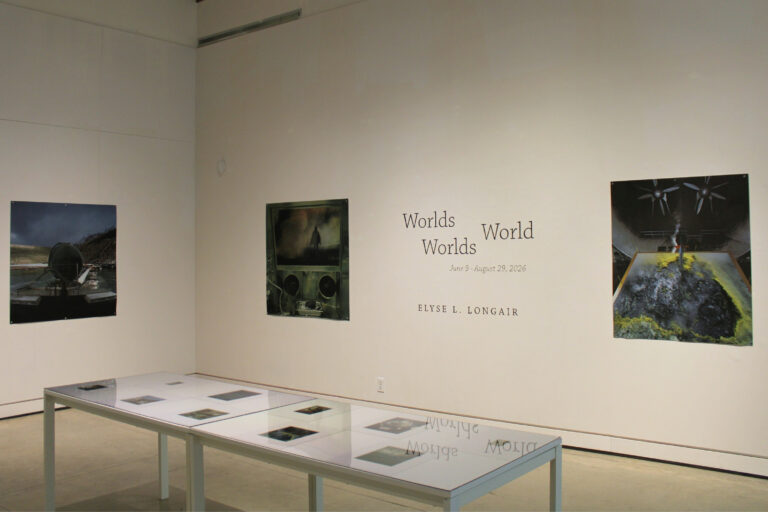
On June 9, the Union Gallery opened a new exhibit by artist Elyse Longair, titled Worlds World Worlds.
Longair, currently pursuing a Ph.D. in Screen Cultures and Curatorial Studies at Queen’s, uses digital collage in her latest exhibition to explore how images shape the worlds people imagine.
Created in response to the gallery’s summer curatorial theme, Living Together — which emphasizes togetherness in challenging times — the exhibit’s title is a quote taken from philosopher Donna Haraway’s book Staying with the Trouble: Making Kin in the Chthulucene: “It matters what stories tell stories, it matters what thoughts think thoughts, it matters what worlds, world worlds.”
In this context, “world” is used as a verb. To “world” is to build or create something, like a new reality. Longair contributes to Haraway’s concept with the use of collage, creating a new world by combining different images.
In her Union Gallery Artist Statement, Longair intended for each added image to leave a trace, and “a relationship to the context of the world from which they were taken from.” As inspired by Haraway, Longair uses the influence from one world to develop another.
While traditional collages are made through gluing material together, Longair combined images digitally, which allows for editing and blending: tools that aren’t always available when collaging is done traditionally.
From a distance, Longair’s prints look less like collages and more like photographs taken on a wide lens. The digital overlapping and editing makes the added materials blend in smoothly. Visitors must examine the collages closely to see remnants of the original image and to understand how new images were created from many others.
The exhibit consisted of twenty prints: ten large ones hung on the Gallery’s back walls and ten smaller copies in a display case. The prints were hung without frames, upon white walls, creating a minimalistic backdrop that allowed the work to take centre stage.
The wide angles and lack of frames gave the collages an air of endlessness. Longair’s aim was to present them as more than static images, but as a glimpse into a moment that continues after the collage’s initial boundaries, adding that the “interest is what could exist beyond that moment, outside of the frame.”
Longair’s curatorial approach meant that, other than a pamphlet with a message from the artist, there was no text to accompany the collages. However, this decision was not to the exhibition’s detriment. Instead, it encourages viewers to examine the exhibit, not as twenty separate prints, but as one larger work of art.
As inspired by Donna Haraway’s theories, the collages combine nature and technology to reject our human-centered perception of the world. Machines are placed in the middle of grassy fields and humans are engulfed by massive switchboards and computers. Haraway’s book becomes relevant once more, as her argument is that human and non-human aspects of life are intrinsically connected: “We become-with each other or not at all.”
Ultimately, Worlds World Worlds invites viewers to explore and reconsider the impact that images have on how society perceives the past and present. Haraway’s quote is ever present, and through her own art, Longair reminds viewers that the ways images are created, combined, and interpreted impacts the ways the world can be imagined.
Tags
Elyse Longair, Union Gallery, Visual art
All final editorial decisions are made by the Editor(s) in Chief and/or the Managing Editor. Authors should not be contacted, targeted, or harassed under any circumstances. If you have any grievances with this article, please direct your comments to eic@queensjournal.ca.