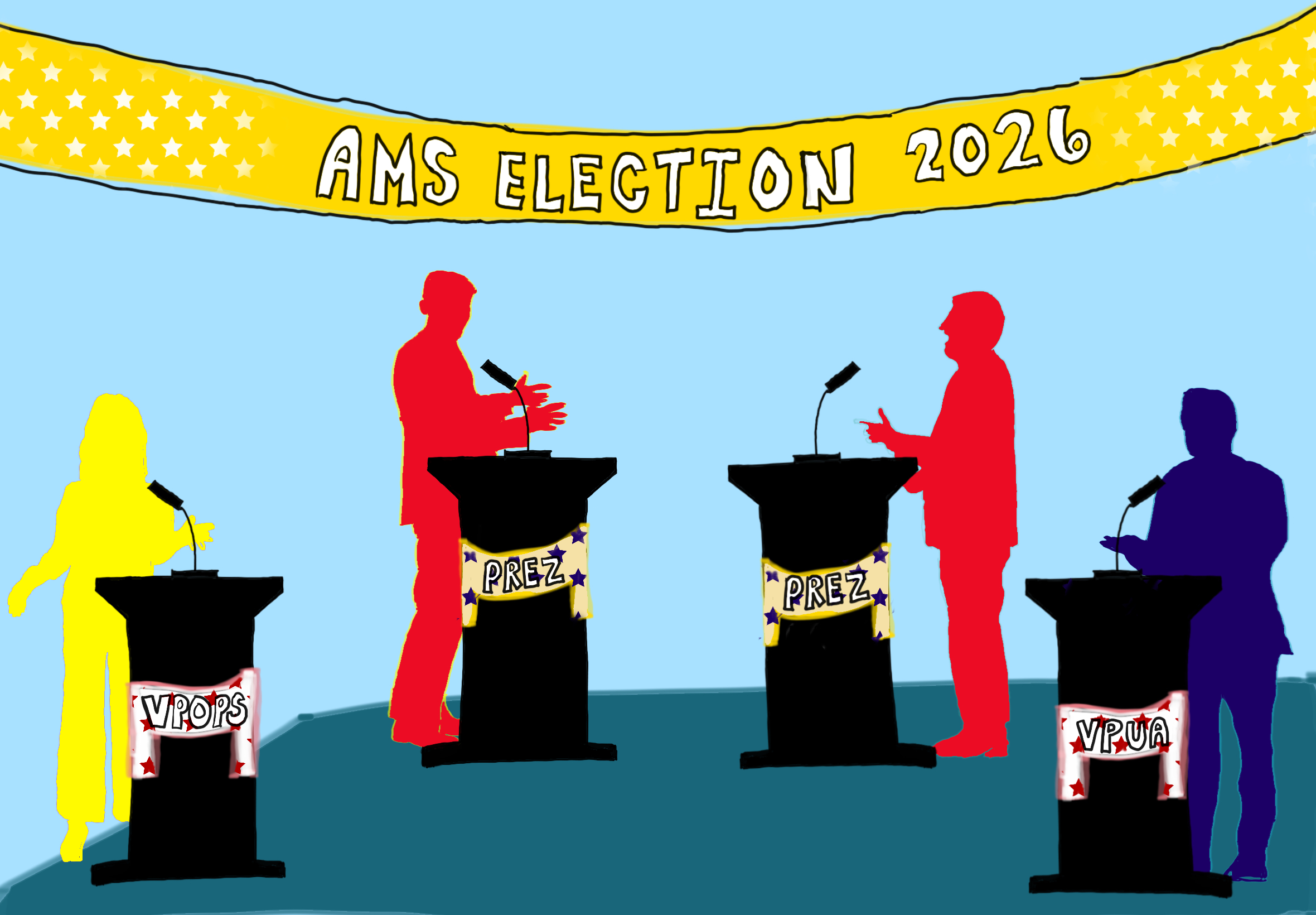
Our Process: The endorsement is the result of a vote by The Journal‘s Editorial Board. The Editorial Board considers prior interviews, debates, platforms, and a private questioning period with the teams before making a decision.
In the face of challenges from Bill 33, the mounting AMS budget deficit, and the continued difficulties of adequately representing the student body, Queen’s needs a strong AMS executive now more than ever. Shifts in governance and financial pressures all increase the pertinence of effective student leadership.
In the second ever de-slated AMS election, The Journal chose to endorse some candidates over others.
President
In a 17 to 0 vote, The Journal Editorial Board voted to endorse Dreyden George, ArtSci ’27, for AMS President.
George confidently presented his platform, grounded in three pillars of transparency, accountability, and engagement. He cited his experience as AMS Commissioner of External Affairs, Clubs, and Social Issues, as well as being the current chair of the Board of Directors, which’ll help him confidently step into the role. He also referenced his experience as co-president of Queen’s Backing Action on the Climate Crisis (QBACC), and role in the Bus-It contract renewal—experiences he feels will help him work collaboratively with the University administration.
While holding some leadership roles within the AMS, The Journal found Alex McArthur ArtSci ’27 less experienced than George, and in either case, was unable to adequately draw on his experience to expand on his platform. Each candidate was offered a strict 15-miniute time frame to present their platform and take questions from The Journal Editorial Board. McArthur arrived three minutes late to the already short time frame and appeared significantly under prepared.
When asked about the AMS’s $514,412 deficit, McArthur explained that students need to understand the deficit, noting the potential impact of Bill 33, and not wanting to cut student jobs. He references “strategic investment” followed by a vague elaboration on what this would look like in comparison to the AMS’s current portfolio.
In contrast, George was able to confidently field questions about the deficit. He mentioned the need for better student awareness about fees and administrative matters, increasing returns on investment funds, and learning from mistakes in the JDUC development. He stressed proportionally representing the offices portfolio, something that’s been missing in prior budget presentations.
Both candidates mentioned the need for better AMS visibility among the student body, however, only George was able to provide tangible examples of what this would look like. McArthur mentioned marketing and improving relationships with students, while George referenced OnQ announcements, presence in first year classrooms and dining halls, as well as advertising on TVs in the Queen’s Centre.
When asked about becoming a more adequate representative in senate meetings, both candidates referenced the need for a more hands on and active voice from the AMS.
McArthur spoke about wanting to be more involved with The Journal, expressing a desire to “learn” and “chat” more. George had a more grounded approach, citing communications deadlines, understanding the AMS likely won’t have a close personal relationship with The Journal, but expressed a desire to learn more about our operations.
Overall, George seemed significantly more prepared to take questions, citing specific examples and drawing on his experience. In comparison, McArthur’s responses seemed disjointed and vague.
Vice-President (Operations)
In a vote of 13 for and 3 against, The Journal gave a vote of confidence to endorse sole candidate Avery Papoulidis, HealthSci ’27 for the role of AMS Vice-President (Operations).
Papoulidis spoke to her experience as Assistant Manager of Marketing and Events at The Queen’s Pub, and highlighted her platform’s pillars of support, accessibility, and transparency. She outlined her platform in relation to the budget deficit, underscoring the extensive personnel costs, and need for meaningful financial recovery. Papoulidis also noted that the budget presentation should be moved earlier than December, leaving time to take a more proactive approach, given the one-year term, to students’ concerns regarding the budget.
While under experienced in student government, Papoulidis was able to draw on her work with The Pub to identify a need to treat all AMS services equally, as well as ensuring an extensive transition process for all head managers as they come into their role. Papoulidis also recognized the need to maintain an unbiased and professional working relationship with The Journal.
Acknowledging the de-slated nature of the election, Papoulidis expressed a clear willingness to work as a team, regardless of who will be stepping into the presidential, and vice presidential (university affairs) role.
With clearly outlined initiatives and experience working within an AMS service, The Journal’s confident in Papoulidis’s ability to take on the vice president (operations) role.
Vice-President (University Affairs)
With 16 votes in favour, The Journal gave a vote of confidence to endorse Edward Sy, HealthSci ’27, in their uncontested candidacy for vice-president (university affairs).
With experience as the current Social Issues Commissioner, Sy presented a platform grounded in accountability, community, and efficiency.
In reference to Bill 33, Sy outlined how the AMS isn’t currently engaging in enough advocacy work on behalf of the student body, particularly for equity deserving students. He mentioned how students need to be more informed about the Bill, and how it’ll affect services, before the AMS can meaningfully advocate on student’s behalf.
Sy emphasized the need for more publicity in the AMS’s operations, to maintain a sense of social accountability. He mentioned creating an AMS vice president (operations and university affairs) digest, where they can show students what they’re working on, and build trust and engagement within the student body.
Given their experience as social issues commissioner, Sy understands the need for clear communication, putting himself in front of students as a direct link to the AMS. They emphasized the need for office hours and open houses to help build visibility, engagement, and trust.
Regarding making students more aware of the resources available to them, Sy plans to initiate a multi-year action plan, grounded in short- and long-term visibility of AMS services. They plan to develop this plan in consultation with current students and AMS members. He also mentioned their intent to meet monthly with The Journal. Sy also consulted with The Journal in the creation of his platform.
With a strong vision for visibility of AMS services, and working in consultation with equity deserving groups, Sy was naturally endorsed by The Journal.
The Board has faith in George, Papoulidis and Sy to form a strong AMS executive in the coming academic year. But it’s up to the student vote, and time will tell if their leadership capabilities are as presented.
—Journal Editorial Board
Tags
AMS elections, AMS president, AMS VPOPS, AMS VPUA, Endorsement Board
All final editorial decisions are made by the Editor(s) in Chief and/or the Managing Editor. Authors should not be contacted, targeted, or harassed under any circumstances. If you have any grievances with this article, please direct your comments to eic@queensjournal.ca.