It was a big week at the Union Gallery (UG).
Two new exhibitions opened at UG, located on the first floor of Joseph F. Stauffer Library, earlier this week. Both exhibits invite visitors to explore storytelling through material forms. In Loan Stars: Beading Back our Manidoo, Nico Williams reimagines beading as an act of cultural and spiritual exchange, while Jung-Ah Kim’s Weaving Turns turns collaboration into woven dialogue. Loan Stars runs from Oct. 28 to Dec. 13, and Weaving Turns continues until Nov. 15.
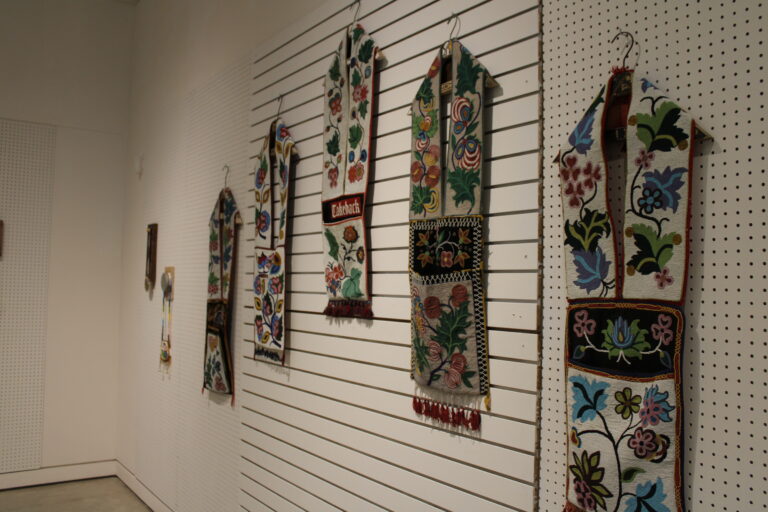
In Loan Stars: Beading Back our Manidoo, Williams transforms UG’s Main Space into an homage to pawn shops, displaying intricate beadwork by Williams and other artists. The pawn shop setting invokes ideas of exchange, survival and spiritual resurgence. The title is a layered reference to pop culture and tradition: “Loan Stars” parodies Pawn Stars (2009), a popular American reality television show about pawn shops. The word manidoo is Anishinaabemowin for “spirit.”
Williams, inspired by witnessing the 2008 financial crisis and the pawn-shop circuit drew on his experience, using it as metaphor for archival history. “For Indigenous communities, however, pawn shops have long carried another meaning: alternative systems of survival where exchange and trust make life possible,” Williams wrote in his artist statement. “That cycle of giving, losing, and redeeming objects informs the title of this exhibition.”
In person, Loan Stars is striking. The beadwork was elevated by the wealth of unusual objects chosen to bead. Among the exhibition’s pieces were traditional earrings, satchels and tapestries. But the most captivating work sat in a glass display case at the centre of the gallery: a collection of movie and video-game boxes with dazzling, intricate beaded covers.
Resting atop the case was a retro CRT television looping gameplay footage from Pocahontas (1995), a video game for the Sega Genesis. The installation’s blend of cultural practices with nostalgic pop- culture felt both playful and reverent, an unexpected bridge between past and present iterations of Indigenous storytelling.
While Williams explores the exchange of stories through objects, Kim explores it through direct process and participation. Weaving Turns is housed in the Project Room. Kim reimagines the frame loom as both a collaborative tool and a shared game board. In each session, a participant who’s signed up for a timeslot sits across from Kim at a horizontal loom; they both begin weaving from opposite sides, taking turns one pick at a time. In this way, the exhibit is durational, involving the viewer in the process of creation.
Each player draws from a stack of cards, which contain different and simple, game-like instructions that either mirror, disrupt, or respond to one another. After the game is complete, each uniquely woven piece is cut from the loom and displayed in the gallery, adding to the installation.
In both Loan Stars and Weaving Turns, both artists champion the unity of art and craft. Their works reveal that the slow, deliberate processes of beading and weaving are just as beautiful as their final forms.
Tags
Art, Beadwork, crafting, Crafts, exhibition, Loan Stars, Union Gallery, Visual art, Weaving Turns
All final editorial decisions are made by the Editor(s) in Chief and/or the Managing Editor. Authors should not be contacted, targeted, or harassed under any circumstances. If you have any grievances with this article, please direct your comments to eic@queensjournal.ca.