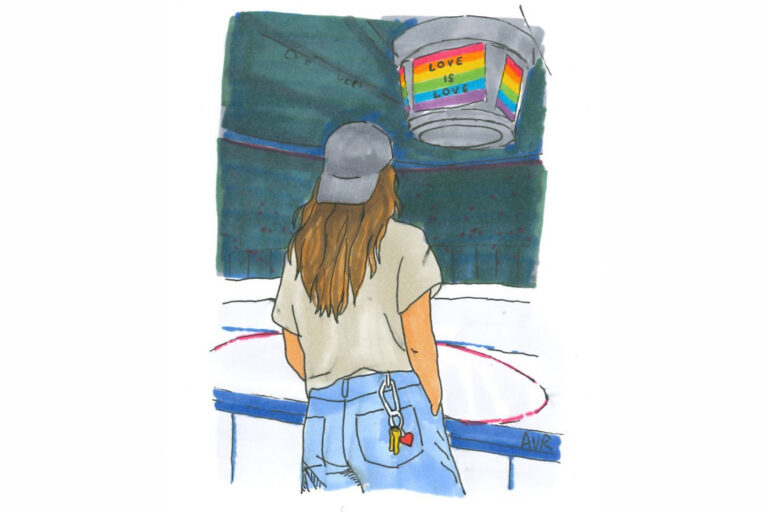
I’ve been told that I talk about being gay every five minutes.
Well, I overheard a friend saying it about me behind my back.
Although I consider myself confident in who I am, sometimes I slip up. After hearing that comment, for the first time in years, I worried about how others perceived my identity. Since I am not confrontational, I stayed up that night writing in my journal, questioning whether being gay really is my whole personality.
I concluded that my personality is queer.
I unapologetically talk about being gay all the time, and I am a better person for loving myself out loud.
My queer identity influences why I hold certain values, what hobbies I have, how I dress, and who I love. My sexuality forms these characteristics, and in turn, composes elements of my personality. Although there are other components that shape who I am, a defining aspect of the unique qualities that characterize me as an individual is that I am “a” lesbian.
If people have a problem with how my personhood developed, they view my queerness as a character flaw: an unrespectable quality that an acceptable individual must overcome.
Our heteronormative world functions on the idea that there are respectable ways of being queer. The framework of respectability politics relies on us conforming to socially respectable versions of ourselves, annihilating any unacceptable aspects of our identities through assimilation.
Respectable queerness falls on the condition that one silences their true selves to perform queerness in “acceptable” ways, submitting to homonormativity by complying with heteronormative ideals to achieve social acceptance.
In the process, we disrespect who we are to be accepted by those who do not respect us. Leave carabiners at home, turn backwards caps around, and love out loud only the parts of yourself that society deems lovable.
Before I accepted myself, I tried to be respectable. I kept crushes to myself instead of gushing about them at sleepovers. There where nights when I went to bed, hoping I wouldn’t wake up as a lesbian again. That day never came.
Adhering to society is the most straightforward way to forget who you are. My personality can’t be too gay if I don’t have one at all. Looking for a respectable version of myself was like chasing the end of a rainbow.
I never found it.
No matter how much I repressed myself, I could not assimilate without being perceived as different. Under the structure of our world, achieving respectability is always a losing battle.
Now I love myself out loud to liberate myself from respectability.
One of the ways I achieve this is by clipping a carabiner around my belt loop. Last year, I vowed to never take it off and keep it as a visible marker of my lesbian identity.
I promised this to myself when a classmate, who I had never spoken to, came up to me after class, sharing how she knows whenever I enter a room because of the music my keys make.
In that moment, I realized that my carabiner is my leitmotif — my recurring musical phrase that shows how my identity and personality are entangled like a complex arrangement of notes that sound best when played together.
As liberating as it is to live openly, letting identity affect your individuality comes with challenges because it outs you as different.
I never have to bring up my sexuality to receive the comment that my queerness is my “whole personality.” When I discuss aspects of myself that happen to be coded as queer, I contribute to the idea that my whole selfhood is my queerness without having to say the word “lesbian.”
For example: I love watching women’s hockey. Arts and crafts nights are everything to me. Mulholland Drive is in my top four films.
Even common topics of conversation turn “gay” when I discuss my girlfriend, my favourite movies, or songs I love. While we might discuss the same topics, my fear is that my contributions to a conversation are deemed unrelatable, unacceptable, and unrespectable.
When I have been told that I am making my identity my “whole personality,” those harmful comments don’t always come from straight people policing queer expression.
I have met queer people who internalize these heteronormative ideals, then direct their fears onto others who embody traits they repressed within themselves. Those who hope they’re not like “other” gays by performing respectable queerness and unaccepting their community in the process.
Their pick-me problem stems from being afraid of anyone who has accepted their identities. In that sense, we have all been “other” gays.
I have been “baby gay who came out in middle school,” whose lexicon consisted of telling the world who I was — a problem for those who wish I could have stayed quiet like them. I have been “blue hair and pronouns.” While my hair is back to brown, I still use they/them — a problem for those who act like gender neutral pronouns aren’t in the dictionary.
My lived experiences are not dictated by respect. They are controlled by acceptance for whoever I am and have been, which is why my personality being gay isn’t all that bad.
If we perceive queerness affecting our personalities as character flaws, we risk perpetuating our own social exclusion by discriminating against members of our own communities.
Although I can attest that my lesbian identity does not make up my entire personality, it would be wrong to say that my queerness does not shape my character.
Through my process of self-acceptance, I have become confident, resilient, and compassionate.
When anyone complains about my personality being too gay, I see that comment as a sign that I am not silencing who I am. There’s nothing wrong with being proud of who you are and choosing to be loud about it.
I am privileged for not having to be accepted by everyone around me. I am lucky that my queerness does not require respect. I am reminded that pride is a celebration of our differences, not a call to painstakingly assimilate.
Tags
Personality, Pride, proud, respectability
All final editorial decisions are made by the Editor(s) in Chief and/or the Managing Editor. Authors should not be contacted, targeted, or harassed under any circumstances. If you have any grievances with this article, please direct your comments to eic@queensjournal.ca.