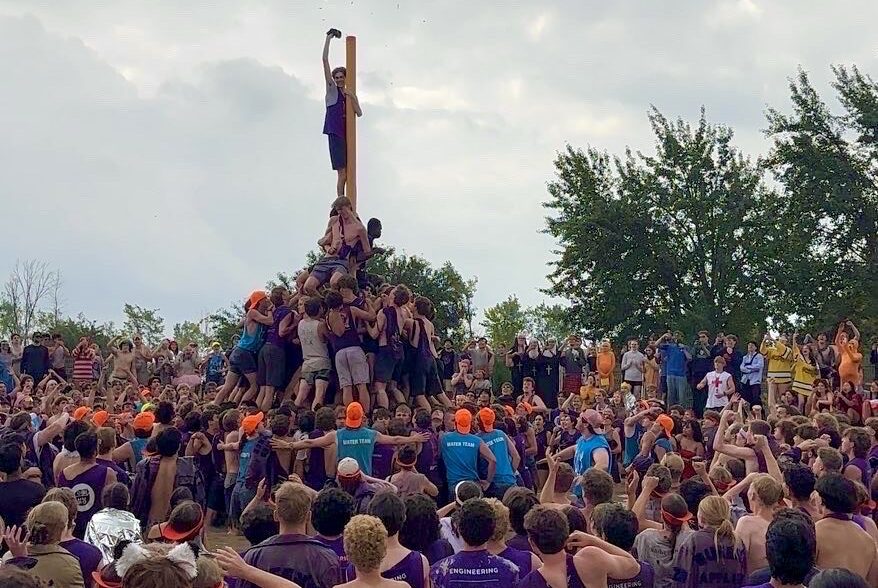
The newest class of engineering students completed the fastest Grease Pole climb in 22 years, according to Engineering Society(EngSoc) President Stephie Leitch.
On Sept. 13 students arrived at the off-campus site owned by EngSoc. As the final event of EngSoc’s orientation, first-years attempt to grab a tam — a Queen’s Scottish bonnet — sitting atop the Grease Pole. Inside a pit of mud, students use each other as human ladders to climb the slick pole.
While this year’s students completed the climb themselves in 1:30:02, in past years students have had to tip the pole to complete the tradition.
READ MORE: Sci ’29 tips the Grease Pole, joining decades-long tradition
The event is attended by first-year students, their orientation leaders — also known as FRECs — and upper year students who come to watch the event.
According to FREC Sophie Fowler, Sci ’29, all FRECs stood in a line, with their arms linked together, while upper years were let in to spray the FRECs in the face with spray paint and acrylic paint, then tape their mouths with duct tape.
When the first years arrived, the upper years sprayed them with muddy water while their FRECs tried to protect them with their jackets, Fowler said.
In a statement to The Journal, Stephie Leitch said some upper years had body paint that they would put on the cheeks of the FRECs. She said that upper years also put duct tape on the faces of the FRECs but emphasized that “no one would have been struggling to breathe.”
Leitch also said that, when the first-years arrived, the upper years splashed around in the water to build excitement, at which point their FRECs tried to protect them with their jackets.
The first-years were then allowed to have their go at the pole. With no plan or structure, Fowler said first-years took their chances climbing the pole, slipping and falling from the slipperiness.
She also mentioned that, before the event, FRECs told the first years in the group that there was a ladder buried somewhere in the pit that would be useful for the climb. Labelling themselves the “ladder committee,” first years showed up with goggles and went diving, only to find out there was no ladder in the first place.
First-years then began to form what Fowler called the “iron ring.” She described this as three students, selected because of their larger size and strength, that linked themselves around the pole at the base.
Ian Zamuner, Sci ’30, was part of the third ring, meaning he had two rings of people under him.
In an interview with The Journal, he said they had to attend training before the event to learn how to properly and safely form the ring.
Leitch said the students collected the tam without tipping the pole for the first time in three years with no “breaks.” A break can take place when someone may be injured, and the ring needs to disassemble and assemble again.
As the iron ring was being formed, everyone at the event had to remain in complete silence to ensure the water team could help anyone in the ring who may have been injured or passed out, Fowler said.
Zamuner also said there were paramedics at the event, as well as a nurse’s station for minor injuries.
During the experience, Zamuner said he couldn’t feel his arm and, after some celebrating once the tam had been grabbed, needed to visit a medic because his arm had gone numb.
He said the tip of his thumb was still a bit numb a day after the climb. However, he also described the event as “shockingly injury free,” with Leitch saying that there were no major injuries that occurred.
When asked if it was worth it, Zamuner said it was, noting how it was a bonding experience with people he hardly knew.
“I feel like the people that you’re in there with, like I don’t know them that well, but they feel like my brothers already,” Zamuner said.
He also said that being within the ring and outside of the ring are two entirely different perspectives of the event. He said that being in the ring, you don’t get to see the atmosphere around the pole because you are waiting for someone to get off of you.
He also noted that those inside the ring sometimes have to help each other breathe because of the pressure on peoples’ chests.
“It’s hard to believe, like, the person behind me couldn’t really breathe at all,” Zamuner said.
In her statement, Leitch highlighted the positives of the event, saying that it was the first time in history that all members of the organizing committee including the chief FREC, Grease Pole Day coordinator, and head of Water Team, were women.
She also noted how new safety measures were implemented into the event this year, such as padding on the pole, more extensive training, and daily mock climbs.
Zamuner highlighted how their class was confident that they would get the tam this year.
“I feel like, to be honest, we knew we were going to do it,” said Zamuner.
Leitch said it is encouraging to see how engaged the incoming class have been at orientation events.
“We are so proud of Sci ’30, all upper years in attendance, and all leadership that made yesterday possible,” Leitch wrote.
She noted that the event was “incredible,” and that attendance and participation can have a great impact on the students’ sense of community and belonging at Queen’s.
Tags
EngSoc, EngSoc orientation, Grease Pole, Sci '30
All final editorial decisions are made by the Editor(s) in Chief and/or the Managing Editor. Authors should not be contacted, targeted, or harassed under any circumstances. If you have any grievances with this article, please direct your comments to eic@queensjournal.ca.