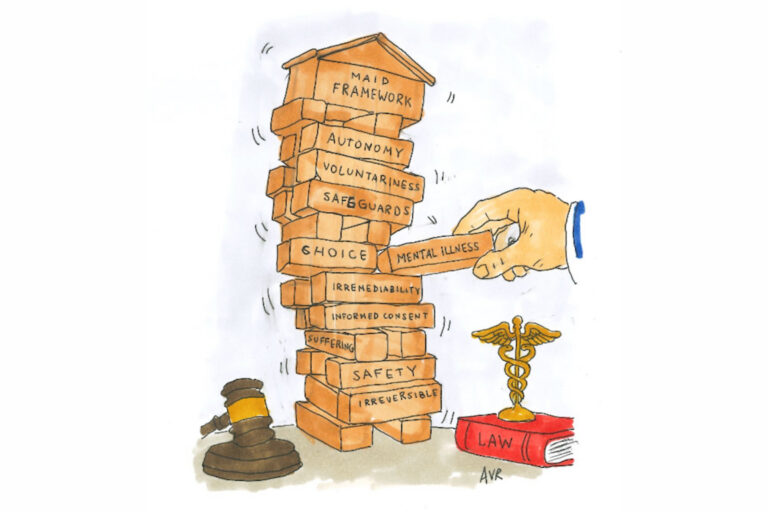
While mental suffering is no less real than the physical kind, Medical Assistance in Dying (MAID) was built for failing bodies, and Canada needs to reckon with that.
On June 17, a special joint parliamentary committee recommended that Ottawa indefinitely bar people whose sole underlying condition is a mental illness from MAID. The recommendation was not unanimous, and it changes nothing on its own: unless Parliament passes new legislation, those seeking MAID for mental disorders will be eligible to apply starting March 17, 2027.
The systemic deprioritization of mental health, by the healthcare system and by Canadian society writ large, has left it less understood and less well defined in the medical context.
Consider the threshold MAID sets: a patient must demonstrate “irreversible, incurable pain,” a criterion built around physical symptoms. That construction makes the same standard difficult to apply to mental illness.
There is a systemic component at work here. Absent a structural reorientation that treats mental health as a holistic part of our healthcare system, we will keep discounting it, reflecting that arrangement.
It is unreasonable, even disingenuous, to leave unexamined how the Canadian healthcare system, and Canadian society more broadly, define and accept what counts as a legitimate use of MAID. If the moral permissibility of MAID rests on a patient in a state of “incurable, irreversible pain,” that picture is far easier to draw through metastasizing lung cancer than through post-traumatic stress disorder.
Whatever side of the debate one falls on, endorsing a decision-making regime that cannot accommodate a more nuanced understanding of human health, the kind that mental illness demands, is a problem.
Mental health has long been neglected in Canadian medicine and defining MAID in a way that entrenches that neglect does no one any good. Real change requires accounting for more than health narrowly construed in physical terms.
The assumption that physical health takes precedence over mental health runs deep, and yet little compelling evidence supports it. Mental health issues are health issues, not secondary to physical ones.
None of this is to say we should stop asking hard questions about the role of mental health in MAID, because real ones remain. For all our limited understanding of mental illness, we know it can distort our perception of reality and drive people toward drastic, life-altering decisions they would not otherwise make.
Given the stakes, life and death in the most literal sense, the possibility that widening MAID to include mental illness could embolden suicidal ideation is not something we can ignore.
Clarity and competency are preconditions for a decision like this, not merely desirable factors. If mental illness distorts judgment to the point that a person cannot act rationally, that cannot be set aside.
And while MAID is, in general, a good thing, it would be foolhardy to treat it as possessing intrinsic moral value. It inspires lively debate in Canada for a reason. Shift the criteria for what qualifies as a legitimate use, and we should expect socio-political blowback, along with real questions about the precedent it sets.
Discerning any of this, though, means encouraging the debate rather than foreclosing it. Rejecting the question at the outset gets us nowhere.
What recent events make plain is that MAID demands clearer procedures, firmer guidelines, and greater attention to underexplored factors — such as mental health — we can hold our moral clarity while acting in the best interest of our citizens.
However, to accomplish this, we must open the issue to wider discussion rather than shutting it down; the means of accounting for new contexts, different variables, and competing perspectives have not yet been weighed. We should use that discussion to reach clearer guardrails, not a closed verdict.
— Journal Editorial Board
Tags
All final editorial decisions are made by the Editor(s) in Chief and/or the Managing Editor. Authors should not be contacted, targeted, or harassed under any circumstances. If you have any grievances with this article, please direct your comments to eic@queensjournal.ca.