The lakes north of Kingston don’t exactly look like the site of an international science story. But for Queen’s PhD student Haolun (Allen) Tian, that was the point.
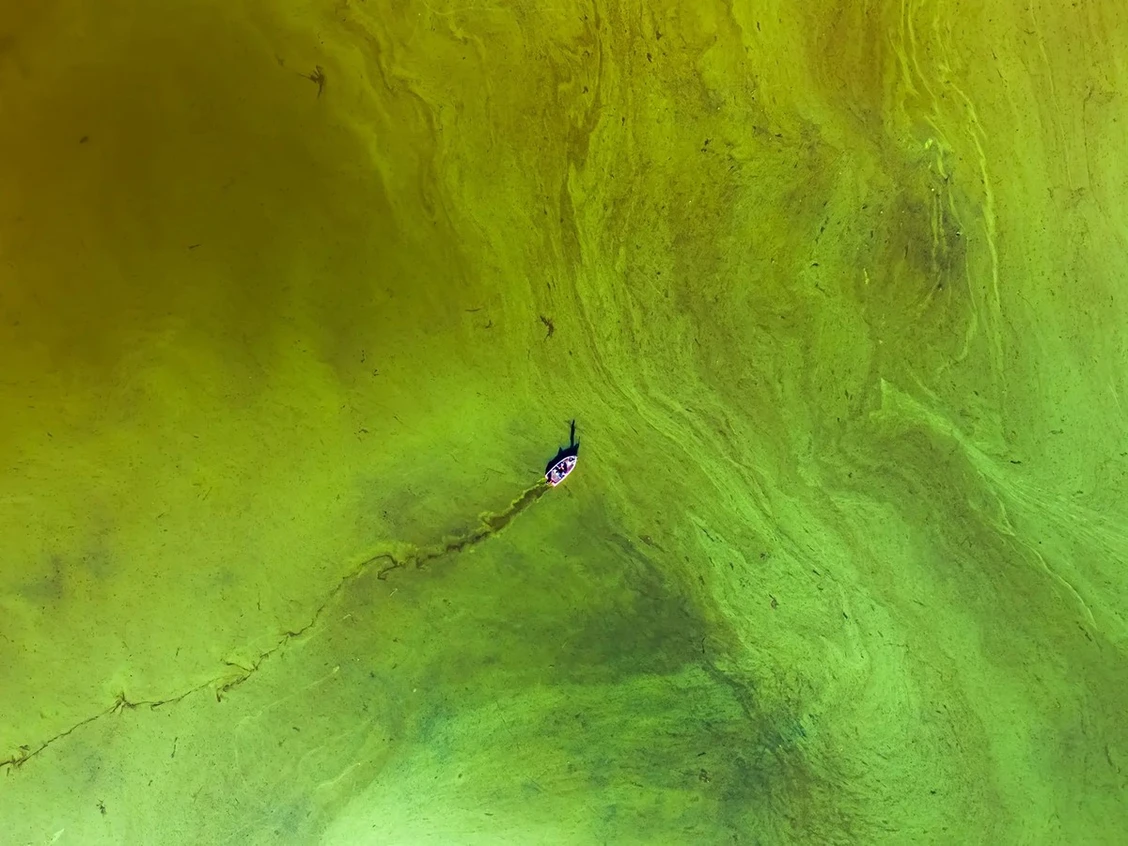
Taken on Dog Lake in 2021, Tian’s drone photograph was named one of the top five winners of the “Scientists at Work” category in Nature’s international photo competition, announced June 10th. The image depicts a small boat gliding across a lake, covered with layers of thick bright green algae. On the boat, Queen’s master’s student, Kelly Estrada Piedrahita, collects water samples.
For Tian, who is defending his PhD in the Queen’s Department of Biology in late June, the photo wasn’t originally meant to be world renowned art. His drones original purpose was to survey the bodies of water he was researching, while taking environmental DNA, or eDNA, sampling. He would then study algae blooms, but specifically why they are an environmental concern and a growing problem along the Rideau Canal corridor from Kingston to Ottawa.
“Algae blooms are an emerging issue on freshwater small lakes,” Tian said in an interview with The Journal. “”They’ve only started appearing regularly in the last 15 to 20 years, and we weren’t exactly sure why.”
The usual cause of runoff pollution from sources like phosphate detergents do not explain what he has been seeing. “Our lakes are fairly not disturbed, we don’t have that many people,” Tian said. “So, my research was to find out why.”
The blooms can have dangerous consequences once they die off and rot. “This rotting takes away oxygen from the water, which suffocates all the fish,” he said. “They also produce toxins, which can hurt drinking water supplies, and cause dogs and local wildlife to suffer.” The photo itself came out of leftover battery life after a long day of surveying and sampling. “After each survey, I would just begin flying around with whatever battery life I had left, and then just randomly taking photos,” Tian said.
When he showed his images to fellow students and professors, they were extremely impressed and encouraged him to continue pursuing photography and to submit his photos into competitions. He then won the Queen’s Art of Research photography contest and used the prize money to purchase an actual camera.
What stands out to him about winning the competition isn’t the algae, but the photo’s relationship with his research. “I really like this photo because it shows the sense of scale between the environment and us,” Tian said. “The environment is so much bigger than us. We’re only one part of the food web.”
This idea is the reason why Tian became so passionate about capturing his research through photography. “Fieldwork is a huge appeal of ecology to me,” he said. “This photo to me shows my workspace.” These experiences have helped shape what Tian wants to do after he finishes his PhD. He plans to launch a startup business aimed at making eDNA sampling more accessible to the same communities he has been studying for years. “What I want to do is empower individuals and empower communities to do their own monitoring,” Tian said. He described the goal as building “a lab in a suitcase,” which would be simple enough for landowners to test for invasive species and toxic algae themselves.
For Tian, his startup is the next step in the project that began by accident on a dock in Dog Lake. As he finishes up his PhD this month, the algae bloom he set out to understand years ago have led him many places from an enriching master’s project to winning an international photo competition and will soon lead him to a business of his own. It all started with something as simple looking as toxic algae that most people would have driven right past, not knowing the hours of research and significance behind it.
Tags
award winning research, Kingston, PhD, photography
All final editorial decisions are made by the Editor(s) in Chief and/or the Managing Editor. Authors should not be contacted, targeted, or harassed under any circumstances. If you have any grievances with this article, please direct your comments to eic@queensjournal.ca.