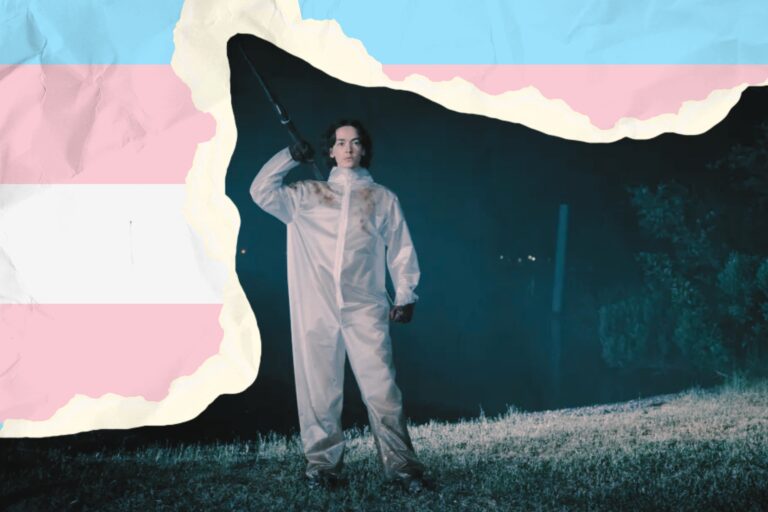
Teenage Sex and Death at Camp Miasma: a transgressive queer slasher whose meta commentary on the genre itself is a horror theorist’s wet dream, as it oozes allegories and subversions.
Released at The Screening Room on Aug. 21, Jane Schoenbrun’s third “Screen Trilogy” feature examines horror’s most culturally influential subgenre as a vessel for queer discovery by working with and against previous media representations of queerness.
Throughout cinematic history, academics have examined what slashers reveal about our reality. Much like the mirror of a screen, slasher narratives are often reflections of repressed cultural anxieties, allegorically questioning what society fears most. Teenage Sex and Death at Camp Miasma seems to examine our current moral panic about transgender identity.
The film follows queer director Kris Williams, who is rebooting Camp Miasma: a campy yet problematic ’80s slasher franchise. However, when Kris becomes infatuated with Billy, the original’s final girl, the killer, called Little Death, escapes the screen, leading every cliché slasher character on a psychosexual frenzy of sex and death.
Through meta takes on slasher history, Camp Miasma doesn’t restrain itself to one message. It’s a fluid exploration of cultural meaning-making as Little Death’s gender fluidity intersects with Kris’ sexual awakening.
Most obviously, “Little Death,” or “la petite mort,” is a French expression for that post-orgasm sensation when the body numbs, and the mind briefly loses consciousness. Kris achieves this life-altering state with Billy as Little Death penetrates them with their spear.
As pain and pleasure become one, her classic slasher death induces an orgasm, an homage to Carol J. Clover’s Men, Women, and Chain Saws. A groundbreaking investigation of gender in horror, Clover theorizes that the slasher’s weapon is a phallic extension of their body they use to penetrate flesh, producing psychosexual gender troubles within these character tropes.
However, Schoenbrun plays around with these gender troubles to connect sex with gender non-conformity. Little Death’s psychosexual gender troubles begin when they emerge out of a wet, fleshy, pink hole at the bottom of the lake. Their body is wrapped in plastic, carefully showing how their body doesn’t conform to binary assumptions. When Kris and Billy willingly invite Little Death into their cabin, those final girl slashings are only the beginning of their allegorical adventure.
Raised as both a boy and a girl by their parents, Camp Miasma treats Little Death’s gender fluidity like any other classic slasher. At sleep away camp, they are bullied and eventually drowned by other campers. In a Jason-style return, Little Death emerges out of Camp Miasma’s lake as a vengeful killer ready to slash anyone with their spear.
In fact, Little Death parallels Angela, Sleepaway Camp‘s transgender teenage camper turned tormented killer. The similarities go as far as Kris joking about “Bruce Springsteen’s sister” being in the sequel. These real slashers represent gender non-conformity as the point of fear, risking connecting gender bending with violence, which led to the creation of the transgender killer trope.
Teenage Sex and Death at Camp Miasma subverts this trope by setting Camp Miasma within this time in horror history to explore how these harmful narratives continue to be written off-screen as conservative rhetorics affect our cultural perception of trans people. The film’s subversion of slasher tropes is an act of resistance that transforms the film’s campy slasher façade into a heartwarming love letter to queerness and horror.
Kris’ identification with her favourite final girl and killer runs deeper than her repressed sexual desires. It recognizes that they have both endured the pillars of the queer experience: survival, discovery, and liberation.
Tags
movie review, Queer, The Screening Room
All final editorial decisions are made by the Editor(s) in Chief and/or the Managing Editor. Authors should not be contacted, targeted, or harassed under any circumstances. If you have any grievances with this article, please direct your comments to eic@queensjournal.ca.