Following Assembly’s approval, AMS President Jana Amer’s resignation date has now officially been set.
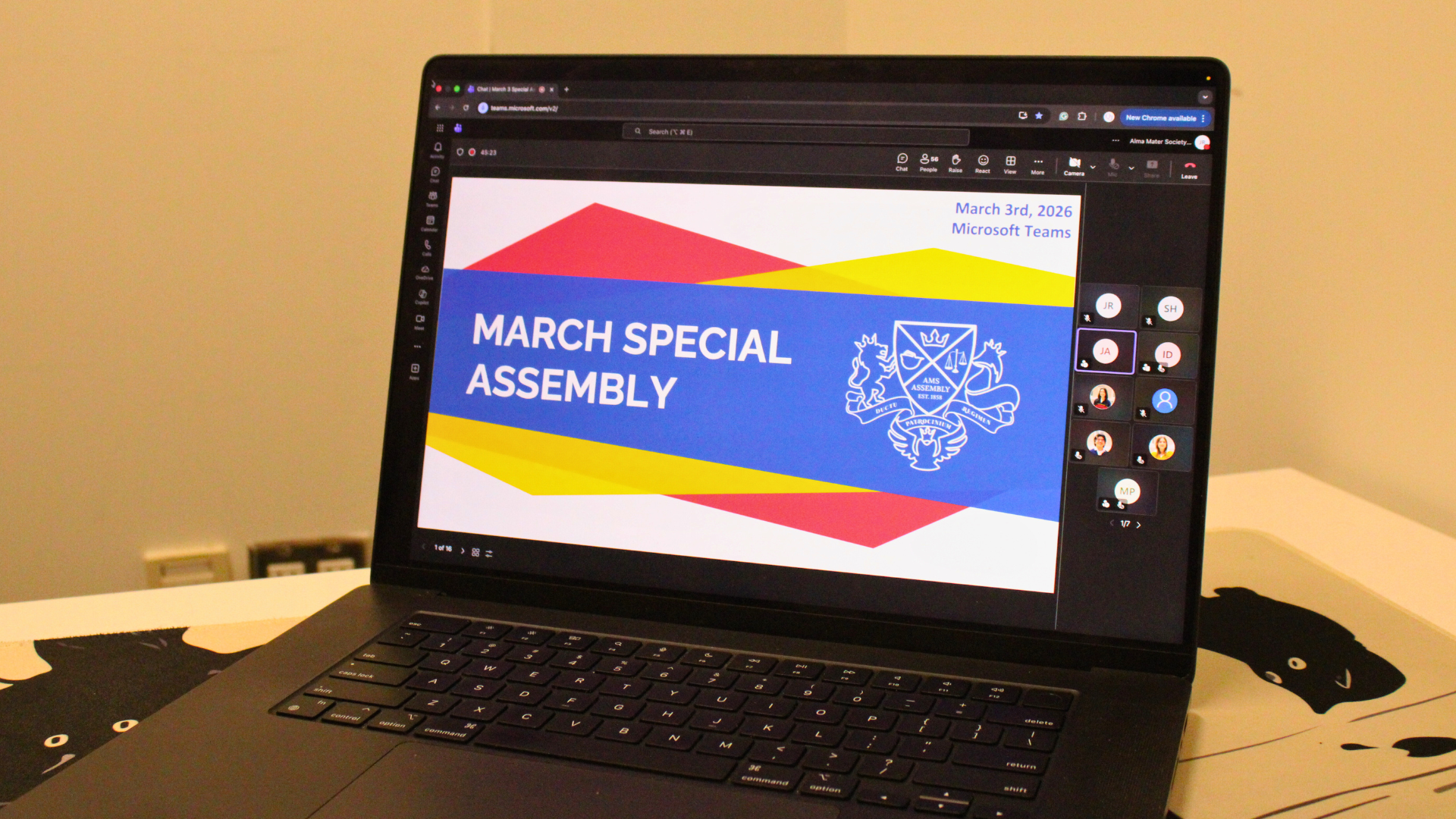
Special Assembly began on March 3 at 7 p.m., with AMS Chief Governance Officer Solomiia Horbatso acting as speaker. The meeting primarily discussed one motion: the acceptance of Amer’s resignation, which came following backlash due to issues relating to her presidential card and, ultimately, a motion calling for her impeachment.
READ MORE: Jana Amer resigns as the 156th AMS President
Reports
After the agenda was approved, Assembly moved into Amer’s final presidential report, where she gave further context as to why she left her role. She also mentioned a full resignation letter, which is available in a Letter to the Editor published by The Queen’s Journal.
Amer said the decision “didn’t come lightly,” describing the role as “one of the greatest honours” of her life. She highlighted several initiatives during her term, including supporting the reopening of JDUC, advocating for free summer access to ARC memberships, and participating in campus events such as the National Day for Truth and Reconciliation Sacred Fire.
She acknowledged that the $377.32 in personal expenses were “mistakenly” charged to the card and took responsibility, saying the charges “shouldn’t have happened.”
“When student dollars are involved, I invite scrutiny, and I think scrutiny is more than important. And with the identified $377.32 that were accidentally charged to the card, which were my personal expenses, that shouldn’t have happened, and I take full responsibility for it, and I’m so sorry for not being able to address it promptly and clearly as students deserved and with the freedom that was required for it.”
Amer explained the overall situation regarding the card, including a receipt backlog of $23,860.37, occurred during a period of internal instability within the AMS Internal Affairs Office (IAO), which experienced more than 10 staff departures between July and December and operated with more than half its positions vacant during September, October, and November, which she said is an especially busy time for the office.
“I would like to note that every single time that this [issue] was brought up to the perm staff, to the executives, to the board, whoever it may be, I was just expected to figure out a plan and move on with it,” Amer claimed.
She added that to keep the office running, she took on an “overwhelming amount of workload.” While this was happening, Amer said “the internal environment had become so incredibly isolating and brutal,” and claimed she didn’t receive support when she reached out.
While acknowledging that this context doesn’t absolve her of the blame, she hopes it explains why “things moved so quickly and [shows] how fast things can unravel when the systems that [people] need to support them do not support them.”
Once the controversy went public, Amer explained she faced “severe harassment,” including spam calls, threats to release her home address, and people contacting her family outside of Queen’s. She said stepping down was necessary for personal safety and to allow the AMS to move forward with stability.
She wrapped up her report by wishing the incoming AMS executive Team DAE cohesion, integrity, and the necessary support they’ll need for the next year, then thanking students for the opportunity to serve as the 156th AMS president.
Assembly then moved into Vice-President (Operations) Elena Nurzynski and Vice-President (University Affairs) Alyssa Perisa’s reports, although both said they had nothing to add apart from their Instagram statement.
The statement went over recent developments relating to Amer’s attempted impeachment and later resignation, as well as Nurzynski explaining she had submitted a letter of intent to resign from her position due to “personal reasons,” although she decided to reverse her decision and no longer intends to resign.
Question Period & Motions
After brief reports by other Assembly members, the meeting moved into a question period, with attendees able to ask questions anonymously through a Formstack QR code.
The first question asked why the IAO had so much turnover this year, with Amer attributing it to the fact that the office takes on a big responsibility of running AMS governance, while also pointing to a “poor transition from the previous year.”
Another question referred to Nurzynski’s recent resignation letter, asking if it could be disclosed to Assembly and whether there’s any proof it wasn’t a binding letter. Nurzynski explained that there’s a certain procedure to follow for a resignation, which includes informing the Secretariat and the Board of Directors, which she didn’t do. She also said releasing the letter would just lead to more confusion, which is why she’s choosing not to make it public.
Despite this, multiple anonymous questions requested the letter, all of which Nurzynski denied. The Journal obtained a screenshot of her intended resignation from an anonymous source.

Screenshot of e-mail resignation sent by Nurzynski. PHOTO BY ANONYMOUS SOURCE.
Another question was posed to Amer, asserting that she caused resignations in the IAO, and asked if she’d like to comment on that. Amer denied these claims, saying the office resignations were due to workload and individual capacity, as students can have trouble balancing a full-time job on top of full-time coursework.
A different anonymous question asked Amer why an individual who previously held the Vice-President (University Affairs) position, although not naming an individual, was hired into the IAO in an “unofficial role.” Amer explained that it wasn’t an unofficial role, but that they were contracted to ensure someone with experience in governance could provide interim support.
Persia was later asked whether she regretted calling a Special Assembly, where the news of the credit card issues broke, given the hate Amer had received online.
“I regret that the way information unfolded may have contributed to negativity online. That was never the intention. My focus has always been on transparency with students and accountability, and moving forward, I’m committed to communicating in a way that is responsible and constructive,” Persia said in response.
Amer was then asked whether she would’ve planned to resign if a motion to impeach had never been brought, to which she responded: “I believe so.”
A question was then posed to Faculty Society (FacSoc) presidents, asking how they respond to allegations that their motion to impeach stemmed from racism, not the president’s capacity. Before FacSoc answered the question, Amer jumped in and said she didn’t believe the motion was due to racism. Commerce Society President Prem Mehta-Spooner addressed the question, saying there was no intention of racism, that they take this concern seriously, and students are welcome to voice their concerns if they wish to discuss it.
Assembly later moved to vote on the resignation of Amer, which was moved by Perisa and seconded by Nurzynski, with Perisa explaining it was a procedural motion in accordance with their constitutional requirements relating to executive resignations.
Mehta-Spooner then asked how committee assignments will work, given that the president sits on various committees. Perisa responded by saying that’s something they need to work on figuring out and promised an update by the next Assembly on March 10.
The motion was then voted on and passed unanimously, marking Amers’ official resignation date as March 9.
Discussion Period
After voting on the motion, Assembly moved into a discussion period where Nurzynski went on to explain that she and Perisa will bring forth a new president to take over for the remaining two months of the term, subject to approval by two-thirds of Assembly, within 30 days. They emphasized their goal in finding someone aware of how the AMS works.
Engineering Society President Jordan Belainsky expanded on Nuzynki’s point, explaining he wants a candidate who is already heavily involved in the AMS, and if it’s a possibility, one of the incoming executives. Rector Niki Boytshuk-Hale added on, saying it would be a waste of resources to onboard someone completely new and said it would make sense to bring someone in who’s already been elected by the student body two months early.
Arts and Science Representative to the AMS Allan Savini then spoke up, arguing that current AMS Board of Directors Chair and President-elect Dreyden George should take up the role, arguing it makes the most sense to get him up to speed for his role.
George then addressed the Assembly, saying he’d be comfortable with that, later adding that Vice-Chair Ali would likely take over his responsibility as Board Chair for the remaining two months if Assembly took this route.
To end off, Nurzynski explained that “Alyssa and I are eager to provide updates and next steps as soon as we can. So hopefully we’ll have another update for everyone at the March 10 assembly, so we’re looking forward to that.”
Assembly then moved to adjourn after roughly one hour of discussions at 8:01 p.m.
Tags
AMS credit card, AMS President Jana Amer, Credit card, Special Assembly, VPops, VPUA
All final editorial decisions are made by the Editor(s) in Chief and/or the Managing Editor. Authors should not be contacted, targeted, or harassed under any circumstances. If you have any grievances with this article, please direct your comments to eic@queensjournal.ca.